To accelerate the large-scale adoption of blockchain technology and build a sustainable GT ecosystem, Gate officially announces two core initiatives: the launch of the Gate Layer, a high-performance Layer 2 network, and the optimization of the GT token economy and ecosystem mechanism.
This upgrade leverages Layer 2 scaling technology to address common pain points such as high gas fees and slow transaction confirmations, while reinforcing GT's core role in the ecosystem. The goal is to deliver faster, more secure, and cost-efficient Web3 services to users worldwide.
Gate Layer Launch: Revolutionizing the Web3 Experience with a High-Performance Layer 2 Network
Layer 2 is a blockchain scaling technology built on top of a main chain (Layer 1). By processing a large volume of transactions off the main chain and submitting the final results to it, Layer 2 achieves the goal of maintaining security while reducing costs and increasing speed. It is analogous to building a smart overpass next to a busy main road; Layer 2 handles most of the traffic flow while still using the main road for final settlement and security.
Gate Layer, a high-performance Layer 2 network, is built on the industry-leading OP Stack and secured by GateChain as the Layer 1 settlement layer. Fully compatible with the Ethereum Virtual Machine (EVM), Gate Layer aims to provide low-barrier, high-efficiency, and low-cost on-chain services for users and developers.
Click to enter the Gate Layer homepage
Core Features & User Benefits of Gate Layer:
- Full EVM compatibility & seamless migration : Supports Ethereum toolchains (e.g., Remix, MetaMask). Developers can migrate Ethereum DApps to it directly, and users can use them without changing habits;
- Dual security protection, more reliable assets : Gate Chain acts as the settlement layer securing the network, while the GT Staking mechanism strengthens consensus and prevents single points of failure;
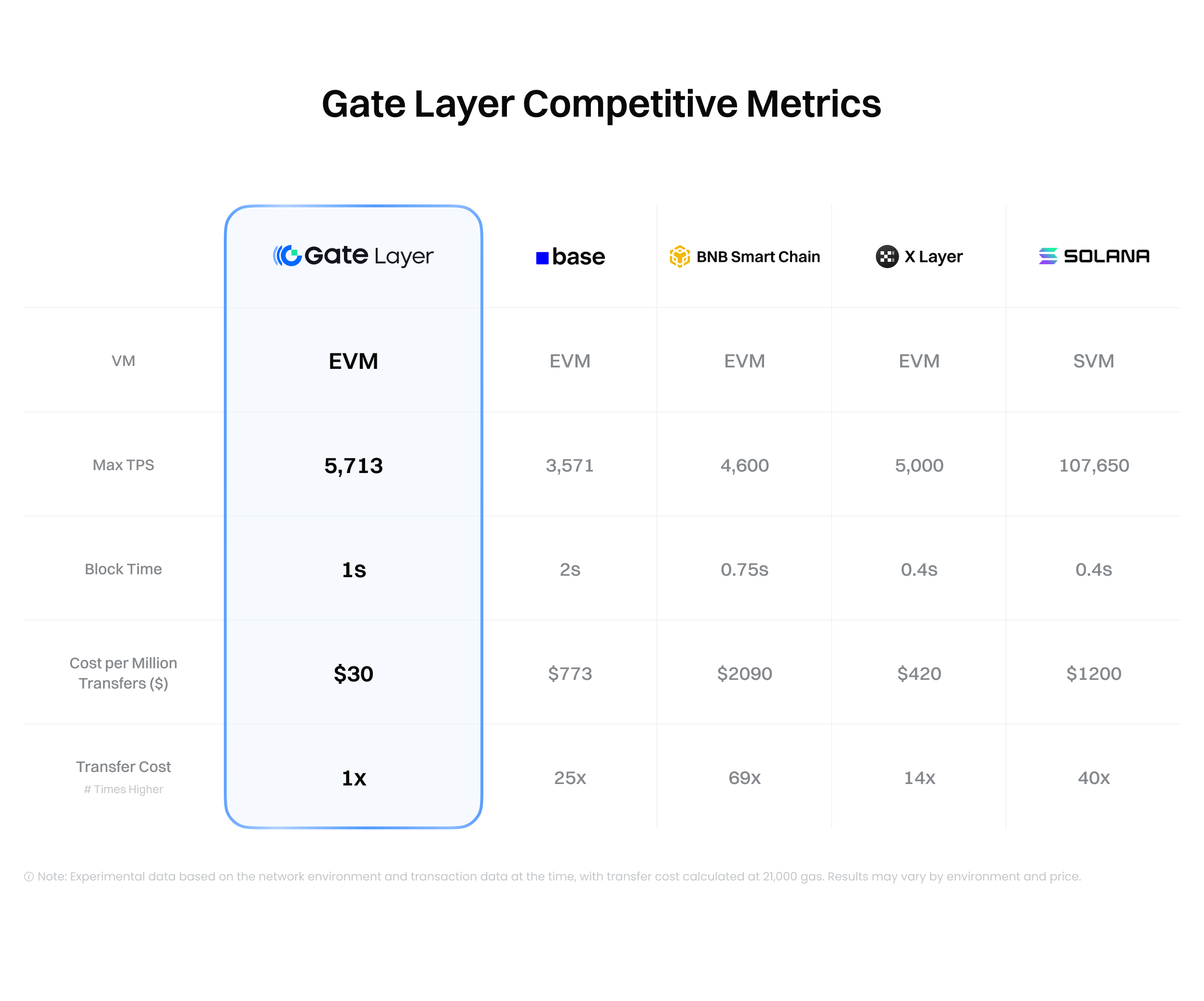
- High performance & low latency, smoother transactions : Processing over 5,700 transactions per second with a block time of just 1 second, Gate Layer significantly outperforms traditional Layer 1 chains — enabling near-instant transfers and contract interactions;
- Ultra-low fees to lower barriers : Gas fees on Gate Layer are substantially lower than other Layer 2 networks, making it more accessible for everyday users to participate in Web3;
- Cross-chain interoperability, freer asset movement : Integration with the LayerZero cross-chain protocol allows seamless asset transfers between Ethereum, BSC, Polygon, and other major blockchains without relying on centralized platforms.
Gate Layer vs. Other Layer 2 Networks: Performance & Fee Comparison
Gate Layer offers ultra-low transaction costs — processing 1 million transfers costs less than 30 USD. Under the same conditions, it would cost around 700 USD on Base, about 2,000 USD on BSC, and around 1,000 USD on Solana.
Ecosystem Planning: All in Web3 — Creating a Comprehensive On-Chain Ecosystem
Gate Layer, built as a high-performance Layer 2 network, serves as the foundation for Gate's "All in Web3" strategy. Its primary goal is to roll out core financial tools as the first step in ecosystem development. Focusing on the full lifecycle needs of Web3 users, Gate is launching three flagship products — Perp, Gate Fun, and Meme Go — to cover every stage of the user journey, from asset creation and trading to value generation.
1. Perp: High-Performance, High-Liquidity Perpetual Futures Trading Hub
As the "trading core" of the Gate Layer DeFi ecosystem, Perp leverages the high-performance Layer 2 capabilities of Gate Layer, which supports over 5,700 TPS and 1-second block times, along with LayerZero cross-chain protocol support. Its core strength is exceptional liquidity, ensuring that users can execute trades smoothly at any time with deep order books. With multi-dimensional liquidity pools and an efficient matching engine, Perp supports trading for both mainstream and long-tail assets, providing users with a stable and reliable trading experience. This creates a decentralized perpetual futures platform that delivers a smooth, CEX-like experience, catering to both casual traders and professionals.
2. Gate Fun: A Low-Barrier Incubator for Small and Mid-Sized Projects
Gate Fun is a "no-code, low-cost" token launch platform designed for small creators, Meme projects, and Web3 developers. It solves common challenges such as difficulty in launching tokens, high user acquisition costs, and low liquidity. Creators can issue their tokens and set up initial liquidity without a technical team, while leveraging Gate's ecosystem to support project growth.
3. Meme Go: Real-Time Trading and Monitoring Hub for Meme Tokens
Meme Go is designed as a cross-chain platform for real-time monitoring and instant trading of Meme tokens. With a multi-chain compatible architecture supporting Ethereum, BSC, Solana, and other major blockchains, combined with a low-latency trading engine, it enables dynamic tracking of popular token launches and near-instant execution of trades.
GT Ecosystem Value Upgrade: Expanded Use Cases and Stronger Deflation Mechanism
As the core platform token of the Gate ecosystem and the native asset of GateChain, GT (GateToken) is expanding its utility with the launch of Gate Layer. At the same time, its dual deflationary mechanisms reinforce long-term value, making GT the key vehicle for value circulation within the ecosystem.
1. GT as the Exclusive Gas Token — Expanded Utility Across Gate Layer
All on-chain activity within Gate Layer—whether it's transactions, smart contract deployment, NFT minting, or cross-chain transfers—requires GT as the sole gas token. As more DApps launch and the user base grows, demand for GT will continue to rise, strengthening its role as the essential infrastructure of the ecosystem.
2. Dual Deflationary Mechanism: Scheduled Burns + On-Chain Burning to Boost Scarcity
Since the launch of GateChain's mainnet in 2019, GT has adopted a sustainable dual deflationary model of scheduled burns and on-chain burning:
- Total burned so far : As of Q2 2025, 180,555,112 GT have been permanently burned—over 60.18% of the original 300 million supply—continuously reducing circulation;
- Scheduled burn rule : Every quarter, Gate burns a portion of GT based on platform performance data. All burn records are publicly announced and verifiable in real time;.
- On-chain burning mechanism : Gate Chain adopts the EIP-1559 protocol, where the base fee of every on-chain transaction is automatically burned. The total GT burned in a block equals the sum of all base fees within that block, making every transaction contribute to supply reduction.
GateChain Continuous Upgrade
GateChain has completed a major upgrade, with its consensus version upgraded to v1.20. After the upgrade, GateChain can now serve as the settlement layer for Gate Layer, offering low-cost and high-security transactions. Key improvements include:
- New core feature: Support for blob transactions (EIP-4844), greatly improving on-chain transaction throughput and efficiency;
- EVM version update: GateChain's EVM has been upgraded to Cancun, enabling broader ecosystem compatibility and support for more complex smart contracts;
- Multi-EIP compatibility: Compatibility with 12 additional Ethereum Improvement Proposals (including EIP-2565 and EIP-2929), optimizing gas cost calculations, enhancing security, and improving operational efficiency;
- RPC improvements: Added blob transaction-related RPC interfaces and updated eth-hash return logic, making data access and developer integration smoother.
The launch of Gate Layer, alongside the continuous upgrade of GateChain and the GT ecosystem, marks more than just a technical iteration—it's a pivotal step toward building an efficient and inclusive Web3 ecosystem. By lowering entry barriers with Gate Layer, strengthening GT's value through a dual deflationary model, and delivering full-spectrum tools that address user needs, Gate is driving the large-scale adoption of blockchain technology and creating long-term, sustainable value for users and developers worldwide.
For more Gate Layer technical documentation and ecosystem updates, please visit the official Gate website and developer community.
Thank you for your continued support and confidence in the GT ecosystem.
Click to enter the Gate Layer technical documentation
Gate Team
September 25, 2025
**Gateway to Crypto**
Trade over 4,500 cryptocurrencies safely, quickly, and easily on Gate
**Take Action Now**
Sign up and claim up to $10,000 in welcome rewards
Invite friends and earn a 40% commission
**Stay Connected**
Visit Gate's official website
Download the Gate App | Desktop
Follow us on X (Twitter) to get more bonuses
Join our Telegram community to discuss trending topics
Engage with our global community for the latest insights
**Transparency & Security**
Check our 100% Proof of Reserves


