As decentralized applications and on-chain protocols continue to expand, traditional data indexing tools are increasingly unable to deliver the low latency, advanced visualization, and automated alerting required by the space. Sentio offers a solution purpose-built for real-time monitoring.
In the Web3 infrastructure stack, data indexing platforms serve as a crucial bridge between on-chain data and the application layer. Effective DeFi protocol monitoring, on-chain risk alerts, and user behavior analysis all depend on robust data infrastructure. Sentio enhances the availability and responsiveness of on-chain data through real-time indexing, customizable dashboards, and automated alerting, establishing itself as a key component of the Web3 data layer.
What Is Sentio (ST)?
Sentio is a Web3 data infrastructure platform specializing in real-time on-chain data processing, designed to provide developers with data indexing, visual analytics, and automated alert capabilities. Its mission is to transform complex on-chain data into actionable, real-time insights for protocol monitoring, risk management, and business analytics.
Unlike traditional data indexing protocols that rely on offline synchronization or scheduled updates, Sentio’s defining feature is real-time responsiveness. Sentio prioritizes the immediate capture and processing of on-chain events, enabling developers to receive rapid feedback as events unfold.
What On-Chain Data Infrastructure Challenges Does Sentio Solve?
Web3 applications generate massive volumes of on-chain data, but this data is often complex, difficult to process, and slow to respond. Developers accessing data directly from blockchain nodes must invest significant resources in parsing, storage, and processing—driving up development and maintenance costs.
Sentio addresses three primary challenges:
First, data acquisition latency. Traditional indexing tools typically cannot deliver instant updates, yet real-time data is critical for DeFi risk control and protocol operations.
Second, insufficient data visualization. On-chain data is usually presented as raw event logs, making rapid analysis difficult. Sentio’s dashboards convert complex data into visual metrics for easier interpretation.
Third, lack of automated alerting. Manual monitoring is inefficient when protocols behave abnormally, but real-time alerting dramatically improves response times.
How Does Sentio’s Real-Time Data Indexing Work?
Sentio’s real-time indexing engine consists of three main components: on-chain event listening, data parsing and processing, and real-time output.
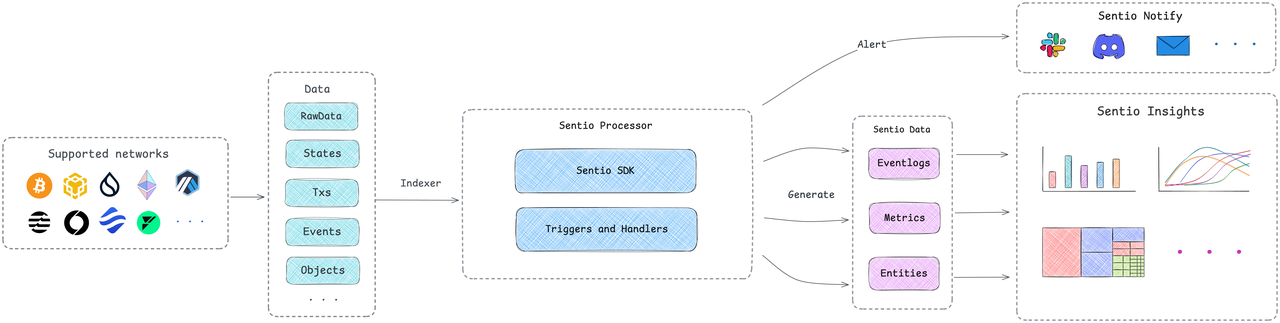
First, the system continuously listens for Smart Contract events on the blockchain, capturing transactions, status changes, fund movements, and more. Sentio instantly detects and collects this information as soon as events occur.
Next, the platform parses and structures the captured data, converting raw logs into developer-friendly formats. This eliminates the need for developers to build their own complex parsing logic.
Finally, processed data is delivered to visualization dashboards or alert systems for real-time display and notifications. This streamlined workflow significantly lowers the barrier to leveraging on-chain data.
What Are the Benefits of Sentio’s Visualization and Alert Features?
Sentio provides customizable dashboards, allowing developers to monitor protocol status in real time—including trading volume, active addresses, fund flows, and other key metrics.
The value of visualization lies in transforming raw data into intuitive charts, enabling teams to quickly spot trends and anomalies. For example, if a metric spikes unexpectedly, the dashboard immediately highlights the change.
Sentio’s alert system also allows users to set monitoring rules. When on-chain data hits a defined threshold, the system automatically triggers notifications. This is ideal for monitoring abnormal transactions, significant fund movements, and protocol risk events.
What Role Does the ST Token Play in the Sentio Ecosystem?
ST is the core utility token of the Sentio ecosystem, linking platform services with participants.
ST can be used to pay for premium platform features and services, such as advanced analytics or specialized data processing. It also acts as an incentive mechanism, encouraging developers and users to contribute to the platform.
As the ecosystem grows, ST may also be used for governance, empowering token holders to participate in protocol decisions and enhance network collaboration.
What Are Sentio’s Main Use Cases?
Sentio’s real-time data capabilities make it well-suited for a range of Web3 scenarios.
In DeFi protocol monitoring, Sentio tracks liquidity shifts, trading volumes, and risk metrics, giving protocol teams real-time insight into platform health.
For security alerting, Sentio monitors abnormal fund flows or large transactions to reduce potential risks.
In on-chain operations analytics, the platform helps project teams analyze user behavior, trading patterns, and growth trends, providing data-driven support for product optimization.
These applications make Sentio a vital link between on-chain data and business operations.
Sentio vs The Graph: A Web3 Data Protocol Comparison
Sentio and The Graph both process on-chain data, but with different priorities.
| Comparison Dimension |
Sentio |
The Graph |
| Data Update Method |
Real-time indexing |
Subgraph indexing |
| Data Response Speed |
High |
Relatively slow |
| Visualization Capability |
Built-in dashboard |
Requires external integration |
| Automated Alerts |
Supported |
Not supported |
| Use Cases |
Real-time monitoring & alerting |
Data query & aggregation |
In summary, The Graph is ideal for building on-chain data query interfaces, while Sentio excels in real-time monitoring and automated response scenarios.
Sentio’s Limitations and Risks
While Sentio delivers real-time data, its effectiveness depends on the quality of underlying on-chain data. Delays or anomalies in source data can impact analysis accuracy.
Real-time processing also demands significant infrastructure resources, which may result in higher operating costs. For smaller projects, resource requirements could pose an adoption barrier.
Ecosystem value depends on developer adoption and network effects. If ecosystem growth is limited, Sentio’s impact may be constrained.
Summary
Sentio is a real-time on-chain data infrastructure platform for Web3, providing developers and protocols with efficient data support through real-time indexing, visual analytics, and automated alerting. It overcomes the limitations of traditional on-chain data solutions in real-time performance, visualization, and alerting, and delivers strong value in DeFi monitoring, security alerting, and on-chain analytics.
As demand for real-time data in Web3 continues to rise, platforms like Sentio will become increasingly central to the on-chain application ecosystem.
FAQs
How does Sentio differ from The Graph?
The Graph is primarily for on-chain data queries, while Sentio focuses on real-time monitoring and automated alerting.
What is the function of the ST token?
ST is used for ecosystem incentives, platform service payments, and potential governance participation.
What scenarios is Sentio suitable for?
Sentio is ideal for DeFi monitoring, security alerting, on-chain data analytics, and user behavior analysis.
What are Sentio’s core advantages?
Sentio’s strengths are its real-time data indexing, integrated visual analytics, and automated alerting capabilities.







