AI vs KAVA: The Battle for Cognitive Enhancement in the Digital Age


Introduction: Investment Comparison between AI and KAVA
In the cryptocurrency market, the comparison between Sleepless AI vs Kava has been an unavoidable topic for investors. The two not only have significant differences in market cap ranking, application scenarios, and price performance, but also represent different positioning in crypto assets.
Sleepless AI (AI): Launched in 2024, it has gained market recognition for its innovative Web3+AI virtual companion game.
Kava (KAVA): Since its introduction in 2019, it has been hailed as a cross-chain decentralized finance platform, providing mortgage and stablecoin services for mainstream digital assets.
This article will comprehensively analyze the investment value comparison between Sleepless AI vs Kava, focusing on historical price trends, supply mechanisms, institutional adoption, technological ecosystems, and future predictions, attempting to answer the question investors care most about:
"Which is the better buy right now?"
I. Price History Comparison and Current Market Status
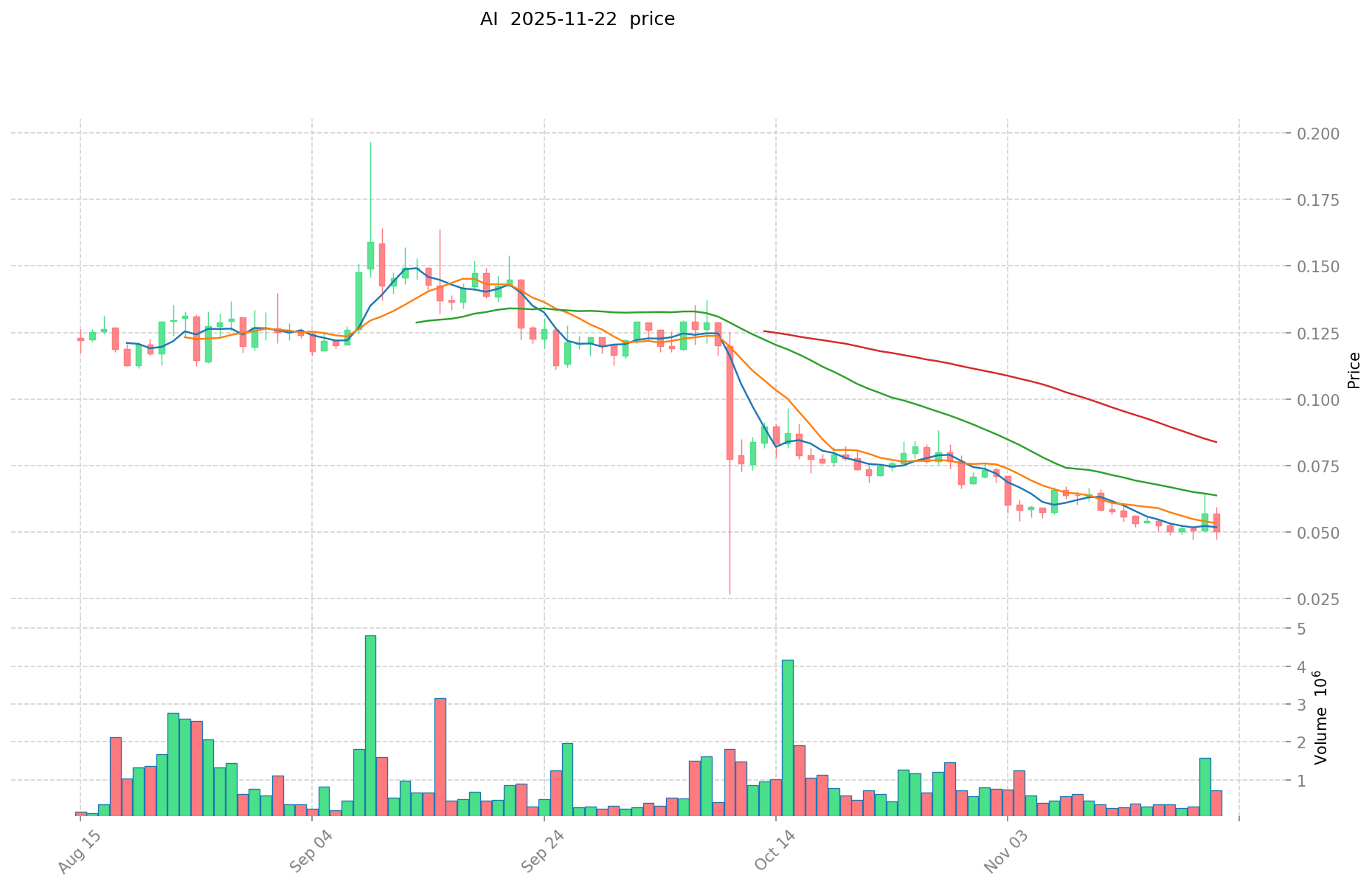
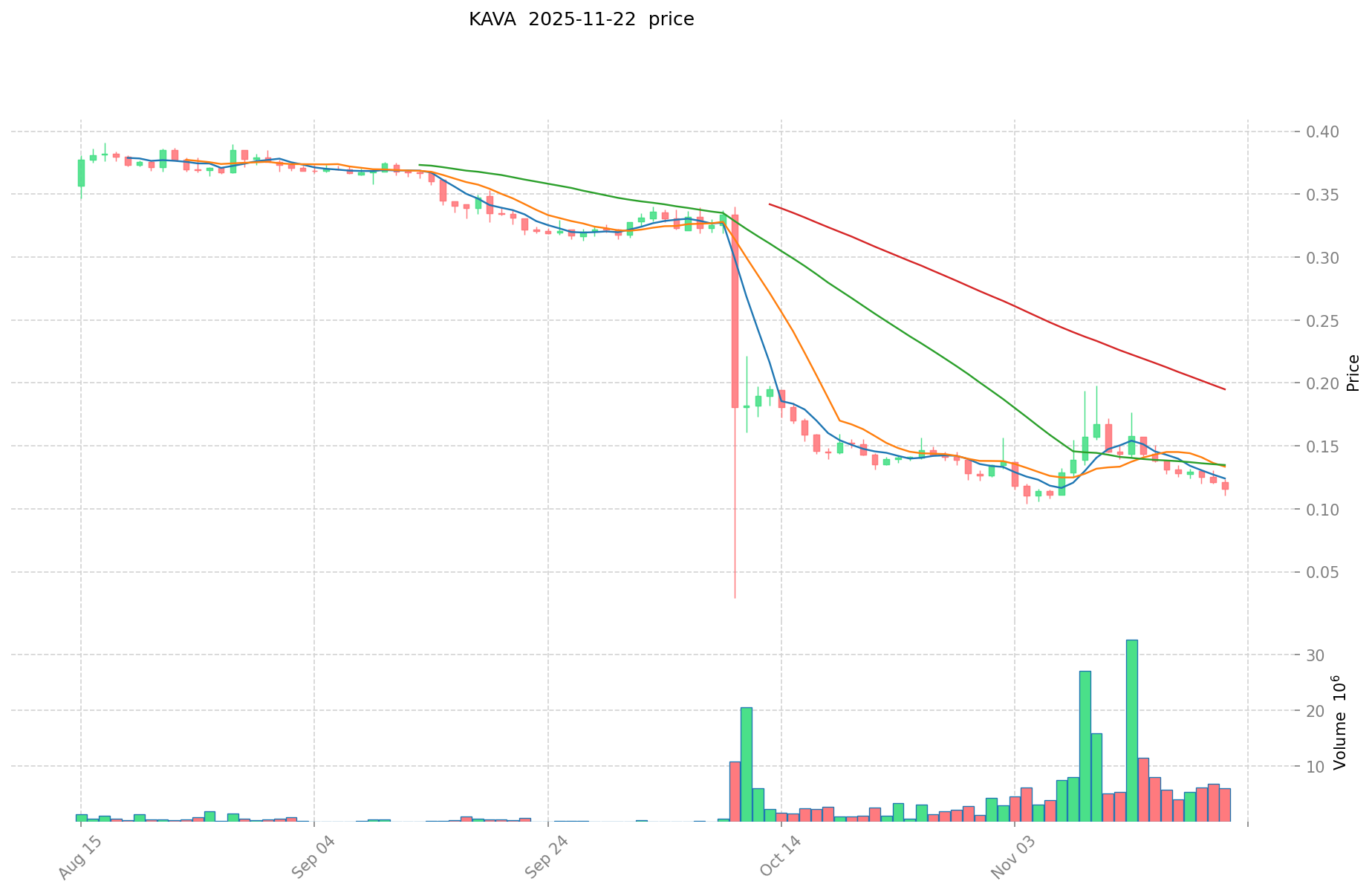
Sleepless AI (AI) and Kava (KAVA) Historical Price Trends
- 2024: AI reached its all-time high of $2.3781 on March 9, 2024, likely due to significant project developments or market enthusiasm.
- 2025: KAVA hit its all-time low of $0.105588 on November 5, 2025, possibly influenced by broader market downturns or project-specific challenges.
- Comparative analysis: In the recent market cycle, AI has fallen from its ATH of $2.3781 to the current price of $0.0514, representing a significant decline. KAVA has also experienced a substantial drop from its all-time high of $9.12 (reached on August 30, 2021) to the current price of $0.11605.
Current Market Situation (2025-11-22)
- AI current price: $0.0514
- KAVA current price: $0.11605
- 24-hour trading volume: AI $36,074.93 vs KAVA $732,401.70
- Market Sentiment Index (Fear & Greed Index): 11 (Extreme Fear)
Click to view real-time prices:
- View AI current price Market Price
- View KAVA current price Market Price
II. Key Factors Influencing AI vs KAVA Investment Value
Supply Mechanism Comparison (Tokenomics)
- AI: The maximum supply cap is set at 180 million tokens, with a deflationary mechanism through a 1% burn rate on transactions.
- KAVA: Implements a supply control mechanism through its three-phase token release schedule, with initial supply focused on building ecosystem infrastructure.
- 📌 Historical Pattern: Deflationary tokenomics like AI's burn mechanism tend to create upward price pressure over time, while KAVA's phased distribution approach aims to balance growth with stability.
Institutional Adoption and Market Applications
- Institutional Holdings: KAVA has stronger institutional backing through partnerships with major financial institutions and its cross-chain DeFi infrastructure.
- Enterprise Adoption: KAVA offers more comprehensive cross-chain settlement solutions within its DeFi ecosystem, while AI focuses more on retail-oriented services.
- Regulatory Attitudes: Both tokens face varying regulatory scrutiny across jurisdictions, with KAVA's DeFi infrastructure potentially facing more complex compliance challenges.
Technical Development and Ecosystem Building
- AI Technical Upgrades: Focuses on enhancing its multi-chain compatibility and DeFi functionalities for better user experience.
- KAVA Technical Development: Continues to expand its cross-chain capabilities with the Cosmos SDK and integration with multiple blockchain networks.
- Ecosystem Comparison: KAVA has a more developed DeFi ecosystem with lending, borrowing, and staking protocols, while AI is building out its multi-chain DEX capabilities.
Macroeconomic and Market Cycles
- Performance in Inflationary Environments: KAVA's staking rewards and yield-generating capabilities may provide better inflation hedging.
- Macroeconomic Monetary Policy: Both tokens show sensitivity to broader market conditions and Federal Reserve policies.
- Geopolitical Factors: KAVA's cross-chain infrastructure may benefit from increased demand for decentralized financial services during periods of geopolitical uncertainty. III. 2025-2030 Price Prediction: AI vs KAVA
Short-term Prediction (2025)
- AI: Conservative $0.0355557 - $0.05153 | Optimistic $0.05153 - $0.072142
- KAVA: Conservative $0.1102855 - $0.11609 | Optimistic $0.11609 - $0.1195727
Mid-term Prediction (2027)
- AI may enter a growth phase, with predicted prices ranging from $0.04081176 to $0.077542344
- KAVA may enter a steady growth phase, with predicted prices ranging from $0.0726489188425 to $0.155148538545
- Key drivers: Institutional capital inflow, ETF, ecosystem development
Long-term Prediction (2030)
- AI: Base scenario $0.0844768742004 - $0.115733317654548 | Optimistic scenario $0.115733317654548+
- KAVA: Base scenario $0.189586773452201 - $0.248358673222383 | Optimistic scenario $0.248358673222383+
Disclaimer: The above predictions are based on historical data and market analysis. Cryptocurrency markets are highly volatile and subject to rapid changes. These projections should not be considered as financial advice or guarantees of future performance. Always conduct your own research and consult with financial professionals before making investment decisions.
AI:
| 年份 | 预测最高价 | 预测平均价格 | 预测最低价 | 涨跌幅 |
|---|---|---|---|---|
| 2025 | 0.072142 | 0.05153 | 0.0355557 | 0 |
| 2026 | 0.0742032 | 0.061836 | 0.03771996 | 20 |
| 2027 | 0.077542344 | 0.0680196 | 0.04081176 | 32 |
| 2028 | 0.08660935668 | 0.072780972 | 0.0509466804 | 41 |
| 2029 | 0.0892585840608 | 0.07969516434 | 0.0733195511928 | 55 |
| 2030 | 0.115733317654548 | 0.0844768742004 | 0.048151818294228 | 64 |
KAVA:
| 年份 | 预测最高价 | 预测平均价格 | 预测最低价 | 涨跌幅 |
|---|---|---|---|---|
| 2025 | 0.1195727 | 0.11609 | 0.1102855 | 0 |
| 2026 | 0.1284361715 | 0.11783135 | 0.07069881 | 1 |
| 2027 | 0.155148538545 | 0.12313376075 | 0.0726489188425 | 6 |
| 2028 | 0.19201478651355 | 0.1391411496475 | 0.1168785657039 | 19 |
| 2029 | 0.213595578823877 | 0.165577968080525 | 0.145708611910862 | 42 |
| 2030 | 0.248358673222383 | 0.189586773452201 | 0.174419831576025 | 63 |
IV. Investment Strategy Comparison: AI vs KAVA
Long-term vs Short-term Investment Strategies
- AI: Suitable for investors focused on AI and gaming ecosystems, multi-chain DeFi potential
- KAVA: Suitable for investors seeking cross-chain DeFi exposure, yield generation, and stability
Risk Management and Asset Allocation
- Conservative investors: AI: 20% vs KAVA: 80%
- Aggressive investors: AI: 60% vs KAVA: 40%
- Hedging tools: Stablecoin allocation, options, cross-token combinations
V. Potential Risk Comparison
Market Risk
- AI: Higher volatility due to newer project status and AI hype cycles
- KAVA: Exposure to broader DeFi market fluctuations and cross-chain risks
Technical Risk
- AI: Scalability, network stability, AI integration challenges
- KAVA: Cross-chain interoperability issues, smart contract vulnerabilities
Regulatory Risk
- Global regulatory policies may impact both tokens differently, with KAVA potentially facing more scrutiny due to its DeFi focus
VI. Conclusion: Which Is the Better Buy?
📌 Investment Value Summary:
- AI advantages: Innovative AI-gaming integration, deflationary tokenomics, multi-chain DEX development
- KAVA advantages: Established cross-chain DeFi infrastructure, institutional partnerships, yield generation capabilities
✅ Investment Advice:
- New investors: Consider a balanced approach with a higher allocation to KAVA for its more established ecosystem
- Experienced investors: Explore a dynamic allocation strategy, adjusting based on market cycles and project developments
- Institutional investors: Evaluate KAVA for its cross-chain DeFi infrastructure and AI for potential disruptive technology exposure
⚠️ Risk Warning: The cryptocurrency market is highly volatile. This article does not constitute investment advice. None
VII. FAQ
Q1: What are the main differences between Sleepless AI (AI) and Kava (KAVA)? A: Sleepless AI is a newer project focused on Web3+AI virtual companion gaming, while Kava is an established cross-chain decentralized finance platform. AI has a deflationary tokenomics with a 1% burn rate, while KAVA implements a phased token release schedule. Kava has a more developed DeFi ecosystem, while AI is building out its multi-chain DEX capabilities.
Q2: Which token has performed better in terms of price history? A: Based on the provided data, AI has experienced a significant decline from its all-time high of $2.3781 to $0.0514, while KAVA has dropped from its all-time high of $9.12 to $0.11605. Both have seen substantial decreases, but KAVA has maintained a higher current price.
Q3: How do the supply mechanisms of AI and KAVA differ? A: AI has a maximum supply cap of 180 million tokens with a deflationary mechanism through a 1% burn rate on transactions. KAVA implements a supply control mechanism through a three-phase token release schedule, focusing on building ecosystem infrastructure.
Q4: What are the key factors influencing the investment value of AI and KAVA? A: Key factors include supply mechanisms, institutional adoption, market applications, technical development, ecosystem building, macroeconomic conditions, and market cycles. KAVA generally has stronger institutional backing and a more comprehensive DeFi ecosystem, while AI offers exposure to AI and gaming integration.
Q5: What are the predicted price ranges for AI and KAVA in 2030? A: For AI, the base scenario predicts a range of $0.0844768742004 to $0.115733317654548, with an optimistic scenario above $0.115733317654548. For KAVA, the base scenario predicts a range of $0.189586773452201 to $0.248358673222383, with an optimistic scenario above $0.248358673222383.
Q6: How should investors approach risk management when investing in AI and KAVA? A: Conservative investors might consider allocating 20% to AI and 80% to KAVA, while aggressive investors might opt for 60% AI and 40% KAVA. Risk management strategies include using stablecoin allocation, options, and cross-token combinations for hedging.
Q7: What are the potential risks associated with investing in AI and KAVA? A: Risks include market volatility, technical challenges (such as scalability and interoperability issues), and regulatory uncertainties. AI may face higher volatility due to its newer status, while KAVA may be more exposed to broader DeFi market fluctuations and cross-chain risks.
Share
Content
How to Buy Cryptocurrency


Trending Cryptocurrencies



AIPUMP vs UNI: The Battle of Decentralized Exchanges Shaping the Future of Crypto Trading

Is Velvet (VELVET) a good investment?: A Comprehensive Analysis of Price Trends, Market Potential, and Risk Factors for 2024
Is Velvet (VELVET) a good investment?: A comprehensive analysis of tokenomics, market potential, and risk factors for 2024

Sahara AI (SAHARA) Price Analysis: Recent Volatility Trends and Market Correlations

why is crypto crashing and will it recover ?

MYX Token Price and Market Analysis on Gate.com in 2025
Discover the Reduced Expenses of Launching Your Own Blockchain Node
What is QUICK: A Comprehensive Guide to Understanding the Revolutionary Payment System
What is LUMIA: A Comprehensive Guide to Understanding This Innovative Technology Platform
How to Purchase Bitcoin in India

What is COMMON: Understanding the Universal Patterns That Connect All Living Things