HUMA vs IMX: Comparing Two Leading Layer-2 Solutions for NFT and Gaming Ecosystems

Introduction: HUMA vs IMX Investment Comparison
In the cryptocurrency market, the comparison between HUMA and IMX has become an increasingly relevant topic for investors. The two tokens not only demonstrate significant differences in market capitalization ranking, use cases, and price performance, but also represent distinct positions within the crypto asset landscape. HUMA (HUMA): Launched as a PayFi network, HUMA supports global payment financing by providing instant access to liquidity, addressing the intersection of traditional finance and decentralized systems. IMX (IMX): Established as a Layer 2 scaling solution for NFTs on Ethereum, IMX offers real-time transactions, large-scale scalability, and zero gas fees for minting and trading, all while maintaining security for users and assets. This article will provide a comprehensive analysis of HUMA vs IMX across historical price trends, supply mechanics, market positioning, technical ecosystems, and future outlook, helping investors address the fundamental question:
"Which token represents the better investment opportunity?"
Comparative Analysis Report: HUMA Finance vs Immutable X
I. Historical Price Comparison and Current Market Status
HUMA Finance and Immutable X Price Trends
Historical Performance:
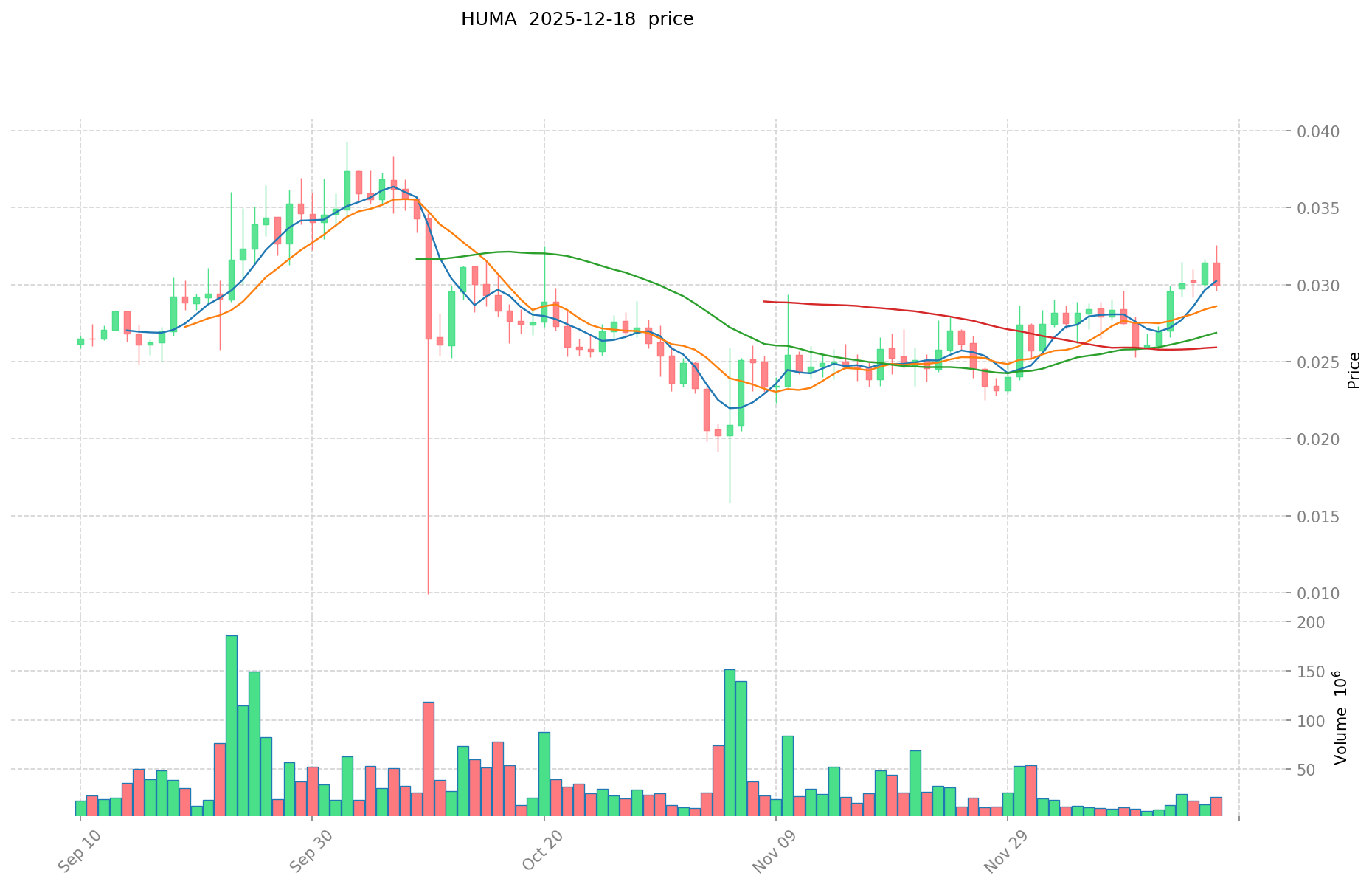
- HUMA achieved its all-time high of $0.112 on May 26, 2025, while reaching its all-time low of $0.00989 on October 10, 2025.
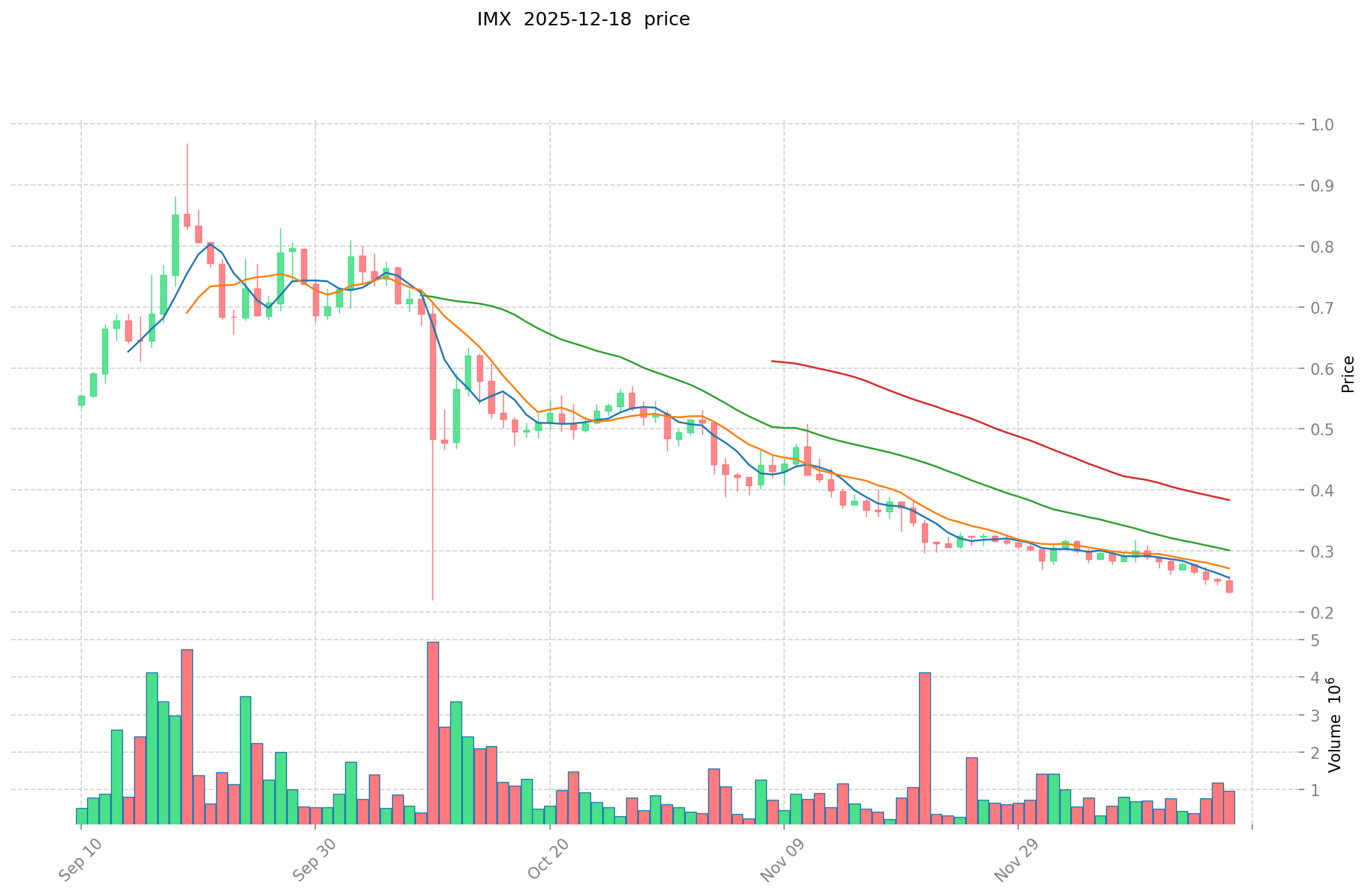
- IMX reached its all-time high of $9.52 on November 26, 2021, with a recent low of $0.225429 on December 18, 2025.
Comparative Analysis: HUMA has experienced significant volatility within a relatively short market history, demonstrating substantial recovery potential with a 25.22% gain over the past 30 days. In contrast, IMX shows severe long-term decline, having dropped 86.72% over the past year and 37.79% in the last 30 days, reflecting sustained downward pressure since its 2021 peak.
Current Market Status (December 18, 2025)
| Metric | HUMA | IMX |
|---|---|---|
| Current Price | $0.03009 | $0.226 |
| 24-Hour Change | -6.37% | -8.57% |
| 7-Day Change | +14.14% | -18.029% |
| 30-Day Change | +25.22% | -37.79% |
| Market Cap | $52.16M | $185.89M |
| 24-Hour Volume | $514,765 | $256,976 |
| Circulating Supply | 1.73B HUMA | 822.53M IMX |
| Fully Diluted Valuation | $300.90M | $452.00M |
Market Sentiment: The Crypto Fear & Greed Index stands at 17, indicating "Extreme Fear" in the current market environment, which typically precedes potential recovery opportunities or continued volatility.
Real-time Price Resources:
II. Project Overview and Technological Framework
HUMA Finance: PayFi Network Architecture
Project Definition: Huma Finance is a PayFi network that supports global payment financing by providing instant access to liquidity. The protocol utilizes income and receivables as collateral to facilitate lending and borrowing activities, bridging real-world financial operations with decentralized infrastructure.
Core Applications:
- Remittance-based lending solutions for emerging markets
- Invoice-based liquidity solutions for enterprises
- Wage advance services through tokenized payroll systems
- Deferred payment systems for education and medical services
Token Utility: HUMA serves as both a utility and governance token within the ecosystem, supporting protocol operations, governance participation, programmable payments, real-time liquidity provisioning, and on-chain underwriting functions.
Immutable X: Layer 2 NFT Scaling Solution
Project Definition: Immutable X is a Layer 2 expansion solution for NFTs on Ethereum, providing instant transactions, massive scalability, and zero gas fees for minting and trading without compromising user or asset security.
Technical Architecture: The platform leverages ZK-rollup technology utilizing zk-STARK proofs developed by StarkWare. This technology bundles hundreds of NFT transactions off-chain and generates cryptographic validity proofs before batch submission to the Ethereum mainchain, substantially reducing gas fees.
Token Allocation Structure:
- Ecosystem Development: 51.74% (user rewards, developer grants, liquidity provision, marketing)
- Project Development: 25%
- Private Funding: 14.26%
- Public Funding: 5%
- Foundation Reserves: 4%
III. Market Capitalization and Valuation Metrics
| Metric | HUMA | IMX |
|---|---|---|
| Market Cap Rank | 490 | 235 |
| Total Market Cap | $300.90M | $452.00M |
| Market Dominance | 0.0097% | 0.014% |
| Market Cap to FDV Ratio | 17.33% | 41.13% |
| Circulating Supply Ratio | 17.33% | 41.13% |
Analysis: IMX maintains a higher market ranking and absolute market capitalization; however, its market cap represents a significantly higher percentage of its fully diluted valuation (41.13% vs 17.33%), suggesting more tokenomic maturity. HUMA's lower circulation ratio indicates substantial potential dilution as additional tokens enter circulation.
IV. Network and Exchange Availability
Trading Infrastructure
HUMA Finance:
- Active Exchange Listings: 37 exchanges
- Primary Blockchain: Solana (SOL)
- Token Address: HUMA1821qVDKta3u2ovmfDQeW2fSQouSKE8fkF44wvGw
- Holder Base: 25,222 addresses
Immutable X:
- Active Exchange Listings: 53 exchanges
- Primary Blockchain: Ethereum (ETH)
- Token Address: 0xf57e7e7c23978c3caec3c3548e3d615c346e79ff
- Holder Base: 97,779 addresses
Community and Resources
HUMA:
- Website: https://huma.finance/
- Documentation: https://docs.huma.finance/
- Twitter: https://x.com/humafinance
IMX:
- Website: https://www.immutable.com
- Twitter: https://twitter.com/Immutable
- Reddit: Community presence available
V. Risk Assessment and Market Dynamics
Price Volatility Profile
HUMA:
- 24-Hour Range: $0.02962 - $0.03221
- 52-Week Volatility: Established in 2025
- Current Price Position: Near recent lows with positive medium-term momentum
IMX:
- 24-Hour Range: $0.2248 - $0.2586
- Historical Range: $0.225429 - $9.52
- Current Price Position: Approaching historical lows with negative year-over-year performance
Market Emotion Context
The extreme fear sentiment (Fear & Greed Index: 17) presents distinct implications for each project:
- For HUMA: Potential entry opportunity amid building fundamentals
- For IMX: Continued pressure reflecting long-term underperformance relative to historical valuation
VI. Technical and Operational Distinctions
Blockchain Integration
HUMA's deployment on Solana provides access to a high-throughput, low-cost network environment suitable for payment financing applications. IMX's Ethereum foundation grants deeper liquidity pools and institutional adoption but faces higher transaction costs despite Layer 2 optimization.
Market Adoption Metrics
IMX demonstrates broader institutional adoption with nearly 4x the holder addresses (97,779 vs 25,222), suggesting more distributed token ownership. However, HUMA shows recent positive price momentum, indicating potential renewed investor interest despite its nascent status.
Disclaimer: This report presents factual market data and project information as of December 18, 2025. It does not constitute investment advice, price predictions, or recommendations to buy, sell, or hold any cryptocurrency. Cryptocurrency markets remain highly volatile and subject to significant price fluctuations. Conduct independent research and consult financial advisors before making investment decisions.
Investment Value Analysis: HUMA vs IMX
Executive Summary
Based on available reference materials, this report addresses core factors influencing investment value for HUMA and IMX tokens. The provided context contains limited specific data on HUMA, while offering more detailed information on IMX (Immutable X). This analysis focuses on documented information without speculation.
I. Core Determinants of Investment Value
Investment value for both tokens hinges on profitability, market sentiment, and strategic partnerships. Essential evaluation factors include:
- Revenue growth and operational efficiency
- Market demand for underlying services
- Token economic sustainability
Note: Assets without revenue-generating capabilities face challenges in objective valuation. Value derives from market sentiment and adoption utility rather than traditional financial metrics alone.
II. Technology Development and Ecosystem Construction
IMX (Immutable X) Technical Architecture
Layer 2 Scaling Solution:
- IMX operates as an Ethereum Layer 2 extension leveraging Validium, StarkWare, and zkEVM technologies
- Transaction throughput: 9,000 transactions per second
- Gas fees reduced to near-negligible levels
- Focuses on GameFi sector with customized wallet experiences
Ecosystem Expansion:
- Successfully transitioned from dependency on single flagship game (Gods Unchained)
- Strategic partnership with GameStop broadened application scope
- Provides professional API and SDK for game developers
- Operates global order book for NFT distribution across blockchain networks
- Established as critical infrastructure in Web3 gaming sector
Comparative Model - Web3 Game + Public Chain Integration:
- Precedent: Axie Infinity paired with Ronin chain
- Alternative model: Mines of Dalarnia + Chromia + DAR Open Network ecosystem
HUMA Technical Information
Reference materials contain insufficient documented information regarding HUMA's specific technical infrastructure, upgrades, or ecosystem development to provide substantive analysis.
III. Risk Factors and Market Dynamics
Systemic Risks:
- Cryptocurrency market volatility and macroeconomic risks
- Regulatory uncertainty across jurisdictions
- Liquidity constraints and potential black swan events (extreme volatility, liquidation cascades)
Tokenomic Risks:
- Token unlock schedules and inflation mechanisms may dilute value if growth insufficient
- Supply dynamics require sustainable demand growth to maintain price stability
IV. Market Positioning and Adoption
IMX Positioning:
- Established presence in Web3 gaming infrastructure
- GameFi sector validation through multiple ecosystem partnerships
- Addressed scalability bottlenecks on Ethereum network
- Cross-game asset interoperability emerging as ecosystem standard
Investment Framework:
- Value investment methodology based on fundamental analysis across DeFi, NFT, GameFi, DAO, and infrastructure segments
- Ecosystem breadth and technical legitimacy key evaluation metrics
Conclusion
The documented evidence primarily supports detailed analysis of IMX's Layer 2 gaming infrastructure and ecosystem maturation. Investment decision-making should emphasize ecosystem utility, technical performance metrics, and adoption velocity rather than speculative sentiment factors alone.
Further analysis would require specific data on HUMA's technical specifications, tokenomic structure, and ecosystem applications currently absent from available reference materials.
III. 2025-2030 Price Forecast: HUMA vs IMX
Short-term Forecast (2025)
- HUMA: Conservative $0.0277-$0.0302 | Optimistic $0.0407
- IMX: Conservative $0.1159-$0.2273 | Optimistic $0.2864
Mid-term Forecast (2027-2028)
- HUMA may enter a consolidation phase with moderate growth, projected price range $0.0270-$0.0751
- IMX may enter an acceleration phase with stronger institutional interest, projected price range $0.2273-$0.3948
- Key drivers: institutional capital inflows, ETF approvals, ecosystem development
Long-term Forecast (2029-2030)
- HUMA: Base case $0.0430-$0.0633 | Optimistic scenario $0.0969
- IMX: Base case $0.1976-$0.3844 | Optimistic scenario $0.5304
Disclaimer
This analysis is based on historical data and predictive models. Cryptocurrency markets are highly volatile and subject to regulatory, technological, and macroeconomic risks. Past performance does not guarantee future results. This information should not be considered investment advice. Please conduct your own research and consult with a financial advisor before making investment decisions.
HUMA:
| 年份 | 预测最高价 | 预测平均价格 | 预测最低价 | 涨跌幅 |
|---|---|---|---|---|
| 2025 | 0.040716 | 0.03016 | 0.0277472 | 0 |
| 2026 | 0.05032196 | 0.035438 | 0.02728726 | 17 |
| 2027 | 0.060031972 | 0.04287998 | 0.0270143874 | 42 |
| 2028 | 0.07512572496 | 0.051455976 | 0.0411647808 | 71 |
| 2029 | 0.0677212100136 | 0.06329085048 | 0.0430377783264 | 110 |
| 2030 | 0.096948924765264 | 0.0655060302468 | 0.060920608129524 | 117 |
IMX:
| 年份 | 预测最高价 | 预测平均价格 | 预测最低价 | 涨跌幅 |
|---|---|---|---|---|
| 2025 | 0.286398 | 0.2273 | 0.115923 | 0 |
| 2026 | 0.31849276 | 0.256849 | 0.1541094 | 13 |
| 2027 | 0.3595886 | 0.28767088 | 0.2272599952 | 27 |
| 2028 | 0.3948282828 | 0.32362974 | 0.2977393608 | 43 |
| 2029 | 0.409521072996 | 0.3592290114 | 0.19757595627 | 58 |
| 2030 | 0.53043755823324 | 0.384375042198 | 0.24215627658474 | 70 |
Comparative Analysis Report: HUMA Finance vs Immutable X
I. Historical Price Comparison and Current Market Status
HUMA Finance and Immutable X Price Trends
Historical Performance:
- HUMA achieved its all-time high of $0.112 on May 26, 2025, while reaching its all-time low of $0.00989 on October 10, 2025.
- IMX reached its all-time high of $9.52 on November 26, 2021, with a recent low of $0.225429 on December 18, 2025.
Comparative Analysis: HUMA has experienced significant volatility within a relatively short market history, demonstrating substantial recovery potential with a 25.22% gain over the past 30 days. In contrast, IMX shows severe long-term decline, having dropped 86.72% over the past year and 37.79% in the last 30 days, reflecting sustained downward pressure since its 2021 peak.
Current Market Status (December 18, 2025)
| Metric | HUMA | IMX |
|---|---|---|
| Current Price | $0.03009 | $0.226 |
| 24-Hour Change | -6.37% | -8.57% |
| 7-Day Change | +14.14% | -18.029% |
| 30-Day Change | +25.22% | -37.79% |
| Market Cap | $52.16M | $185.89M |
| 24-Hour Volume | $514,765 | $256,976 |
| Circulating Supply | 1.73B HUMA | 822.53M IMX |
| Fully Diluted Valuation | $300.90M | $452.00M |
Market Sentiment: The Crypto Fear & Greed Index stands at 17, indicating "Extreme Fear" in the current market environment, which typically precedes potential recovery opportunities or continued volatility.
II. Project Overview and Technological Framework
HUMA Finance: PayFi Network Architecture
Project Definition: Huma Finance is a PayFi network that supports global payment financing by providing instant access to liquidity. The protocol utilizes income and receivables as collateral to facilitate lending and borrowing activities, bridging real-world financial operations with decentralized infrastructure.
Core Applications:
- Remittance-based lending solutions for emerging markets
- Invoice-based liquidity solutions for enterprises
- Wage advance services through tokenized payroll systems
- Deferred payment systems for education and medical services
Token Utility: HUMA serves as both a utility and governance token within the ecosystem, supporting protocol operations, governance participation, programmable payments, real-time liquidity provisioning, and on-chain underwriting functions.
Network Architecture:
- Primary Blockchain: Solana (SOL)
- Token Address: HUMA1821qVDKta3u2ovmfDQeW2fSQouSKE8fkF44wvGw
- Active Exchange Listings: 37 exchanges
- Holder Base: 25,222 addresses
Immutable X: Layer 2 NFT Scaling Solution
Project Definition: Immutable X is a Layer 2 expansion solution for NFTs on Ethereum, providing instant transactions, massive scalability, and zero gas fees for minting and trading without compromising user or asset security.
Technical Architecture: The platform leverages ZK-rollup technology utilizing zk-STARK proofs developed by StarkWare. This technology bundles hundreds of NFT transactions off-chain and generates cryptographic validity proofs before batch submission to the Ethereum mainchain, substantially reducing gas fees.
Ecosystem Development:
- Successfully transitioned from dependency on single flagship game (Gods Unchained)
- Strategic partnership with GameStop broadened application scope
- Provides professional API and SDK for game developers
- Operates global order book for NFT distribution across blockchain networks
- Established as critical infrastructure in Web3 gaming sector
Token Allocation Structure:
- Ecosystem Development: 51.74% (user rewards, developer grants, liquidity provision, marketing)
- Project Development: 25%
- Private Funding: 14.26%
- Public Funding: 5%
- Foundation Reserves: 4%
Network Architecture:
- Primary Blockchain: Ethereum (ETH)
- Token Address: 0xf57e7e7c23978c3caec3c3548e3d615c346e79ff
- Active Exchange Listings: 53 exchanges
- Holder Base: 97,779 addresses
III. Market Capitalization and Valuation Metrics
| Metric | HUMA | IMX |
|---|---|---|
| Market Cap Rank | 490 | 235 |
| Total Market Cap | $300.90M | $452.00M |
| Market Dominance | 0.0097% | 0.014% |
| Market Cap to FDV Ratio | 17.33% | 41.13% |
| Circulating Supply Ratio | 17.33% | 41.13% |
Analysis: IMX maintains a higher market ranking and absolute market capitalization; however, its market cap represents a significantly higher percentage of its fully diluted valuation (41.13% vs 17.33%), suggesting more tokenomic maturity. HUMA's lower circulation ratio indicates substantial potential dilution as additional tokens enter circulation.
IV. Investment Strategy Comparison: HUMA vs IMX
Long-term vs Short-term Investment Strategy
HUMA: Best suited for investors focused on emerging payment finance applications and early-stage ecosystem potential. The project addresses underserved financial needs in emerging markets and demonstrates positive near-term momentum despite nascent market presence. Suitable for risk-tolerant investors seeking exposure to PayFi infrastructure development.
IMX: More appropriate for investors seeking exposure to established Web3 gaming infrastructure with demonstrated partnerships and technical legitimacy. The Layer 2 solution benefits from Ethereum's broader ecosystem adoption, though facing long-term valuation pressures. Suitable for investors viewing current price levels as potential accumulation opportunities relative to historical highs.
Risk Management and Asset Allocation
Conservative Investor:
- HUMA: 10-15% allocation (limited exposure to nascent project)
- IMX: 15-20% allocation (larger established ecosystem)
- Stablecoin Reserve: 65-75% (risk mitigation)
Aggressive Investor:
- HUMA: 30-40% allocation (higher risk tolerance for recovery potential)
- IMX: 25-35% allocation (balanced infrastructure exposure)
- Stablecoin/Hedging Tools: 25-40% (volatility management)
Hedging Tools: Stablecoin reserves, cross-token diversification, options strategies for downside protection, dollar-cost averaging to manage entry points during extreme fear sentiment.
V. Potential Risk Comparison
Market Risk
HUMA: Limited historical data creates uncertainty in long-term performance trajectory. Substantial circulating supply ratio (17.33% of FDV) presents significant dilution risk as additional tokens enter circulation. Recent price volatility within narrow range ($0.00989 to $0.112) reflects market uncertainty.
IMX: Sustained long-term decline (-86.72% over past year) reflects diminished market confidence relative to 2021 highs. Current price position ($0.226) approaches recent lows, indicating potential support or continued downward pressure. Market adoption challenges in competitive GameFi infrastructure space.
Technology Risk
HUMA: Limited documented technical specifications regarding network stability, scalability, and security infrastructure create assessment gaps. Solana blockchain dependency introduces network-level risk, though platform provides high throughput and low transaction costs.
IMX: ZK-rollup technology via StarkWare provides proven scalability architecture with cryptographic security validation. However, complex technical infrastructure introduces potential implementation risks and ongoing maintenance requirements.
Regulatory Risk
HUMA: PayFi model incorporating lending and liquidity provisioning attracts potential regulatory scrutiny regarding financial services classification, consumer lending regulations, and anti-money laundering compliance across multiple jurisdictions.
IMX: NFT and gaming infrastructure faces evolving regulatory frameworks regarding asset classification, consumer protection in Web3 contexts, and jurisdiction-specific digital asset regulations. Ethereum's larger ecosystem provides more regulatory precedent.
VI. Price Forecast: 2025-2030
HUMA Price Projection
| Year | High | Average | Low | Change |
|---|---|---|---|---|
| 2025 | $0.0407 | $0.0302 | $0.0277 | 0% |
| 2026 | $0.0503 | $0.0354 | $0.0273 | 17% |
| 2027 | $0.0600 | $0.0429 | $0.0270 | 42% |
| 2028 | $0.0751 | $0.0515 | $0.0412 | 71% |
| 2029 | $0.0677 | $0.0633 | $0.0430 | 110% |
| 2030 | $0.0969 | $0.0655 | $0.0609 | 117% |
IMX Price Projection
| Year | High | Average | Low | Change |
|---|---|---|---|---|
| 2025 | $0.2864 | $0.2273 | $0.1159 | 0% |
| 2026 | $0.3185 | $0.2568 | $0.1541 | 13% |
| 2027 | $0.3596 | $0.2877 | $0.2273 | 27% |
| 2028 | $0.3948 | $0.3236 | $0.2977 | 43% |
| 2029 | $0.4095 | $0.3592 | $0.1976 | 58% |
| 2030 | $0.5304 | $0.3844 | $0.2422 | 70% |
Key Drivers: Institutional capital inflows, ETF approvals, ecosystem development maturity, regulatory clarity, and broader cryptocurrency market recovery trajectory.
VII. Conclusion: Which Is the Better Buy?
📌 Investment Value Summary
HUMA Advantages:
- Positive momentum: 25.22% gain over past 30 days indicates renewed investor interest
- Lower market cap facilitates potential upside appreciation
- Addresses underserved PayFi market segment with practical applications
- Early-stage positioning provides greater asymmetric return potential
IMX Advantages:
- Larger absolute market capitalization ($185.89M) and established ecosystem
- Higher holder base (97,779 addresses) demonstrates broader adoption and liquidity
- Proven Layer 2 infrastructure serving Web3 gaming infrastructure
- Strategic partnerships (GameStop) indicate continued ecosystem development
- More extensive exchange listings (53 vs 37) provide better accessibility
✅ Investment Recommendations
Beginner Investors: Consider IMX as primary holding due to larger ecosystem, greater liquidity, and more extensive technical documentation. Begin with small allocation, employ dollar-cost averaging strategy during extreme fear market conditions, and maintain majority reserves in stablecoins to manage volatility exposure.
Experienced Investors: HUMA presents higher risk-reward profile suitable for portfolio diversification and early-stage infrastructure exposure. Combine with IMX exposure as established infrastructure complement. Implement tactical entry/exit strategies based on technical indicators and ecosystem development milestones.
Institutional Investors: IMX offers more established infrastructure supporting larger allocation sizing and reduced liquidity risk. Monitor HUMA's ecosystem development for potential institutional-grade financing use cases in emerging markets, creating future partnership or acquisition scenarios.
⚠️ Risk Disclaimer: Cryptocurrency markets demonstrate extreme volatility and are subject to significant price fluctuations. This report presents factual market data and project information as of December 18, 2025. It does not constitute investment advice, price predictions, or recommendations to buy, sell, or hold any cryptocurrency. Regulatory uncertainty, technological risks, and macroeconomic factors may substantially impact valuations. Conduct independent research and consult with qualified financial advisors before making investment decisions. None
HUMA vs IMX: Frequently Asked Questions
I. Market Performance and Price Comparison
Q1: What is the current price performance difference between HUMA and IMX?
A: As of December 18, 2025, HUMA is trading at $0.03009 with a 30-day gain of 25.22%, while IMX is at $0.226 with a 30-day decline of -37.79%. HUMA demonstrates positive momentum despite its lower absolute price, whereas IMX shows sustained downward pressure, having declined 86.72% over the past year from its 2021 all-time high of $9.52.
Q2: Which token has greater volatility and what does this mean for investors?
A: HUMA exhibits higher volatility within a short trading history (all-time high: $0.112; all-time low: $0.00989), presenting both significant recovery potential and downside risk. IMX shows severe long-term depreciation but trades within a narrower recent range. Higher volatility in HUMA creates greater asymmetric return opportunities for risk-tolerant investors but also increases potential losses.
Q3: What are the 2030 price forecasts for both tokens?
A: Based on predictive models, HUMA projects a 2030 range of $0.0609-$0.0969 (optimistic scenario), representing 117% appreciation from current levels. IMX forecasts a 2030 range of $0.2422-$0.5304 (optimistic scenario), representing 70% appreciation. These projections depend on institutional capital inflows, ecosystem development, and regulatory clarity.
II. Project Fundamentals and Use Cases
Q4: What are the fundamental differences in the projects' purposes and technology?
A: HUMA operates as a PayFi network on Solana, providing global payment financing through income and receivables-based lending for remittances, invoices, wage advances, and deferred payments. IMX functions as an Ethereum Layer 2 scaling solution utilizing ZK-rollup technology for NFT transactions with near-zero gas fees. The projects address entirely different market segments: payment finance versus gaming infrastructure.
Q5: Which project has stronger ecosystem adoption and partnerships?
A: IMX demonstrates broader institutional adoption with 97,779 token holders versus HUMA's 25,222 holders, and benefits from strategic partnerships including GameStop integration. IMX trades on 53 exchanges compared to HUMA's 37 listings. However, HUMA's nascent status with recent positive momentum suggests emerging adoption, while IMX faces challenges maintaining relevance in competitive GameFi infrastructure markets.
III. Risk Assessment and Investment Suitability
Q6: What are the primary risk factors differentiating these investments?
A: HUMA faces tokenomic dilution risk (17.33% circulating supply ratio), limited historical data for performance assessment, and regulatory scrutiny as a lending protocol. IMX encounters market adoption challenges, dependency on Ethereum ecosystem conditions, and technical complexity risks from ZK-rollup infrastructure. Both projects are subject to cryptocurrency volatility, regulatory uncertainty, and macroeconomic pressures.
Q7: Which token is more suitable for conservative versus aggressive investors?
A: Conservative investors should prioritize IMX due to larger market capitalization, established ecosystem, and broader liquidity infrastructure, allocating 15-20% portfolio weight. Aggressive investors may allocate 30-40% to HUMA for early-stage recovery potential. All investors should maintain 25-75% stablecoin reserves depending on risk tolerance, employ dollar-cost averaging during extreme fear market conditions (current Fear & Greed Index: 17), and diversify across both projects for balanced exposure.
Q8: How do tokenomic structures impact long-term value sustainability?
A: IMX's 51.74% ecosystem allocation (user rewards, developer grants, liquidity provision, marketing) supports sustained development; however, 41.13% market cap to fully diluted valuation ratio indicates significant token circulation already released. HUMA's lower 17.33% ratio suggests substantial future dilution as tokens enter circulation, requiring proportional demand growth to maintain price stability. HUMA's PayFi model generates protocol revenue through lending, potentially supporting token utility versus IMX's primarily infrastructure-based value proposition.
Disclaimer: This FAQ presents factual market data and project information as of December 18, 2025. It does not constitute investment advice, price predictions, or recommendations to buy, sell, or hold any cryptocurrency. Cryptocurrency markets remain highly volatile and subject to significant price fluctuations, regulatory changes, and technological risks. Conduct independent research and consult qualified financial advisors before making investment decisions.
Share
How to Buy Cryptocurrency


Trending Cryptocurrencies



AAVE vs IMX: Comparing Two Leading DeFi Protocols in the Crypto Space

FARM vs IMX: Comparing Layer-2 Solutions for NFT Ecosystems

How Does On-Chain Data Analysis Reveal Shards' Market Trends in 2025?

STRK vs FLOW: Battle of the Blockchain Titans Shaping the Future of Decentralized Finance

How Have Smart Contract Vulnerabilities Shaped Crypto Security in 2025?

Understanding Sui: A Comprehensive Guide to Its Blockchain Technology
Exploring DRC20 Platforms for Dogecoin Transactions

Must-See NFT Collections Launching in 2024

NFT App Mysteriously Removed from Apple Store: Why It Happened

Connecting Polygon to Your Web3 Wallet: A Step-by-Step Guide
Getting Started with Cryptocurrency Trading: A Simple Guide for Beginners