Is Perpetual Protocol (PERP) a good investment?: Analyzing Market Performance, Risk Factors, and Future Potential in the Decentralized Derivatives Ecosystem


Introduction: Perpetual Protocol (PERP) Investment Position and Market Prospects
PERP is an important asset in the crypto industry. Since its launch in 2020, it has achieved significant accomplishments in decentralized perpetual futures trading. As of December 2025, PERP has a market capitalization of approximately $13.98 million, with a circulating supply of around 72.61 million tokens, while the current price hovers near $0.09319. Leveraging its distinctive positioning as a "decentralized perpetual contract protocol powered by virtual automated market makers (vAMM)," PERP has gradually become a focal point when investors discuss the question "Is Perpetual Protocol (PERP) a good investment?" This article provides a comprehensive analysis of PERP's investment value, historical price trends, future price forecasts, and investment risks to offer reference insights for investors.
I. Protocol Foundation and Functionality
Perpetual Protocol operates as a decentralized perpetual contract protocol that supports trading of any asset through its virtual automated market maker (vAMM) architecture. The protocol enables traders to execute transactions directly through the vAMM without requiring a counterparty. By integrating price data from oracles such as Chainlink and Uniswap, the protocol can create perpetual contracts for any asset with reliable on-chain price feeds.
II. PERP Token Utility
PERP serves as the native utility token of the platform with two primary functions: governance, allowing token holders to vote on new assets to be listed and influence protocol development directions, and staking, enabling token holders to earn staking rewards, capture portions of trading fees, and contribute to market protection mechanisms.
III. Current Market Metrics
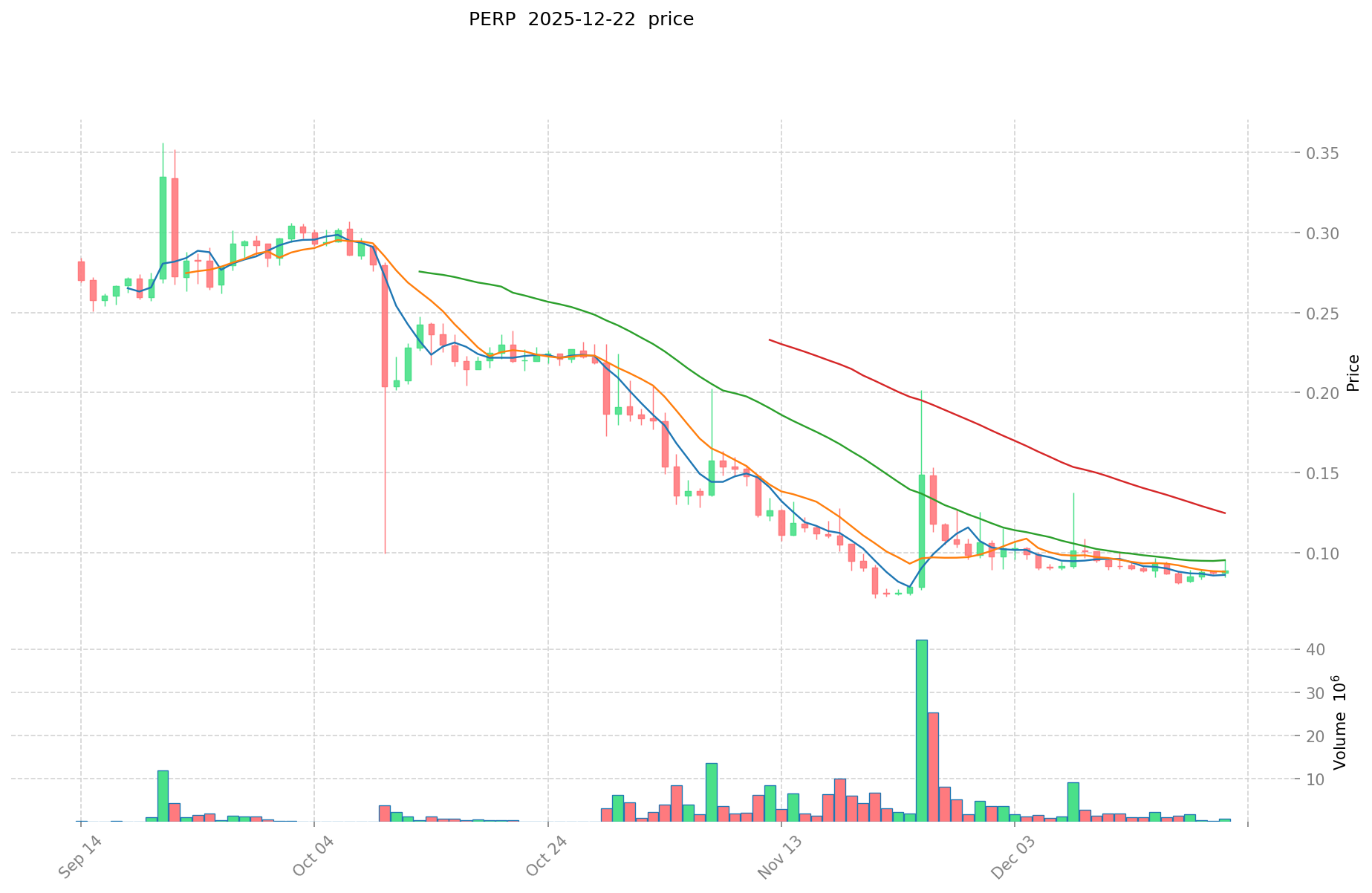
The token currently ranks 1,369 in market capitalization with a fully diluted valuation of $13.98 million and a circulating supply ratio of 48.41%. The 24-hour trading volume stands at approximately $292,314.69, while the token demonstrates historical volatility ranging from an all-time high of $24.40 (August 30, 2021) to a recent low of $0.072752 (November 22, 2025).
Perpetual Protocol (PERP) Research Report
I. Price History Review and Current Investment Status
PERP Historical Price Performance and Investment Returns
All-Time High and Low:
- All-Time High (ATH): $24.40 on August 30, 2021
- All-Time Low (ATL): $0.072752 on November 22, 2025
- Cumulative Return from ATH to ATL: -99.70%
Price Performance by Timeframe (As of December 23, 2025):
- 1 Hour: -1.47%
- 24 Hours: +6.55%
- 7 Days: +6.4%
- 30 Days: +24.4%
- 1 Year: -88.09%
Current PERP Market Status (December 23, 2025)
Key Market Metrics:
- Current Price: $0.09319 USD
- 24-Hour Trading Volume: $292,314.69
- Market Capitalization: $6,766,513.25 USD
- Fully Diluted Valuation (FDV): $13,978,500.00 USD
- Circulating Supply: 72,609,864.24 PERP (48.41% of total supply)
- Total Supply: 150,000,000 PERP
- 24-Hour Price Range: $0.08744 - $0.10616
- Market Dominance: 0.00043%
- Token Holders: 13,196
Monitor real-time PERP market prices and data via Gate
II. Project Overview and Technical Foundation
Protocol Architecture and Core Mechanism
Perpetual Protocol is a decentralized perpetual contracts protocol designed to support trading of any asset through an innovative virtual automated market maker (vAMM) model. The protocol enables traders to execute perpetual contract trades without requiring a direct counterparty, facilitating frictionless market access.
Key Technical Components:
- Virtual Automated Market Maker (vAMM): Replaces traditional order book matching with algorithmic pricing, allowing traders to interact directly with the protocol's liquidity mechanism
- Oracle Integration: Utilizes price feeds from Chainlink, Uniswap, and other decentralized oracles to determine asset prices for perpetual contract creation
- Asset Universality: Any asset with verifiable on-chain price data can theoretically be created as a perpetual contract market
PERP Token Utility and Governance
PERP serves as the native functional token of the Perpetual Protocol ecosystem with dual primary use cases:
Governance:
- Token holders exercise voting rights on asset listing decisions
- Participation in protocol development direction and parameter adjustments
- Democratic decision-making over protocol evolution
Staking and Value Capture:
- Token holders stake PERP to earn staking rewards
- Participants receive proportional share of transaction fees generated by the platform
- Staked tokens provide protective mechanisms for market integrity and system stability
III. Competitive Landscape and Industry Context
Decentralized Perpetual Contracts Market Evolution
The perpetual derivatives trading sector has undergone significant competitive transformation. As of October 2025, the market demonstrates substantial concentration shifts:
Market Share Distribution (Top Protocols):
- Aster: 40% weekly trading volume share (displaced previous leader)
- Lighter: ~17% weekly trading volume share
- Hyperliquid: 7.67% weekly trading volume share (declined from historical ~65% market share)
User Scale Comparison:
- Aster ecosystem: 4.6+ million total users
- Hyperliquid: 750,000 total users (after one year of mainnet operation)
Market Dynamics and Innovation Trends
The Perp DEX sector has transitioned from early technical validation to active ecosystem and business model competition. Notable developments include:
- Liquidity Pool Innovations: Leading protocols implement differentiated models (HLP at Hyperliquid with ~6.7% annual yield; ALP at Aster supporting yield-bearing collateral assets)
- Fee Structure Evolution: Zero-fee models (Lighter) compete against tiered fee mechanisms with sophisticated maker/taker rebates
- Cross-Chain Integration: Emerging protocols facilitate unified liquidity across blockchain networks through advanced bridging infrastructure
IV. Token Economics and Market Structure
Supply Dynamics
- Maximum Supply: 150,000,000 PERP (fixed cap)
- Circulating Supply: 72,609,864.24 PERP (48.41% circulation ratio)
- Remaining Unlocked Supply: 77,390,135.76 PERP (51.59%)
Market Capitalization Analysis
| Metric | Value |
|---|---|
| Market Cap (Circulating) | $6,766,513.25 USD |
| FDV (Fully Diluted) | $13,978,500.00 USD |
| Market Cap/FDV Ratio | 48.41% |
| Per-Token Price | $0.09319 USD |
V. Key Information Resources
Official Channels and Verification
Platform Access:
- Main Application: https://app.perp.com
- Official Website: https://perp.com
- Token Platform: https://token.perp.com
Blockchain Verification:
- Ethereum Contract Address: 0xbc396689893d065f41bc2c6ecbee5e0085233447
- Explorer Link: https://etherscan.io/token/0xbc396689893d065f41bc2c6ecbee5e0085233447
Community:
- Twitter/X: https://twitter.com/perpprotocol
VI. Risk Considerations and Market Context
The perpetual contracts market remains highly competitive with ongoing technical and business model innovation. PERP's significant price depreciation (-88.09% over one year) reflects broader market dynamics and competitive pressures within the sector. Token holders should conduct comprehensive due diligence regarding protocol adoption metrics, competitive positioning, and token utility evolution before making any investment decisions.
Cryptocurrency markets demonstrate substantial volatility and inherent risk factors. This report provides factual market data and should not be construed as financial advice or investment recommendation.
Perpetual Protocol (PERP) Investment Analysis Report
Report Date: December 23, 2025
I. Executive Summary
Perpetual Protocol (PERP) is a decentralized perpetual futures protocol that enables traders to execute derivatives trades without requiring counterparties through virtual automated market makers (vAMM). As of December 23, 2025, PERP is trading at $0.09319, representing a significant decline from its all-time high of $24.4 recorded on August 30, 2021. The token has experienced a one-year decline of 88.09%, though it has recovered 6.55% over the past 24 hours and 24.4% over the past 30 days.
II. Core Factors Influencing PERP Investment Assessment
Supply Mechanism and Token Economics
The PERP token operates within a carefully structured supply framework:
- Total Supply: 150 million tokens (fixed maximum supply)
- Circulating Supply: 72.61 million tokens (48.41% of maximum supply)
- Current Circulation Ratio: 48.41%
This supply structure indicates significant potential for token inflation as additional tokens enter circulation. The gradual release of tokens from the maximum supply represents a medium-term headwind for price appreciation. The relatively low circulation ratio suggests that future supply increases could exert downward pressure on the token's valuation.
Protocol Functionality and Use Cases
PERP serves dual purposes within the ecosystem:
Governance Function: Token holders utilize PERP to vote on protocol decisions, including which assets receive perpetual contract listings and the broader development trajectory of the Perpetual Protocol.
Staking and Value Accrual: Token holders can stake PERP to:
- Receive staking rewards
- Capture a portion of platform trading fees
- Participate in market protection mechanisms
The fee-sharing model provides direct economic incentives for long-term token holders, linking token value to platform growth and trading volume.
Platform Architecture and Market Access
Perpetual Protocol leverages virtual automated market makers (vAMM) to facilitate trading without traditional order books:
- Oracle Integration: Price data sourced from Chainlink, Uniswap, and other decentralized oracle networks
- Asset Flexibility: Supports perpetual contracts for any asset with reliable on-chain price feeds
- Market Creation: Future framework enables community members to create new contract markets and capture portions of associated trading fees
Token Holder Base
- Active Holders: 13,196 addresses holding PERP
- Market Distribution: The relatively modest holder count relative to trading activity suggests concentration among informed participants and traders
III. Market Performance Metrics
Current Valuation
| Metric | Value |
|---|---|
| Current Price | $0.09319 |
| 24-Hour Range | $0.08744 - $0.10616 |
| Market Capitalization | $6.77 million |
| Fully Diluted Valuation | $13.98 million |
| 24-Hour Trading Volume | $292,314.69 |
| Market Dominance | 0.00043% |
Price Performance Timeline
| Period | Change |
|---|---|
| 1-Hour | -1.47% |
| 24-Hour | +6.55% |
| 7-Day | +6.4% |
| 30-Day | +24.4% |
| 1-Year | -88.09% |
The recent 30-day recovery of 24.4% follows an extended bear market period, suggesting potential stabilization near historical lows reached on November 22, 2025.
Historical Price Extremes
- All-Time High: $24.4 (August 30, 2021)
- All-Time Low: $0.072752 (November 22, 2025)
- Initial Launch Price: $1.2 (September 12, 2020)
The token has declined 92% from its all-time high and 99.8% from its initial launch price, indicating severe devaluation over its operational history.
IV. Market Sentiment and Technical Assessment
Market analysis regarding PERP investment presents divergent perspectives:
Bearish Indicators:
- Multiple technical quantitative indicators suggest a bearish outlook for 2025
- Q4 2025 forecast indicates potential downward pressure with weak liquidity conditions
- Persistent selling pressure noted in recent analysis
Bullish Considerations:
- Recent positive price movement over 24-hour, 7-day, and 30-day periods
- DeFi derivatives sector positioning offers exposure opportunities
- Fee-capture mechanism provides functional utility beyond speculative trading
V. Ecosystem and Adoption Status
Perpetual Protocol operates on the Ethereum blockchain with contract address 0xbc396689893d065f41bc2c6ecbee5e0085233447. The protocol is actively traded on multiple exchanges, though detailed adoption metrics, total value locked (TVL), or active user counts are not provided in available data.
Official Channels:
- Website: https://perp.com, https://app.perp.com, https://token.perp.com
- Social Media: Twitter (@perpprotocol)
- Block Explorer: Etherscan
VI. Risk Considerations
- Valuation Decline: The 88% one-year decline reflects significant market skepticism regarding current protocol viability or competitive positioning
- Liquidity Constraints: Trading volume of $292,314 daily relative to market capitalization suggests limited liquidity depth
- Supply Dilution: Less than half of the maximum supply currently circulates, creating future inflation pressures
- Market Concentration: Modest holder base may indicate liquidity concentration risk
- Competitive Landscape: DeFi derivatives market includes well-established competitors with larger user bases and capital reserves
VII. Disclaimer
This report provides factual information regarding Perpetual Protocol (PERP) based on available market data as of December 23, 2025. This analysis does not constitute investment advice, recommendations, or endorsements. Cryptocurrency investments carry substantial risk, including potential total loss of capital. Prospective investors should conduct independent research, consult qualified financial advisors, and carefully evaluate their risk tolerance before making investment decisions.
III. PERP Future Investment Predictions and Price Outlook
Short-term Investment Predictions (2025, Short-term PERP Investment Outlook)
- Conservative forecast: $0.0639 - $0.0927
- Neutral forecast: $0.0927 - $0.1067
- Optimistic forecast: $0.1067 - $0.1307
Mid-term Investment Outlook (2026-2028, Mid-term Perpetual Protocol (PERP) Investment Forecast)
- Market stage expectations: Platform consolidation phase with potential ecosystem expansion, gradual user adoption in decentralized derivatives trading.
- Investment return predictions:
- 2026: $0.0983 - $0.1418 (19% potential upside)
- 2027: $0.0710 - $0.1356 (36% potential upside)
- 2028: $0.0879 - $0.1718 (40% potential upside)
- Key catalysts: Platform liquidity growth, expansion of tradeable assets, institutional adoption of perpetual contracts, governance token utility enhancement, and ecosystem partnerships.
Long-term Investment Outlook (Is PERP a Good Long-term Investment?)
- Base case scenario: $0.1609 - $0.2159 (Assumes steady protocol adoption and stable market conditions)
- Optimistic scenario: $0.2159 - $0.2900 (Assumes significant institutional adoption and successful ecosystem scaling)
- Risk scenario: $0.0800 - $0.1200 (Assumes limited adoption, increased competition, or adverse regulatory developments)
Visit PERP long-term investment and price predictions: Price Prediction
2025-12-23 to 2030 Long-term Outlook
- Base case scenario: $0.1609 - $0.2159 USD (Corresponding to steady growth and mainstream application expansion)
- Optimistic scenario: $0.2159 - $0.3200 USD (Corresponding to mass adoption and favorable market conditions)
- Transformative scenario: $0.3200 USD and above (If the ecosystem achieves breakthrough progress and mainstream adoption)
- 2030-12-31 predicted peak: $0.2159 USD (Based on optimistic development assumptions)
Disclaimer: This analysis is for informational purposes only and should not be construed as investment advice. Cryptocurrency markets are highly volatile and unpredictable. Past performance does not guarantee future results. Investors should conduct thorough independent research (DYOR) and consider their risk tolerance before making investment decisions. Price predictions involve substantial uncertainty and may not materialize as forecasted.
| 年份 | 预测最高价 | 预测平均价格 | 预测最低价 | 涨跌幅 |
|---|---|---|---|---|
| 2025 | 0.1306647 | 0.09267 | 0.0639423 | 0 |
| 2026 | 0.1418175345 | 0.11166735 | 0.098267268 | 19 |
| 2027 | 0.1356144132075 | 0.12674244225 | 0.07097576766 | 36 |
| 2028 | 0.171843740324662 | 0.13117842772875 | 0.087889546578262 | 40 |
| 2029 | 0.193934187554184 | 0.151511084026706 | 0.096967093777092 | 62 |
| 2030 | 0.215903294738056 | 0.172722635790445 | 0.160632051285114 | 85 |
Perpetual Protocol (PERP) Investment Analysis Report
I. Project Overview
Basic Information
Perpetual Protocol is a decentralized perpetual contract protocol that supports any asset through a virtual automated market maker (vAMM) mechanism. The protocol enables traders to trade directly through vAMM without requiring a counterparty.
Token Details:
- Token Name: PERP
- Current Price: $0.09319
- Market Capitalization: $6,766,513.25
- Fully Diluted Valuation: $13,978,500.00
- Circulating Supply: 72,609,864 PERP
- Total Supply: 150,000,000 PERP
- Market Ranking: 1,369
Core Mechanism
The protocol utilizes vAMM infrastructure to facilitate perpetual contract trading. Price data is sourced from oracle providers such as Chainlink and Uniswap. Future development plans include enabling any user to create new contract markets and receive transaction fee portions, similar to liquidity providers on Uniswap.
Token Utility
PERP serves two primary functions:
- Governance: Token holders can vote on new assets to be listed or influence protocol development direction.
- Staking: Token holders can stake PERP on the platform to earn staking rewards and transaction fee sharing. Staked tokens also provide market protection mechanisms.
II. Market Performance Analysis
Price Movements
| Time Period | Change |
|---|---|
| 1 Hour | -1.47% |
| 24 Hours | +6.55% |
| 7 Days | +6.40% |
| 30 Days | +24.40% |
| 1 Year | -88.09% |
24-Hour Trading Metrics:
- High: $0.10616
- Low: $0.08744
- Trading Volume: $292,314.69
- Volume Concentration: Limited liquidity relative to market cap
Historical Price Data
- All-Time High: $24.40 (August 30, 2021)
- All-Time Low: $0.072752 (November 22, 2025)
- Current Price: $0.09319 (83.37% below ATH)
Market Position
- Market Share: 0.00043%
- Circulating-to-Total Supply Ratio: 48.41%
- Token Holders: 13,196
III. Technical & Fundamental Analysis
Strengths
- Innovative vAMM Model: Enables counterparty-free trading with flexible asset support
- Oracle Integration: Leverages established price feeds (Chainlink, Uniswap) for security
- Decentralized Governance: Community participation in protocol development
- Fee-sharing Mechanism: Staking rewards tied to protocol revenue
Challenges
- Severe Price Decline: 88.09% loss over one year indicates sustained selling pressure
- Low Trading Liquidity: 24-hour volume significantly lower than market cap
- Limited Adoption: Relatively small holder base (13,196) suggests restricted user engagement
- Market Concentration Risk: High circulating-to-total supply ratio (48.41%) leaves room for significant dilution
IV. Investment Strategy and Risk Management
Investment Approaches
- Long-Term Holding (HODL): Suitable for investors believing in protocol adoption growth and governance participation
- Active Trading: Dependent on technical analysis given high volatility; requires careful entry/exit discipline due to low liquidity
Risk Management
Asset Allocation Recommendations:
- Conservative Investors: 0-2% portfolio allocation maximum
- Active Traders: Position sizing with strict stop-losses given volatility
- Institutional Investors: Requires liquidity analysis before significant positions
Risk Mitigation:
- Multi-asset portfolio diversification to reduce single-token exposure
- Staking consideration only with long-term conviction
- Avoid over-leveraging due to extreme price volatility
Secure Storage:
- Small holdings: Hardware wallets (Ledger, Trezor)
- Active trading: Cold storage for majority, hot wallet for trading allocation only
- Never maintain significant PERP holdings on centralized exchanges
V. Investment Risks and Challenges
Market Risk
- Extreme Volatility: 88% annual decline demonstrates susceptibility to market cycles
- Low Liquidity: Limited trading volume may result in significant slippage on large orders
- Price Manipulation: Smaller market cap increases vulnerability to coordinated trading activity
Regulatory Risk
- Derivatives protocol regulation remains uncertain across jurisdictions
- Potential restrictions on perpetual trading mechanisms in various countries
- Classification ambiguity as "security" vs. "utility" token in different regulatory frameworks
Technology Risk
- Smart contract vulnerability exposure on Ethereum mainnet
- Protocol upgrade execution risks
- Dependency on external oracle price feeds for system integrity
- Market protection mechanisms adequacy under extreme volatility scenarios
VI. Conclusion: Is Perpetual Protocol a Good Investment?
Investment Value Summary
Perpetual Protocol addresses a meaningful market need through innovative vAMM technology for decentralized perpetual trading. However, the 88% annual price decline and limited holder adoption suggest either extended market skepticism or potential structural challenges to protocol adoption. The project remains speculative with asymmetric risk profile.
Investment Recommendations
✅ Beginners: Dollar-cost averaging into small positions only; prioritize hardware wallet storage; do not exceed 1% portfolio allocation
✅ Experienced Traders: Technical analysis-based swing trading only; maintain strict position sizing; avoid leverage; consider governance participation benefits
✅ Institutional Investors: Conduct thorough liquidity analysis before entry; verify oracle mechanism robustness; assess regulatory exposure in target jurisdictions
⚠️ Disclaimer: Cryptocurrency investment carries substantial risk. This analysis is for informational purposes only and does not constitute investment advice. Past performance does not guarantee future results. Investors should conduct independent research and consult qualified financial advisors before making investment decisions.
Perpetual Protocol (PERP) FAQ Report
I. FAQ - Perpetual Protocol (PERP) Investment Guide
Q1: What is Perpetual Protocol (PERP) and how does it function?
A: Perpetual Protocol is a decentralized perpetual futures protocol that operates through a virtual automated market maker (vAMM) architecture. The protocol enables traders to execute perpetual contract trades without requiring counterparties. It integrates price data from oracle providers such as Chainlink and Uniswap to create perpetual contracts for various assets. The PERP token serves dual functions: governance (allowing token holders to vote on asset listings and protocol development) and staking (enabling participation in fee-sharing and earning staking rewards).
Q2: What is the current market status and price performance of PERP token?
A: As of December 23, 2025, PERP is trading at $0.09319 USD. The token shows a 24-hour gain of +6.55% and a 30-day gain of +24.4%, though it has declined 88.09% over the past year. The all-time high reached $24.40 on August 30, 2021, while the all-time low stands at $0.072752 on November 22, 2025. Current market capitalization is $6.77 million with a fully diluted valuation of $13.98 million. Daily trading volume is approximately $292,314.69 with 13,196 active token holders.
Q3: What are the supply dynamics and token economics of PERP?
A: PERP operates with a fixed maximum supply of 150 million tokens. Currently, 72.61 million PERP tokens are in circulation, representing 48.41% of the total supply. This leaves 77.39 million tokens (51.59%) still unlocked and potentially entering circulation. The relatively low circulation ratio indicates potential future supply inflation, which could exert downward pressure on token valuation as additional tokens become available to the market.
Q4: What investment risks should I consider before purchasing PERP?
A: Key investment risks include: extreme price volatility (88% annual decline), low trading liquidity relative to market capitalization, regulatory uncertainty surrounding derivatives protocols, potential smart contract vulnerabilities on the Ethereum network, dependency on external oracle price feeds, and concentrated holder base with only 13,196 addresses holding PERP. Additionally, the perpetual contracts market faces intense competition from larger protocols, and less than half of the total supply currently circulates, creating future dilution risks.
Q5: What are the price predictions for PERP through 2030?
A: Short-term predictions (end of 2025) range from $0.0639 to $0.1307. Mid-term forecasts project 2026 at $0.0983-$0.1418 (19% upside potential), 2027 at $0.0710-$0.1356 (36% upside), and 2028 at $0.0879-$0.1718 (40% upside). Long-term scenarios for 2030 include a base case of $0.1609-$0.2159, an optimistic case of $0.2159-$0.3200, and a transformative scenario exceeding $0.3200. However, these predictions involve substantial uncertainty and should not be treated as guaranteed outcomes.
Q6: How does PERP generate value and what are its utility functions?
A: PERP derives value from two primary mechanisms: governance participation and staking rewards. Token holders exercise voting rights on asset listings and protocol parameters, providing democratic control over ecosystem development. Staking PERP enables participation in fee-sharing arrangements where stakers receive proportional shares of platform trading fees. Additionally, staked tokens contribute to market protection mechanisms and system stability. This creates direct economic incentives linking token value to platform growth and trading volume expansion.
Q7: What is the competitive landscape for PERP in the decentralized derivatives market?
A: Perpetual Protocol operates in an increasingly competitive perpetual derivatives sector. As of October 2025, market share distribution shows Aster commanding 40% of weekly trading volume, Lighter at approximately 17%, and Hyperliquid at 7.67% (down from historical ~65% market share). Aster ecosystem has 4.6+ million total users while Hyperliquid has 750,000 users. Competing protocols have implemented liquidity pool innovations, differentiated fee structures, and cross-chain integration features. PERP faces significant challenges maintaining market position against these established competitors with larger user bases and capital resources.
Q8: What investment allocation recommendations apply to different investor profiles?
A: Conservative investors should limit PERP exposure to 0-2% maximum portfolio allocation given extreme volatility. Experienced traders may pursue technical analysis-based swing trading with strict position sizing and no leverage, while maintaining stable coin reserves for opportunities. Institutional investors must conduct thorough liquidity analysis before significant positions, verify oracle mechanism robustness, and assess regulatory exposure across target jurisdictions. All investor types should utilize hardware wallets for storage security, avoid centralized exchange holdings, and conduct independent due diligence before committing capital. Dollar-cost averaging strategies may be appropriate for long-term conviction investors, but leverage should be strictly avoided due to extreme price volatility.
Disclaimer: This FAQ provides factual information for educational purposes only and does not constitute investment advice, recommendations, or financial guidance. Cryptocurrency investments carry substantial risk including potential total loss of capital. Past performance does not guarantee future results. Prospective investors should conduct independent research, consult qualified financial advisors, and carefully evaluate their risk tolerance before making investment decisions.
Share
How to Buy Cryptocurrency


Trending Cryptocurrencies



Is Perpetual Protocol (PERP) a Good Investment?: A Comprehensive Analysis of Its Long-term Potential in the DeFi Derivatives Market

Is NASDEX (NSDX) a good investment?: Analyzing the potential of this decentralized derivatives exchange token

What Do Derivatives Market Signals Reveal About MYX's 20% Pullback Risk?

KCT vs GMX: The Battle of Cryptocurrency Trading Platforms Heats Up
What Are the Key Signals from Crypto Derivatives Markets in 2025?
How Will Derivatives Market Signals Impact HBAR's Price in 2025?
Is Star Atlas (ATLAS) a good investment?: A Comprehensive Analysis of Risks, Potential Returns, and Market Prospects in the Metaverse Gaming Sector

Maximize Profits with Solana Yield Farming

Is Konnect (KCT) a good investment?: A Comprehensive Analysis of Price Performance, Market Potential, and Risk Factors

Is Contentos (COS) a good investment?: A Comprehensive Analysis of Its Market Potential, Technology, and Future Prospects in the Blockchain Industry

Is SCOR (SCOR) a good investment?: A comprehensive analysis of the reinsurance giant's financial performance and future prospects