


Is Treehouse (TREE) a good investment?: A Comprehensive Analysis of Market Potential, Risk Factors, and Future Prospects


Introduction: Treehouse (TREE) Investment Position and Market Prospects
TREE is an important asset in the cryptocurrency sector. As of December 21, 2025, TREE has a market cap of $106.73 million with a circulating supply of approximately 156.12 million tokens, currently trading at $0.10673. Backed by leading investors including Wintermute, GSR, GFC, and Lightspeed, Treehouse addresses a critical infrastructure gap in crypto fixed income markets by introducing two core primitives: tAssets, which aggregate fragmented on-chain rates while offering yield premiums on underlying Liquid Staking Tokens (LSTs); and DOR, a decentralized consensus mechanism that establishes a LIBOR-like system for cryptocurrency, enabling prediction accuracy assessment and construction of term structures for crypto-denominated interest rates.
Positioned as a solution to the underdeveloped fixed income infrastructure in crypto, TREE has become a focal point for investors evaluating emerging infrastructure plays in the digital asset space. This article provides comprehensive analysis of TREE's investment value, historical price dynamics, market positioning, and associated risks to serve as a reference for potential investors.
Treehouse (TREE) Crypto Asset Research Report
I. TREE Price History Review and Current Investment Status
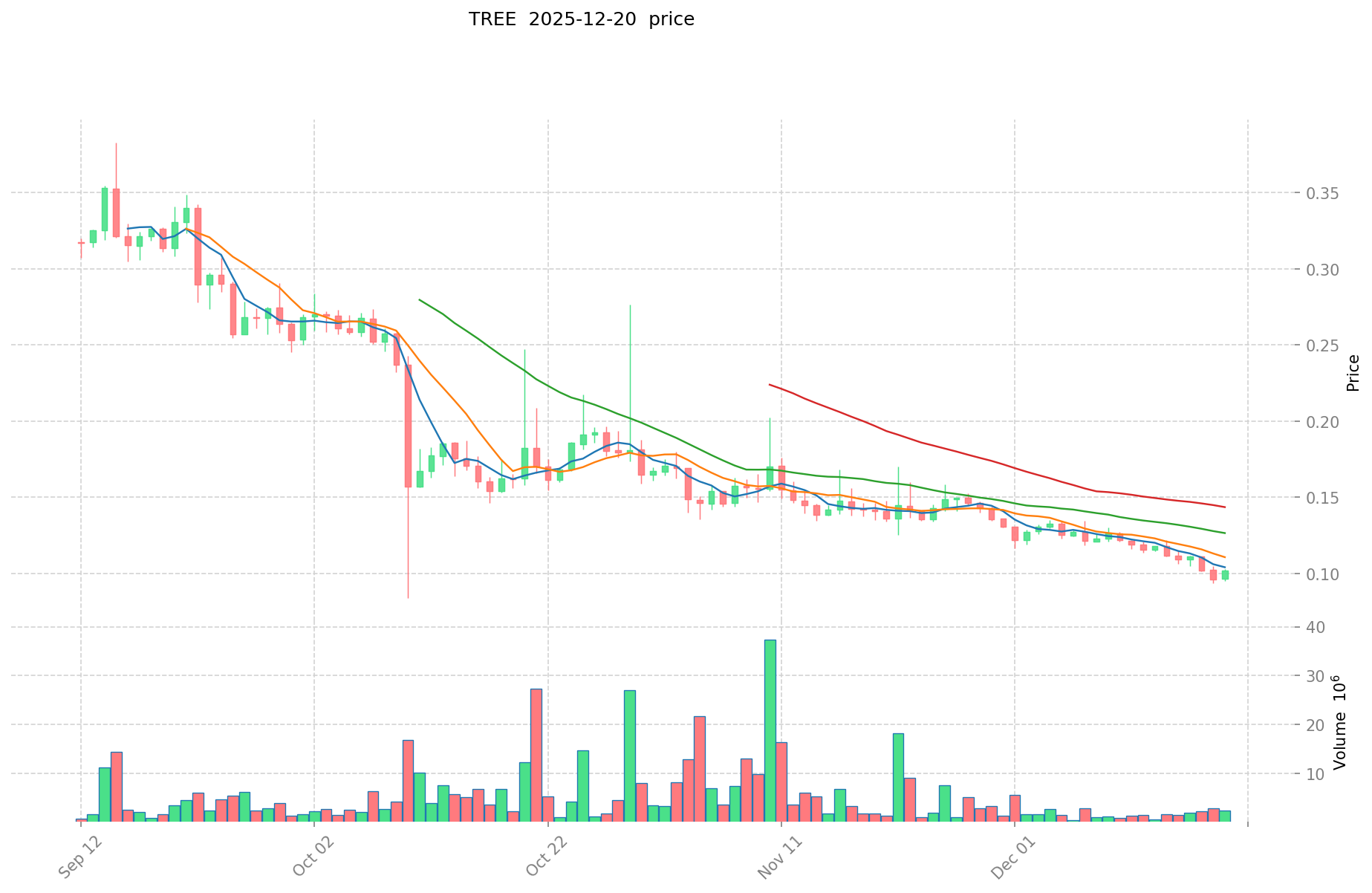
TREE Historical Price Trends and Investment Performance
Based on available market data as of December 21, 2025:
- All-Time High (ATH): $1.3524 reached on July 29, 2025
- All-Time Low (ATL): $0.0835 reached on October 10, 2025
- Current Price: $0.10673 (as of December 21, 2025)
- YTD Performance: Token launched on December 21, 2025, making it a recently listed asset
Current TREE Market Status (December 21, 2025)
- Current Price: $0.10673 USD
- 24-Hour Price Change: +7.21%
- 24-Hour Trading Volume: $455,272.41
- Market Capitalization: $16,662,948.98 (circulating supply basis)
- Fully Diluted Valuation: $106,730,000.00
- Market Dominance: 0.0033%
- Circulating Supply: 156,122,449 TREE
- Total Supply: 1,000,000,000 TREE
- Circulating Supply Ratio: 15.61%
For real-time TREE market price information, visit Gate TREE Market
II. Project Overview and Core Primitives
Protocol Description
Treehouse is a fixed income infrastructure protocol designed to address the underdevelopment of fixed income markets in cryptocurrency. The protocol identifies a critical infrastructure gap: the absence of decentralized benchmark rates for consistent product development and settlement.
Core Technology Primitives
I. tAssets Module
tAssets converge fragmented on-chain interest rates while offering yield premiums on underlying Liquid Staking Tokens (LSTs). This primitive aggregates dispersed rate opportunities across different protocols, creating a unified yield platform for LST holders.
II. DOR (Decentralized Oracle Rate)
DOR functions as a decentralized consensus mechanism establishing a LIBOR-like system for cryptocurrency. The mechanism:
- Uses underlying rates to assess prediction accuracy
- Constructs term structures for any crypto-denominated interest rates
- Creates a foundation for derivative pricing and risk management
III. Investor Backing and Support
The project is backed by leading institutional investors including:
- Wintermute
- GSR (Genesis Block Ventures)
- GFC
- Lightspeed
IV. Token Economics and Distribution
| Metric | Value |
|---|---|
| Token Symbol | TREE |
| Token Standard | ERC-20 |
| Blockchain | Ethereum |
| Total Supply | 1,000,000,000 |
| Max Supply | 1,000,000,000 |
| Circulating Supply | 156,122,449 |
| Circulating Ratio | 15.61% |
| Contract Address | 0x77146784315ba81904d654466968e3a7c196d1f3 |
| Token Holders | 10,398 |
| Listed Exchanges | 38 |
V. Price Performance Analysis
Short-Term Price Movements
| Timeframe | Change Percentage | Change Amount |
|---|---|---|
| 1 Hour | +0.42% | +$0.000446 |
| 24 Hours | +7.21% | +$0.007178 |
| 7 Days | -8.24% | -$0.009584 |
| 30 Days | -25.45% | -$0.036436 |
Price Range (24-Hour Period)
- High: $0.10816
- Low: $0.09771
VI. Network and Community Resources
Official Channels
- Website: https://www.treehouse.finance/
- Twitter/X: https://x.com/TreehouseFi
- Discord: Community channel available
- Documentation: https://docs.treehouse.finance/protocol
- Block Explorer: https://etherscan.io/token/0x77146784315ba81904d654466968e3a7c196d1f3
VII. Market Context
Report Date: December 21, 2025
TREE represents a newly listed token addressing the fixed income infrastructure gap in decentralized finance. The project combines institutional backing with novel protocol primitives designed to create standardized benchmark rates across cryptocurrency markets.
Treehouse (TREE) Comprehensive Asset Analysis Report
Report Date: December 21, 2025
I. Executive Summary
Treehouse (TREE) is an ERC-20 token operating on the Ethereum blockchain, designed to address the underdeveloped fixed income market in crypto. As of December 21, 2025, TREE trades at $0.10673 with a market capitalization of approximately $16.66 million and a fully diluted valuation of $106.73 million. The token has demonstrated volatility over recent periods, with a 24-hour gain of 7.21% but a 30-day decline of 25.45%.
II. Core Factors Influencing TREE as an Investment
Supply Mechanism and Scarcity (TREE Investment Scarcity)
TREE operates with the following supply parameters:
- Total Supply: 1,000,000,000 tokens
- Circulating Supply: 156,122,449 tokens (15.61% of total supply)
- Max Supply: 1,000,000,000 tokens
The token maintains a substantial portion of supply still in reserve, with only 15.61% currently circulating. This significant reserve indicates potential for supply pressure upon future distributions, which could influence price dynamics and investor considerations.
Institutional Investment and Mainstream Adoption
Treehouse benefits from backing by leading institutional investors:
- Key Investors: Wintermute, GSR, GFC, Lightspeed, and other prominent firms
- Market Position: Ranked 932 globally with presence across 38 exchanges
- Community: 10,398 token holders
The institutional support validates the project's foundational approach to solving fixed income infrastructure challenges in crypto, though broader mainstream adoption metrics remain limited at current market stage.
Technology and Ecosystem Development (Technology & Ecosystem for TREE Investment)
Treehouse introduces two core technical primitives addressing infrastructure gaps:
tAssets Module
- Converges fragmented on-chain interest rates
- Offers yield premiums on underlying liquid staking tokens (LSTs)
- Aggregates dispersed lending and staking opportunities into unified framework
DOR (Decentralized Consensus Mechanism)
- Establishes a LIBOR-equivalent system for crypto markets
- Enables assessment of prediction accuracy on underlying rates
- Constructs term structures for any crypto-denominated interest rate products
These innovations directly address the lack of decentralized benchmark rates, a critical infrastructure gap in crypto fixed income markets.
Recent Development: Fee Reinvestment and Buyback Program
As of November 26, 2025, Treehouse implemented a significant tokenomics update:
- Fee Allocation: 50% of tETH fees designated for TREE token buybacks
- Market Impact: Announcement reportedly doubled TREE's price post-announcement
This mechanism creates positive price pressure through capital redeployment while aligning token value with protocol fee generation.
III. Current Market Performance and Price Metrics
| Metric | Value |
|---|---|
| Current Price | $0.10673 |
| 24-Hour Change | +7.21% |
| 7-Day Change | -8.24% |
| 30-Day Change | -25.45% |
| 52-Week High (ATH) | $1.3524 (July 29, 2025) |
| 52-Week Low (ATL) | $0.0835 (October 10, 2025) |
| 24-Hour Volume | $455,272.41 |
| Market Dominance | 0.0033% |
| Holders Count | 10,398 |
Price Range Analysis:
- Current price trades 92.1% below all-time high
- Current price trades 27.9% above all-time low
- Market capitalization to fully diluted valuation ratio: 15.61%
IV. Risk and Consideration Factors
Market Volatility
TREE demonstrates significant price volatility, trading from $1.3524 to $0.0835 over its trading history, representing an 94.3% drawdown from peak. Recent 30-day performance of -25.45% reflects market uncertainty.
Supply Dilution Risk
With only 15.61% of total supply circulating, future token releases represent a significant dilution risk that could pressure price appreciation potential.
Market Liquidity
Daily trading volume of $455,272 relative to market capitalization indicates moderate liquidity, potentially creating execution challenges for large position entries or exits.
Early-Stage Technology Risk
As a relatively nascent infrastructure protocol in the fixed income crypto space, Treehouse faces execution risks in achieving market adoption and validation of its LIBOR-equivalent mechanism.
V. Project Resources and Verification
- Official Website: https://www.treehouse.finance/
- Documentation: https://docs.treehouse.finance/protocol
- Contract Address (Ethereum): 0x77146784315ba81904d654466968e3a7c196d1f3
- Blockchain Explorer: https://etherscan.io/token/0x77146784315ba81904d654466968e3a7c196d1f3
- Social Channels: Twitter, Discord
VI. Conclusion
Treehouse addresses a genuine infrastructure gap in crypto fixed income markets through its tAssets aggregation and DOR decentralized rate mechanism. The project benefits from substantial institutional backing and recent positive tokenomics adjustments through fee-based buyback programs. However, TREE remains an early-stage protocol with significant price volatility, supply dilution potential, and limited market adoption metrics. Investment evaluation should incorporate individual risk tolerance, portfolio allocation strategy, and independent technical and fundamental analysis.
III. TREE Future Investment Predictions and Price Outlook
Short-term Investment Outlook (2025)
- Conservative Forecast: $0.065 - $0.095
- Neutral Forecast: $0.095 - $0.132
- Optimistic Forecast: $0.132 - $0.160
Mid-term Investment Forecast (2026-2028)
-
Market Phase Expectations: Treehouse is positioned to establish itself as a foundational infrastructure player in the decentralized fixed income market. The integration of tAssets and DOR mechanisms should facilitate ecosystem expansion and developer adoption across multiple blockchain networks.
-
Investment Return Predictions:
- 2026: $0.088 - $0.146 (approximately 11% projected growth)
- 2027: $0.129 - $0.198 (approximately 24% projected growth)
- 2028: $0.121 - $0.235 (approximately 54% projected growth)
-
Key Catalysts: Protocol upgrades and tAssets integration, DOR mechanism adoption by major DeFi platforms, partnerships with leading liquidity staking providers, market expansion into new blockchain networks, institutional interest in decentralized fixed income solutions.
Long-term Investment Outlook (2029-2030)
-
Base Case: $0.142 - $0.245 (Assumes steady protocol development and moderate market adoption of Treehouse's fixed income infrastructure within the crypto ecosystem)
-
Optimistic Case: $0.245 - $0.350 (Assumes significant mainstream adoption of decentralized benchmark rates and widespread integration of tAssets across DeFi platforms)
-
Risk Case: $0.050 - $0.100 (Assumes regulatory headwinds, competition from alternative solutions, or limited protocol adoption)
For detailed price predictions and long-term analysis, visit: TREE Price Prediction
2025-2030 Extended Outlook
-
Base Scenario: $0.202 - $0.244 USD (Corresponding to steady protocol improvements and gradual institutional adoption of Treehouse's fixed income infrastructure)
-
Optimistic Scenario: $0.300 - $0.450 USD (Corresponding to mainstream adoption of decentralized benchmark rates and significant expansion across multiple blockchain ecosystems)
-
Transformative Scenario: $0.500+ USD (Assuming breakthrough achievements in protocol functionality, regulatory clarity supporting DeFi infrastructure, and substantial mainstream adoption of crypto fixed income products)
-
2030-12-31 Predicted High: $0.245 USD (Based on moderate growth and expanded market penetration assumptions)
Disclaimer
This analysis is provided for informational purposes only and should not be construed as investment advice. Price predictions are based on historical data, market trends, and analyst forecasts, which are subject to significant uncertainty and volatility. Cryptocurrency markets are highly speculative and subject to regulatory, technological, and systemic risks. Past performance does not guarantee future results. Investors should conduct their own due diligence and consult with qualified financial advisors before making investment decisions.
| 年份 | 预测最高价 | 预测平均价格 | 预测最低价 | 涨跌幅 |
|---|---|---|---|---|
| 2025 | 0.1317624 | 0.10626 | 0.0648186 | 0 |
| 2026 | 0.146383776 | 0.1190112 | 0.088068288 | 11 |
| 2027 | 0.19771925712 | 0.132697488 | 0.12871656336 | 24 |
| 2028 | 0.2345958890352 | 0.16520837256 | 0.1206021119688 | 54 |
| 2029 | 0.221891365185336 | 0.1999021307976 | 0.141930512866296 | 87 |
| 2030 | 0.244640227670102 | 0.210896747991468 | 0.202460878071809 | 97 |
Treehouse (TREE) Comprehensive Research Report
I. Project Overview
Basic Information
Treehouse is a blockchain-based fixed income infrastructure protocol operating on the Ethereum network. The project token TREE is an ERC-20 standard token with the following key metrics as of December 21, 2025:
| Metric | Value |
|---|---|
| Current Price | $0.10673 |
| Market Capitalization | $16,662,948.98 |
| Fully Diluted Valuation | $106,730,000.00 |
| Circulating Supply | 156,122,449 TREE |
| Total Supply | 1,000,000,000 TREE |
| Market Dominance | 0.0033% |
| 24-hour Trading Volume | $455,272.41 |
| All-Time High | $1.3524 (July 29, 2025) |
| All-Time Low | $0.0835 (October 10, 2025) |
| Exchange Listings | 38 exchanges |
| Token Holders | 10,398 |
Market Ranking
Treehouse ranks 932nd by market capitalization in the broader cryptocurrency ecosystem.
II. Project Mission & Core Technology
Problem Statement
Fixed income markets in cryptocurrency remain significantly underdeveloped due to the absence of essential core infrastructure. Specifically, the lack of a decentralized benchmark interest rate standard has hindered consistent product development and settlement mechanisms across the crypto industry.
Project Solution
Backed by prominent investors including Wintermute, GSR, GFC, and Lightspeed, Treehouse introduces two fundamental primitives to address this infrastructure gap:
1. tAssets (Tokenized Assets)
tAssets converge fragmented on-chain interest rates while providing yield premiums on underlying liquid staking tokens (LSTs). This mechanism aggregates disparate rate sources to create more efficient pricing and improved returns for LST holders.
2. DOR (Decentralized Oracle Rate)
DOR functions as a decentralized consensus mechanism designed to establish a LIBOR-equivalent system for cryptocurrency. The mechanism utilizes underlying rates to assess prediction accuracy and construct term structures for any crypto-denominated interest rates, enabling standardized rate reference across the ecosystem.
III. Market Performance Analysis
Price Dynamics
Recent Performance (as of December 21, 2025):
| Time Period | Price Change | Absolute Change |
|---|---|---|
| 1 Hour | +0.42% | +$0.000446 |
| 24 Hours | +7.21% | +$0.007178 |
| 7 Days | -8.24% | -$0.009584 |
| 30 Days | -25.45% | -$0.036436 |
Price Range (24-hour):
- High: $0.10816
- Low: $0.09771
Valuation Metrics
- Market Cap to FDV Ratio: 15.61% (indicating 84.39% of supply remains in circulation)
- Circulating Supply Ratio: 15.61% of total supply
IV. Investment Strategy & Risk Management
Investment Methodology
Long-term Holdings (HODL TREE): Suitable for conservative investors seeking exposure to fixed income infrastructure development. This approach aligns with the project's focus on establishing foundational protocols that may require extended periods for market adoption and maturation.
Active Trading: Dependent on technical analysis and price action patterns. Given the token's volatility profile (ranging from $0.0835 to $1.3524) and 38 exchange listings, opportunities for swing trading exist, though requiring active monitoring and risk discipline.
Risk Management
Asset Allocation Framework:
- Conservative investors: 1-3% portfolio allocation to TREE
- Aggressive investors: 3-8% portfolio allocation
- Institutional investors: Position sizing based on specific mandate and exposure parameters
Risk Mitigation Measures:
- Diversification across multiple crypto asset classes and traditional assets
- Hedging through stablecoin positions or derivatives (where available)
- Portfolio rebalancing based on volatility indicators
Security Considerations:
- Cold storage solutions for long-term holdings
- Hardware wallet utilization (Ledger, Trezor) for enhanced security
- Hot wallet allocation limited to active trading amounts
- Multi-signature wallets for institutional-grade security
V. Investment Risks & Challenges
Market Risk
- High price volatility: Historical price swings from $0.0835 to $1.3524 demonstrate extreme fluctuation potential
- Liquidity concentration: Trading volume of $455,272.41 relative to market cap suggests potential slippage on large orders
- Emerging protocol risk: As a relatively new project, adoption velocity remains uncertain
Regulatory Risk
- Evolving regulatory frameworks across jurisdictions may impact DeFi protocols
- Classification uncertainty regarding decentralized finance products and token utility
- Potential restrictions on fixed income-related financial instruments
Technology Risk
- Smart contract vulnerabilities in protocol implementation
- Oracle manipulation risks in the DOR consensus mechanism
- Integration risks with upstream liquid staking token protocols
- Scalability challenges as transaction volume increases
Project-Specific Risks
- Limited operational history and protocol maturity validation
- Dependency on ecosystem adoption of standardized benchmark rates
- Competitive landscape with alternative fixed income solutions
VI. Conclusion: Is Treehouse (TREE) a Good Investment?
Investment Value Summary
Treehouse addresses a genuine infrastructure gap in crypto fixed income markets by introducing standardized rate benchmarking mechanisms. The backing of established investors (Wintermute, GSR, GFC, Lightspeed) provides credibility. However, the project remains in early stages with significant price volatility (-25.45% over 30 days) and execution risk regarding protocol adoption.
Investor Recommendations
✅ Newcomers: Dollar-cost averaging strategy with secure cold storage allocation; start with 1-2% portfolio exposure
✅ Experienced Investors: Swing trading around support/resistance levels with defined stop-loss discipline; monitor ecosystem adoption metrics; consider 3-5% allocation as part of diversified DeFi exposure
✅ Institutional Investors: Strategic long-term positions contingent upon protocol performance benchmarks; potential positions as infrastructure plays in fixed income derivatives
⚠️ Disclaimer: Cryptocurrency investments carry substantial risk including potential total capital loss. This report provides factual analysis only and does not constitute investment advice. Conduct independent research and consult qualified financial advisors before making investment decisions. Regulatory status and market conditions may change materially.
Data Sources: Gate Data, Etherscan, Project Documentation
Report Date: December 21, 2025
Data Accuracy: Current as of report generation timestamp
Treehouse (TREE) Frequently Asked Questions (FAQ)
I. What is Treehouse (TREE) and What Problem Does It Solve?
Q: What is Treehouse (TREE) and what infrastructure gap does it address?
A: Treehouse is a fixed income infrastructure protocol built on the Ethereum blockchain designed to solve a critical gap in cryptocurrency markets: the absence of decentralized benchmark interest rates. The project introduces two core primitives—tAssets (which aggregate fragmented on-chain interest rates and offer yield premiums on Liquid Staking Tokens) and DOR (Decentralized Oracle Rate, a LIBOR-equivalent system for crypto)—to establish standardized rate benchmarking and enable consistent product development across decentralized finance ecosystems.
II. Current Market Position and Price Information
Q: What is the current price of TREE and how has it performed recently?
A: As of December 21, 2025, TREE trades at $0.10673 with a market capitalization of $16.66 million. Recent performance shows mixed signals: the token gained 7.21% over the past 24 hours but declined 25.45% over 30 days. The all-time high reached $1.3524 on July 29, 2025, while the all-time low was $0.0835 on October 10, 2025, representing significant volatility in the price range.
III. Token Supply and Circulation
Q: How many TREE tokens are in circulation and what is the dilution risk?
A: Currently, 156,122,449 TREE tokens are in circulation, representing only 15.61% of the total supply of 1,000,000,000 tokens. This means 84.39% of supply remains in reserve, creating potential supply dilution risk upon future distributions. Investors should consider that large token releases could create downward price pressure as circulating supply expands.
IV. Institutional Backing and Credibility
Q: Which institutional investors back Treehouse?
A: Treehouse is backed by leading institutional investors including Wintermute, GSR (Genesis Block Ventures), GFC, and Lightspeed. This institutional support provides credibility to the project's approach to solving fixed income infrastructure challenges in cryptocurrency. The project is listed on 38 exchanges and has 10,398 token holders, indicating meaningful market engagement.
V. Technology and Innovation
Q: How do tAssets and DOR work, and why are they important?
A: tAssets converge fragmented on-chain interest rates while offering yield premiums on underlying liquid staking tokens, creating a unified yield platform that aggregates dispersed lending and staking opportunities. DOR establishes a decentralized consensus mechanism functioning as a LIBOR-equivalent system for cryptocurrency, enabling prediction accuracy assessment and construction of term structures for crypto-denominated interest rates. Together, these primitives create standardized benchmark rates essential for consistent product development and risk management across decentralized finance.
VI. Recent Developments and Buyback Program
Q: What recent tokenomics update did Treehouse implement?
A: On November 26, 2025, Treehouse implemented a significant tokenomics update designating 50% of tETH protocol fees for TREE token buybacks. This mechanism creates positive price pressure by redeploying capital while aligning token value directly with protocol fee generation. The announcement reportedly doubled TREE's price post-announcement, demonstrating market response to value-accretive mechanisms.
VII. Investment Recommendations and Risk Considerations
Q: Should I invest in TREE, and what allocation should I consider?
A: Investment suitability depends on individual risk tolerance and investment objectives. Conservative investors may allocate 1-3% portfolio exposure using dollar-cost averaging strategies, while experienced investors might consider 3-5% as part of diversified decentralized finance exposure. Key risks include high price volatility (92% drawdown from all-time high), supply dilution potential (84.39% unreleased supply), and early-stage protocol execution risk. The project addresses genuine infrastructure needs but remains relatively nascent with limited long-term operational history. Conduct independent research and consult qualified financial advisors before making investment decisions—this analysis does not constitute investment advice.
VIII. Long-term Price Outlook and Catalysts
Q: What are the long-term price forecasts for TREE, and what catalysts could drive growth?
A: Conservative long-term forecasts (2029-2030) project TREE trading between $0.142-$0.245 under base case scenarios, with optimistic scenarios suggesting $0.245-$0.350 and transformative scenarios potentially exceeding $0.500. Key price catalysts include protocol upgrades and tAssets integration, DOR adoption by major decentralized finance platforms, partnerships with leading liquid staking providers, expansion into new blockchain networks, and increased institutional interest in decentralized fixed income solutions. However, price predictions carry substantial uncertainty—cryptocurrency markets remain highly speculative and subject to regulatory, technological, and systemic risks.
Share
How to Buy Cryptocurrency


Trending Cryptocurrencies



Is Swell Network (SWELL) a good investment?: Analyzing the potential and risks of this emerging DeFi protocol

Is Eigenpie (EGP) a good investment?: Evaluating the potential and risks of this emerging cryptocurrency

ETH Staking in 2025: On-Chain Options and Best Platforms

when a crypto coin gets an ETF..
Best Crypto to Buy Right Now: 2025 Guide for Smart Investors
Maximize your ETH: Gate's on-chain Staking offers an annual yield of 5.82% in 2025.

Guide to Purchasing Solaxy (SOLX): Embrace the Solana Layer 2 Movement

Understanding GORK Token: AI Meme Coin Insights and Future Predictions

Secure Digital Wallet Solutions in Indonesia 2025: Safety, Legality, and Service Insights

Tapswap Coin Value Insights: Forecasts and Retrieval Process Explained
Evaluating Secure Web3 Wallet Solutions in Indonesia for 2025: Insights on Security and Legality
