Is Uniswap (UNI) a good investment?: A Comprehensive Analysis of the Leading DEX Token's Potential and Risks in 2024

Introduction: Uniswap (UNI) Investment Position and Market Prospects
UNI is an important asset in the cryptocurrency field. Uniswap is the first automatic market making transaction protocol based on Ethereum blockchain. As of December 2025, UNI has a market capitalization of $3.39 billion, with circulating supply of approximately 629.9 million tokens. The current price stands at $5.379, reflecting significant market positioning within the decentralized finance ecosystem.
Since its launch on September 17, 2020, Uniswap has established itself as a foundational infrastructure in the DeFi sector. With a market rank of #38 among cryptocurrencies and trading activity across 63 exchanges, UNI has become a focal point when investors discuss the value proposition of decentralized exchange tokens. The token is held by over 385,000 token holders, indicating broad distribution across the crypto community.
This article provides a comprehensive analysis of UNI's investment value, historical price performance, price predictions, and associated risks to offer investors with valuable reference information for decision-making.
Uniswap (UNI) Token Analysis Report
I. Price History Review and Current Investment Status
UNI Historical Price Performance
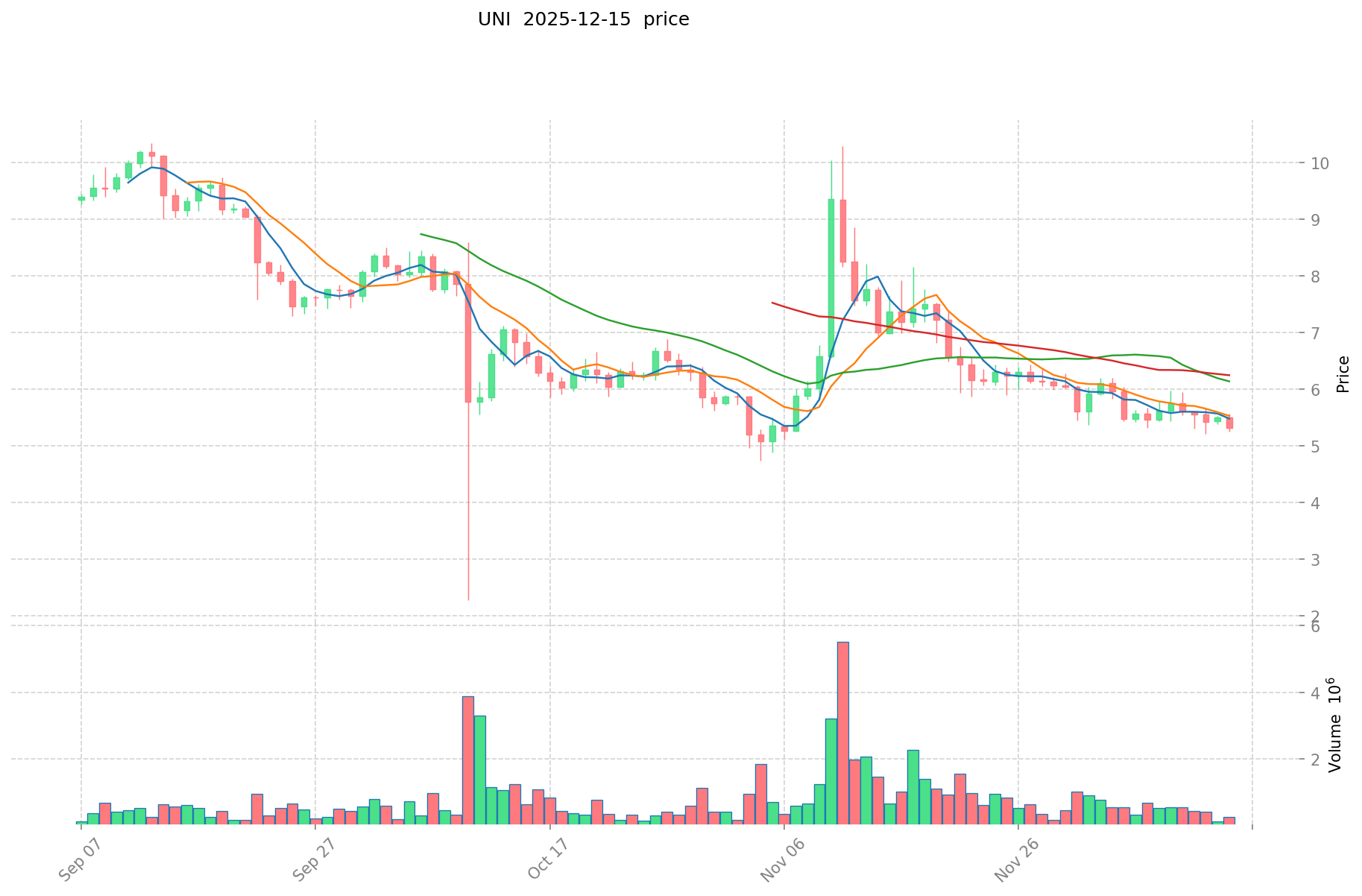
Based on available data as of December 15, 2025:
- All-Time High (ATH): $44.92 USD (May 3, 2021) - representing peak market euphoria during the 2021 bull market cycle
- All-Time Low (ATL): $1.03 USD (September 17, 2020) - the token's lowest point shortly after launch
- 1-Year Performance: -67.9% decline, indicating significant downward pressure over the past twelve months
- 30-Day Performance: -27.91% decline, demonstrating sustained weakness in recent weeks
- Current Drawdown from ATH: Approximately 88% below all-time highs, reflecting substantial long-term depreciation
The token has experienced a comprehensive bear cycle following its 2021 peak, with cumulative losses exceeding 85% from historical highs.
Current UNI Market Status (December 15, 2025)
Price Metrics:
- Current Price: $5.379 USD
- 24-Hour High: $5.464 USD
- 24-Hour Low: $5.248 USD
- 24-Hour Price Change: -0.86%
- 1-Hour Price Change: -0.38%
Market Capitalization & Liquidity:
- Market Capitalization: $3,388,261,007 (based on circulating supply)
- Fully Diluted Valuation (FDV): $5,379,000,000
- Market Dominance: 0.16%
- 24-Hour Trading Volume: $1,462,447.97
- Number of Exchange Listings: 63 exchanges
Token Supply Metrics:
- Circulating Supply: 629,905,374 UNI tokens
- Total Supply: 1,000,000,000 UNI tokens
- Circulating Supply Ratio: 62.99%
- Total Token Holders: 385,494 addresses
Market Sentiment:
- Sentiment Index: Neutral (value: 1)
- Recent volatility reflects ongoing market uncertainty
Current UNI market data: Real-time UNI Price
II. Core Project Overview
Project Name: Uniswap
Ticker Symbol: UNI
Blockchain Network: Ethereum (ETH)
Smart Contract Address: 0x1f9840a85d5af5bf1d1762f925bdaddc4201f984
Protocol Fundamentals
Uniswap is the first automated market maker (AMM) transaction protocol built on the Ethereum blockchain. The protocol enables decentralized token swaps through liquidity pools rather than traditional order books, establishing a foundational mechanism for decentralized finance (DeFi) infrastructure.
Official Resources:
- Website: https://uniswap.org/
- Twitter: https://twitter.com/Uniswap
- Community: https://www.reddit.com/r/Uniswap
- Blockchain Explorer: https://etherscan.io/token/0x1f9840a85d5af5bf1d1762f925bdaddc4201f984
III. Market Position and Competitive Dynamics
Current Rankings:
- Global Cryptocurrency Market Rank: #38
- Market Share: 0.16% of total cryptocurrency market capitalization
Recent Market Context:
The protocol has proposed fee-switching functionality activation, which aims to enable a portion of liquidity provider (LP) fees to be captured by the protocol. These revenues would be utilized for UNI token buybacks and burns. According to available research, estimated annual fee revenue under current projections could reach approximately $300 million USD.
UNI price has historically demonstrated positive correlation with Ethereum DEX trading volumes, serving as a proxy indicator for broader decentralized exchange activity.
IV. Price Trends and Technical Analysis
Multi-Timeframe Price Performance:
| Time Period | Price Change | Change Amount |
|---|---|---|
| 1 Hour | -0.38% | -$0.020518 |
| 24 Hours | -0.86% | -$0.046661 |
| 7 Days | -5.3% | -$0.301042 |
| 30 Days | -27.91% | -$2.082506 |
| 1 Year | -67.9% | -$11.378009 |
Disclaimer
This report presents factual data and observable market metrics as of the report date. It does not constitute investment advice, financial recommendations, or guidance for portfolio allocation decisions. Cryptocurrency markets remain highly volatile and subject to regulatory uncertainty. Readers should conduct independent research and consult qualified financial advisors before making investment decisions.
Report Date: December 15, 2025
Data Sources: Gate.com, Etherscan, on-chain analytics
Uniswap (UNI) Investment Analysis Report
Date: December 15, 2025
I. Executive Summary
Uniswap is the first automatic market making transaction protocol based on Ethereum blockchain. As of December 15, 2025, UNI is trading at $5.379, ranking 38th by market capitalization at approximately $5.379 billion. The token has experienced significant volatility, trading with a 24-hour change of -0.86% and a year-to-date decline of -67.9%. Despite the platform's operational strength—processing 915 million transactions in 2025 and approximately $170 billion in monthly trading volume in October 2025—the UNI token faces structural valuation challenges.
II. Core Factors Influencing UNI Investment Viability
Token Distribution & Supply Mechanism
Uniswap has a maximum supply of 1,000,000,000 UNI tokens with a circulating supply of approximately 629.9 million tokens (62.99% circulating ratio). The token distribution remains subject to governance mechanisms, though concerns exist regarding opaque distribution mechanisms and conflicts of interest between the core development team and investors.
Investment Implication: The substantial gap between circulating and total supply creates ongoing dilution concerns, potentially limiting medium-term price appreciation.
Platform Performance & Revenue Generation
The Uniswap protocol demonstrates exceptional operational metrics:
- Transaction Volume (2025): 915 million swaps completed
- Monthly Trading Volume (October 2025): Approximately $170 billion
- Total Market Cap: $3.388 billion in circulating market value
- 24-Hour Trading Volume: $1.462 billion
Critical Disconnect: Despite generating billions in annual protocol revenue, the UNI token has failed to capture proportional value. Industry experts characterize UNI as increasingly "meaningless," as the token does not directly reflect the platform's revenue performance.
Governance & Fee Distribution Mechanisms
Recent developments indicate evolving governance proposals regarding protocol fee structures. Proposals suggest mechanisms to tie token value to business performance through:
- Protocol fee distribution to token holders
- Buyback mechanisms funded by protocol revenues
Status: As of mid-November 2025, governance proposals surrounding fee switches generated renewed market interest, contributing to a ~50% price spike that brought UNI to approximately $8–$9 trading levels.
Concentration of Holdings
Whale accumulation remains significant, with the top 10 addresses holding approximately 50% of total UNI supply. This concentration creates governance dynamics where large token transfers and voting mechanisms serve as critical price signals.
III. Market Sentiment & Price Action Analysis
Current Market Positioning
| Metric | Value |
|---|---|
| Current Price | $5.379 |
| 24-Hour High | $5.464 |
| 24-Hour Low | $5.248 |
| All-Time High | $44.92 (May 3, 2021) |
| All-Time Low | $1.03 (September 17, 2020) |
| Market Cap Ranking | 38th |
Price Trends (Recent Period)
| Timeframe | Change % | Change Amount |
|---|---|---|
| 1 Hour | -0.38% | -$0.0205 |
| 24 Hours | -0.86% | -$0.0467 |
| 7 Days | -5.30% | -$0.3010 |
| 30 Days | -27.91% | -$2.0825 |
| 1 Year | -67.90% | -$11.3780 |
Analyst Sentiment Overview
Analyst forecasts present divergent outlooks:
Bullish Scenarios:
- Short-term resistance targets: $9.50–$10.00
- Bullish breakout targets: $12.00–$15.00
- Timeframe: 2025–2026 forecast cluster around $10–$15
Bearish Assessments:
- Multiple technical quantitative indicators suggest bearish positioning for 2025
- Technical failure of resistance could trigger pullback to $6.00–$7.00 range
- Regulatory, competitive, and inflationary risks persist
Neutral Observations:
- CoinCodex short-term target: $7.64 for October 2025; $10.81 by year-end
- Stabilization near key support levels with steady trading volumes
IV. Key Risk Factors & Structural Challenges
Value Disconnect Problem
A fundamental disconnect exists between Uniswap's operational success and UNI token valuation. The protocol generates substantial revenue from billions in transaction volume, yet this value does not translate to token holders. This gap reflects:
- Lack of direct fee distribution to token holders
- Unclear mechanism linking protocol economics to token value
- Limited tokenomic incentive structures
Regulatory & Competitive Pressures
Multiple analysts cite ongoing risks from:
- Regulatory environment uncertainty
- Competitive pressure from alternative DEX platforms
- Inflation and macroeconomic headwinds
Centralized Governance Influence
The concentration of voting power among top holders creates potential governance risks, including:
- Potential conflicts of interest
- Unequal influence on protocol direction
- Uncertainty regarding future fee distribution mechanisms
V. Exchange Availability & Liquidity
UNI trades across 63 exchanges with an address holder base of 385,494. The token maintains active trading pairs on Ethereum (contract: 0x1f9840a85d5af5bf1d1762f925bdaddc4201f984).
Liquidity Assessment: Strong 24-hour trading volume of $1.462 billion indicates adequate liquidity for position entry and exit across major exchanges.
VI. Community & Information Channels
- Official Website: https://uniswap.org/
- Twitter: @Uniswap
- Reddit Community: r/Uniswap
- Blockchain Explorer: Etherscan verification available
VII. Conclusion
Uniswap operates as a foundational DeFi infrastructure protocol with exceptional operational metrics and user adoption. However, the UNI token faces structural valuation challenges stemming from:
I. Insufficient mechanisms linking protocol economics to token value II. Significant supply dilution concerns III. Governance concentration among large holders IV. Regulatory and competitive uncertainties
The platform's utility and transaction volume remain strong. Ongoing governance developments regarding fee distribution mechanisms may prove decisive for token valuation trajectory. The divergence between protocol success and token performance represents the core investment consideration for prospective UNI holders.
III. UNI Future Investment Predictions and Price Outlook
Short-term Investment Forecast (2025, short-term UNI investment outlook)
- Conservative Forecast: $4.56 - $5.37
- Neutral Forecast: $5.37 - $6.50
- Optimistic Forecast: $6.50 - $8.03
Mid-term Investment Outlook (2026-2028, mid-term Uniswap(UNI) investment forecast)
-
Market Phase Expectations: UNI is expected to experience gradual recovery and consolidation as decentralized exchange adoption expands within the Ethereum ecosystem. Technical patterns suggest potential continuation of uptrend momentum following key resistance breakouts established in mid-2025.
-
Investment Return Forecasts:
- 2026: $3.56 - $7.89
- 2027: $3.66 - $9.95
- 2028: $6.33 - $11.39
-
Key Catalysts: Ecosystem development within Uniswap protocol, expansion of DeFi services, potential regulatory clarity for decentralized exchanges, TVL growth metrics, and mainstream institutional adoption of decentralized trading platforms.
Long-term Investment Outlook (Is Uniswap a good long-term investment?)
- Base Case: $7.64 - $12.67 (2030, assuming steady protocol adoption and moderate market expansion)
- Optimistic Case: $10.06 - $14.30 (2030-2045, corresponding to accelerated DeFi ecosystem maturation and increased trading volume)
- Risk Case: $6.33 - $9.01 (market consolidation or regulatory headwinds limiting growth trajectory)
For detailed UNI long-term investment and price predictions, visit: Price Prediction
2025-12-15 to 2030 Long-term Outlook
- Base Scenario: $7.64 - $10.06 USD (corresponding to steady protocol improvements and organic DeFi market growth)
- Optimistic Scenario: $10.58 - $12.67 USD (corresponding to substantial DeFi adoption expansion and positive market conditions)
- Transformative Scenario: $14.30 USD and above (reflecting breakthrough ecosystem developments and mainstream adoption acceleration)
- 2030-12-31 Predicted High: $12.67 USD (based on optimistic development assumptions)
Disclaimer
This analysis is based on historical data and expert forecasts sourced from multiple platforms. Cryptocurrency markets exhibit high volatility, and actual price movements may deviate significantly from these predictions. Past performance does not guarantee future results. This content is for informational purposes only and should not be construed as investment advice. Investors should conduct their own due diligence and consult with qualified financial advisors before making investment decisions.
| 年份 | 预测最高价 | 预测平均价格 | 预测最低价 | 涨跌幅 |
|---|---|---|---|---|
| 2025 | 6.4977 | 5.37 | 4.5645 | 0 |
| 2026 | 7.8920205 | 5.93385 | 3.56031 | 10 |
| 2027 | 9.95462676 | 6.91293525 | 3.6638556825 | 28 |
| 2028 | 11.38560435675 | 8.433781005 | 6.32533575375 | 56 |
| 2029 | 10.20698346130125 | 9.909692680875 | 9.01782033959625 | 84 |
| 2030 | 12.673505969571037 | 10.058338071088125 | 7.644336934026975 | 86 |
Uniswap (UNI) Investment Analysis Report
I. Market Overview
Current Market Position
Uniswap (UNI) is ranked 38th in the cryptocurrency market with a current price of $5.379 as of December 15, 2025. The token has a circulating supply of 629,905,374 UNI out of a total supply of 1,000,000,000 UNI, with a fully diluted valuation of $5.379 billion and market capitalization of $3.388 billion.
Price Performance
- 24-hour change: -0.86%
- 7-day change: -5.3%
- 30-day change: -27.91%
- 1-year change: -67.9%
- 24-hour trading range: $5.248 - $5.464
- All-time high: $44.92 (May 3, 2021)
- All-time low: $1.03 (September 17, 2020)
Trading Activity
- 24-hour trading volume: $1,462,447.97
- Market dominance: 0.16%
- Circulating supply ratio: 62.99%
- Active holders: 385,494
II. Project Fundamentals
Core Description
Uniswap is the first automatic market maker (AMM) transaction protocol built on the Ethereum blockchain. The protocol enables decentralized token trading through liquidity pools rather than traditional order books.
Network & Integration
- Primary blockchain: Ethereum (ETH)
- Contract address: 0x1f9840a85d5af5bf1d1762f925bdaddc4201f984
- Exchange listings: Available on 63 exchanges
Community & Resources
- Official website: https://uniswap.org/
- Twitter: https://twitter.com/Uniswap
- Reddit: https://www.reddit.com/r/Uniswap
- Block explorer: https://etherscan.io/token/0x1f9840a85d5af5bf1d1762f925bdaddc4201f984
III. Market Analysis & Trends
Price Trend Analysis
Uniswap has experienced significant downward pressure over the extended timeframe, declining 67.9% over the past year. Short-term momentum remains negative with consecutive declines across 24-hour (-0.86%), 7-day (-5.3%), and 30-day (-27.91%) periods. The token trades substantially below its all-time high of $44.92, representing an 88% reduction from peak valuation.
Market Sentiment
The current market emotion indicator suggests neutral to slightly bearish sentiment, reflecting broader market conditions and the token's recent price performance.
IV. Investment Strategy & Risk Management
Investment Methodology
Long-term holding (HODL UNI)
- Suitable for conservative investors seeking exposure to decentralized exchange infrastructure
- Requires conviction in Uniswap's protocol utility and potential market recovery
Active trading
- Dependent on technical analysis and market cycle positioning
- Requires monitoring of 24-hour and weekly price levels
Risk Management
Asset allocation considerations
- Conservative investors: 2-5% of total cryptocurrency allocation
- Aggressive investors: 5-15% of total cryptocurrency allocation
- Institutional investors: Strategic positioning based on DeFi exposure thesis
Portfolio diversification
- Multi-asset composition including stablecoins and other DeFi protocols
- Hedge strategies through delta-neutral positions or collateral-backed positions
Security storage
- Hot wallets for active trading and liquidity provision
- Cold storage for long-term holdings using hardware wallet solutions
V. Investment Risks & Challenges
Market Risk
- High price volatility with significant daily fluctuations
- Susceptibility to market-wide cryptocurrency corrections
- Liquidity concentration risk in specific trading pairs
Regulatory Risk
- Uncertain regulatory treatment of decentralized exchanges across jurisdictions
- Potential policy changes affecting DeFi protocol operations
- Varying compliance requirements for derivative trading mechanisms
Technology Risk
- Smart contract security vulnerabilities in protocol upgrades
- Ethereum network scalability limitations affecting transaction costs
- Potential technical failures during protocol transitions
VI. Conclusion: Is UNI a Good Investment?
Investment Value Summary
Uniswap represents exposure to decentralized exchange infrastructure with established market utility. However, the 67.9% annual decline and significant drawdown from all-time highs indicate substantial short-term price volatility and potential continued consolidation.
Investor Recommendations
✅ Beginners: Systematic dollar-cost averaging with secure storage in reputable hardware wallets
✅ Experienced investors: Tactical entry positions during technical support levels with defined risk parameters
✅ Institutional investors: Strategic long-term allocation to DeFi infrastructure with diversified position sizing
⚠️ Disclaimer: Cryptocurrency investments carry significant risk. This report is provided for informational purposes only and does not constitute investment advice. Conduct independent research and consult with financial advisors before making investment decisions.
Uniswap (UNI) Investment Analysis Report
Report Date: December 15, 2025
I. Executive Summary
Uniswap (UNI) is the first automated market maker (AMM) protocol built on the Ethereum blockchain. As of December 15, 2025, UNI trades at $5.379 with a market capitalization of $3.388 billion, ranking 38th among cryptocurrencies. The token has experienced significant volatility, declining 67.9% over the past year while maintaining strong protocol fundamentals with 915 million transactions processed in 2025 and approximately $170 billion in monthly trading volume.
II. Current Market Status and Price Performance
Key Price Metrics:
- Current Price: $5.379 USD
- 24-Hour Change: -0.86%
- 7-Day Change: -5.30%
- 30-Day Change: -27.91%
- 1-Year Change: -67.90%
- All-Time High: $44.92 (May 3, 2021)
- All-Time Low: $1.03 (September 17, 2020)
Market Capitalization & Supply:
- Market Capitalization: $3,388,261,007
- Fully Diluted Valuation: $5,379,000,000
- Circulating Supply: 629,905,374 UNI (62.99%)
- Total Supply: 1,000,000,000 UNI
- Active Token Holders: 385,494 addresses
The token demonstrates a fundamental disconnect between protocol performance and token valuation, with operational metrics significantly outpacing price appreciation.
III. Project Fundamentals
Protocol Overview: Uniswap operates as the foundational decentralized exchange infrastructure on Ethereum, enabling peer-to-peer token trading through automated liquidity pools. The protocol eliminates traditional order books in favor of mathematical formulas governing asset exchange rates.
Operational Metrics (2025):
- Total Transactions: 915 million swaps
- Monthly Trading Volume (October 2025): Approximately $170 billion
- Exchange Listings: 63 major cryptocurrency exchanges
- Smart Contract Address: 0x1f9840a85d5af5bf1d1762f925bdaddc4201f984
Official Channels:
- Website: https://uniswap.org/
- Twitter: https://twitter.com/Uniswap
- Community: https://www.reddit.com/r/Uniswap
- Block Explorer: https://etherscan.io/token/0x1f9840a85d5af5bf1d1762f925bdaddc4201f984
IV. Investment Outlook and Price Predictions
Short-term Forecast (2025)
- Conservative Range: $4.56 - $5.37
- Neutral Range: $5.37 - $6.50
- Optimistic Range: $6.50 - $8.03
Medium-term Forecast (2026-2028)
| Year | Predicted High | Predicted Average | Predicted Low | Expected Return |
|---|---|---|---|---|
| 2026 | $7.89 | $5.93 | $3.56 | 10% |
| 2027 | $9.95 | $6.91 | $3.66 | 28% |
| 2028 | $11.39 | $8.43 | $6.33 | 56% |
Long-term Forecast (2030)
- Base Case: $7.64 - $10.06 USD
- Optimistic Case: $10.58 - $12.67 USD
- Transformative Case: $14.30 USD and above
Key catalysts include ecosystem development, regulatory clarity, DeFi adoption expansion, and potential fee-switching governance implementation.
V. Risk Factors and Investment Considerations
Market Risks
- Extreme price volatility with 88% depreciation from all-time highs
- Significant drawdown risk amid macroeconomic uncertainty
- Concentration of holdings among top 10 addresses (approximately 50% of supply)
Structural Challenges
- Limited direct value capture for token holders from protocol revenues
- Supply dilution concerns with only 62.99% of tokens in circulation
- Governance complexity regarding fee distribution mechanisms
Regulatory and Competitive Risks
- Regulatory uncertainty surrounding decentralized exchange classification
- Competition from alternative DEX platforms and blockchain ecosystems
- Potential policy changes affecting DeFi protocol operations
VI. FAQ
Q1: What is the primary use case for UNI tokens?
A: UNI tokens serve three primary functions: governance of the Uniswap protocol through community voting, potential fee distribution from protocol revenues, and staking mechanisms within the ecosystem. However, the token currently lacks direct mechanisms to capture protocol value, representing a structural limitation in tokenomics design.
Q2: Is Uniswap a suitable investment for beginners?
A: Uniswap presents moderate risk for beginners due to high volatility and the token's 67.9% annual decline. Beginners should implement dollar-cost averaging strategies with small position sizes (2-5% of crypto allocation), utilize secure hardware wallets, and develop comprehensive understanding of DeFi mechanics before investing. Consulting qualified financial advisors is strongly recommended.
Q3: How does UNI token value connect to Uniswap protocol performance?
A: A significant disconnect exists between protocol metrics and token valuation. Despite processing $170 billion monthly trading volume and generating estimated $300 million annual fee revenue, UNI has declined substantially. Recent governance proposals aim to activate fee-switching mechanisms that would direct protocol revenues to token holders through buybacks and burns, potentially strengthening this connection.
Q4: What are the differences between UNI's price predictions for different timeframes?
A: Short-term predictions (2025) range from $4.56-$8.03, reflecting near-term consolidation. Medium-term forecasts (2026-2028) project gradual recovery to $3.56-$11.39 based on DeFi ecosystem expansion. Long-term predictions (2030) range from $7.64-$14.30 depending on regulatory clarity and institutional adoption scenarios. Predictions diverge significantly based on catalyst realization.
Q5: What supply dynamics should investors monitor for UNI?
A: UNI has 1 billion total tokens with 629.9 million currently in circulation (62.99% circulating ratio). The substantial gap between circulating and total supply creates ongoing dilution concerns. Additionally, top 10 addresses hold approximately 50% of total supply, creating governance concentration risks and potential price impact from major token movements.
Q6: How does UNI compare to other DeFi governance tokens?
A: UNI represents a mature DeFi protocol with exceptional operational metrics and broad market adoption across 63 exchanges. However, the token faces structural valuation challenges compared to competitors that have implemented direct fee-distribution mechanisms. The platform's first-mover advantage and liquidity depth provide competitive advantages, but governance transparency and tokenomic alignment remain areas requiring improvement.
Q7: What investment strategies are appropriate for different investor profiles?
A: Conservative investors should implement small allocations (2-5%) through dollar-cost averaging with cold storage. Experienced traders may pursue tactical entry positions at technical support levels ($4.50-$5.00) with defined stop-losses. Institutional investors should establish strategic long-term positions with diversified DeFi exposure. All investors should maintain disciplined risk management and avoid over-leveraging given volatility levels.
Q8: What are the critical catalysts that could trigger significant UNI price movements?
A: Primary catalysts include: governance approval of fee-switching mechanisms directing protocol revenues to token holders, regulatory frameworks providing clarity for decentralized exchanges, substantial increases in DeFi trading volumes and total value locked, Ethereum layer-2 scaling solutions reducing transaction costs, mainstream institutional adoption of decentralized trading platforms, and competitive developments within the DEX ecosystem. Monitoring governance proposals and regulatory announcements remains essential.
VII. Disclaimer
This report presents factual market data and analytical observations as of December 15, 2025. The content does not constitute investment advice, financial recommendations, or guidance for portfolio allocation decisions. Cryptocurrency markets remain highly volatile and subject to regulatory uncertainty. Historical performance does not guarantee future results. Investors must conduct independent research and consult qualified financial advisors before making investment decisions. All predictions involve substantial uncertainty and may deviate significantly from actual outcomes.
Data Sources: Gate.com, Etherscan, On-chain Analytics
Report Date: December 15, 2025
Share
How to Buy Cryptocurrency


Trending Cryptocurrencies



XZXX: A Comprehensive Guide to the BRC-20 Meme Token in 2025

Bitcoin Fear and Greed Index: Market Sentiment Analysis for 2025

Top Crypto ETFs to Watch in 2025: Navigating the Digital Asset Boom

5 ways to get Bitcoin for free in 2025: Newbie Guide
Bitcoin Market Cap in 2025: Analysis and Trends for Investors

2025 Bitcoin Price Prediction: Trump's Tariffs' Impact on BTC

USD1 vs DOGE: Which Cryptocurrency Investment Strategy Will Dominate the Market in 2024?

XAUT vs CHZ: A Comprehensive Comparison of Gold-Backed and Gaming Tokens in the Crypto Market

What is NEAR: A Complete Guide to Understanding the NEAR Protocol and Its Ecosystem

What is OKB: A Comprehensive Guide to OKEx's Native Token and Its Use Cases

What is XAUT: Understanding the Gold-Backed Cryptocurrency Token on the Tezos Blockchain