QUAI vs LRC: A Comprehensive Comparison of Layer 2 Scaling Solutions and Their Impact on Blockchain Performance


Introduction: QUAI vs LRC Investment Comparison
In the cryptocurrency market, comparisons between Quai Network and Loopring have always been a topic investors cannot avoid. The two not only show significant differences in market capitalization ranking, application scenarios, and price performance, but also represent different positioning of crypto assets. Quai Network (QUAI): Since its launch, it has gained market recognition by leveraging next-generation proof-of-work technology to build a decentralized global monetary system, combining currency with energy sustainability. Loopring (LRC): Since its introduction, it has been recognized as an open multi-token transaction protocol based on ERC20 and smart contracts, enabling decentralized exchange applications without asset custody or capital freezing. This article will conduct a comprehensive analysis of the investment value comparison between Quai Network and Loopring from multiple perspectives including historical price trends, supply mechanisms, market adoption, and technical ecosystems, while attempting to answer the question investors care most about:
"Which is the better buy right now?"
Comparative Analysis Report: Quai Network (QUAI) and Loopring (LRC)
I. Historical Price Comparison and Market Status
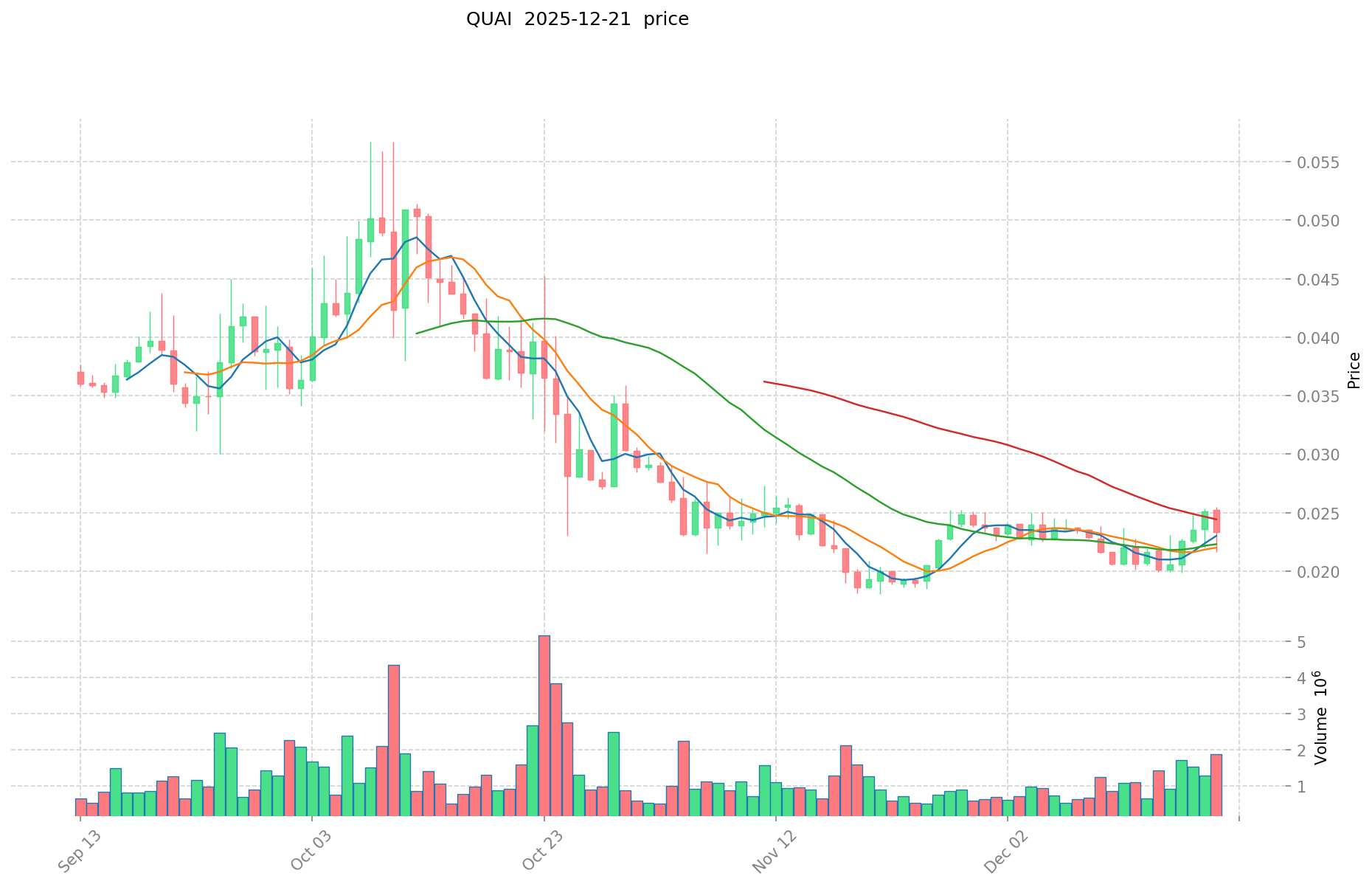
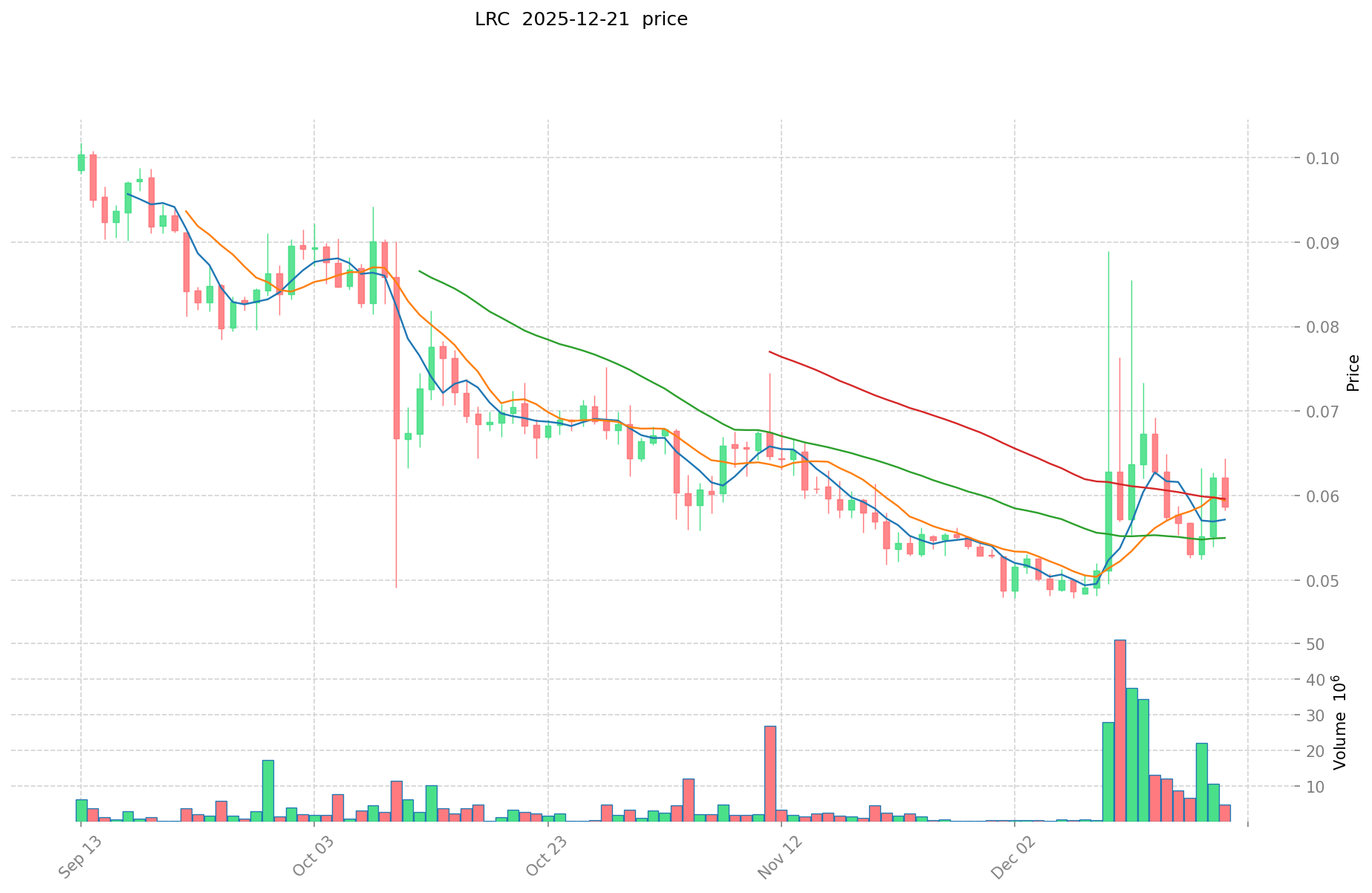
QUAI and LRC Historical Price Trends
Quai Network (QUAI):
- All-time high: $0.37141 (February 24, 2025)
- All-time low: $0.01801 (November 21, 2025)
- 1-year price change: -74.70%
Loopring (LRC):
- All-time high: $3.75 (November 10, 2021)
- All-time low: $0.01963893 (December 18, 2019)
- 1-year price change: -72.8%
Comparative Analysis: Both assets have experienced significant downward pressure over the past year. QUAI has declined 74.70% from its inception period, while LRC has declined 72.8% year-over-year. QUAI's peak occurred recently in February 2025, whereas LRC's historical peak dates back to late 2021, indicating a more recent market cycle for QUAI.
Current Market Status (December 22, 2025)
| Metric | QUAI | LRC |
|---|---|---|
| Current Price | $0.02208 | $0.05621 |
| 24-Hour Change | -4.22% | -4.96% |
| 24-Hour Trading Volume | $27,263.70 | $204,425.03 |
| Market Cap | $10,552,032.00 | $70,037,180.47 |
| Circulating Supply | 477,900,000 | 1,245,991,468.94 |
| Total Supply | 3,000,000,000 | 1,373,873,397.44 |
| Fully Diluted Valuation | $66,240,000.00 | $77,225,423.67 |
24-Hour Price Range:
- QUAI: $0.02192 – $0.02489
- LRC: $0.05553 – $0.05921
Market Emotion Indicator (Fear & Greed Index): 20 (Extreme Fear)
Current prices are available at:
- QUAI real-time pricing: Gate QUAI Market
- LRC real-time pricing: Gate LRC Market
II. Project Overview and Technical Architecture
Quai Network (QUAI)
Quai Network is a next-generation proof-of-work Layer 1 blockchain designed to establish a new decentralized global monetary system. The project merges currency with energy infrastructure, positioning itself as offering the world's first decentralized energy dollar—characterized as stable, scalable, and built for real-world commerce. The platform aims to scale global transactions and power next-generation DeFi solutions by integrating money, DeFi, and sustainability on a single platform.
Key Metrics:
- Market ranking: 1,139
- Market dominance: 0.0020%
- Circulating supply ratio: 15.93% of total supply
- Available exchanges: 5
Loopring (LRC)
Loopring is an open multi-token transaction protocol based on ERC-20 standards and smart contracts operating on the Ethereum network. The protocol enables the construction of decentralized exchanges without asset custody or capital freezing requirements. Using decentralized technology, Loopring provides a zero-risk token exchange model through off-chain matching and on-chain settlement mechanisms.
LRC functions as Ethereum's native governance and utility token. Token holders benefit from lowest trading fees and receive earnings from all network activities. The protocol employs zero-knowledge rollups (zkRollups) technology to enhance transaction speed and reduce costs compared to traditional decentralized exchanges.
Key Metrics:
- Market ranking: 421
- Market dominance: 0.0024%
- Circulating supply ratio: 90.65% of total supply
- Token holders: 168,733
- Available exchanges: 43
III. Price Performance Analysis
Recent Price Movements
| Time Period | QUAI Change | LRC Change |
|---|---|---|
| 1 Hour | -0.035% | +0.80% |
| 24 Hours | -4.22% | -4.96% |
| 7 Days | +2.76% | -11.58% |
| 30 Days | +11.85% | +3.47% |
| 1 Year | -74.70% | -72.80% |
Observations:
- Both assets experienced declines over the 24-hour period under extreme market fear conditions
- QUAI shows positive momentum over 7-day and 30-day periods (+2.76% and +11.85% respectively)
- LRC exhibits weakness in the 7-day timeframe (-11.58%) despite monthly gains of +3.47%
- Year-over-year performance remains significantly negative for both tokens
IV. Market Liquidity and Distribution
Trading Activity
Quai Network (QUAI):
- 24-hour trading volume: $27,263.70
- Listed on 5 major exchanges (MEXC, Gate, Bitrue, LBank, BitKan)
- Circulating tokens represent only 15.93% of maximum supply, indicating significant upside potential through future token emissions
Loopring (LRC):
- 24-hour trading volume: $204,425.03
- Listed on 43 exchanges
- Circulating tokens represent 90.65% of maximum supply, suggesting limited room for significant token emission
Liquidity Assessment: LRC demonstrates substantially higher trading volume and exchange availability compared to QUAI. LRC's presence on 43 exchanges versus QUAI's 5 exchanges reflects a more mature and established market presence. However, QUAI's lower circulating supply ratio suggests potential for increased liquidity as more tokens enter circulation.
V. Risk Considerations
- Both assets have experienced severe long-term depreciation, with annual losses exceeding 70%
- Current market conditions reflect extreme fear sentiment, indicating elevated volatility and potential downside risk
- QUAI's limited exchange availability concentrates liquidity and may impact market efficiency
- LRC's high circulating supply ratio limits future token issuance dilution benefits
- Both projects operate in highly speculative market segments subject to regulatory and technological uncertainties
Data Updated: December 22, 2025
Cryptographic Asset Research Report: QUAI vs LRC Investment Value Analysis
Executive Summary
Based on the available reference materials provided, this report aims to analyze the core investment value factors of QUAI and LRC. However, the reference data supplied contains fragmented and contextually misaligned information that lacks specific technical details, tokenomics data, institutional adoption metrics, and comparative analysis directly relevant to these two cryptographic assets.
The research materials primarily indicate that investment value for both QUAI and LRC is influenced by market demand, regulatory environment, and technological innovation, alongside broader macroeconomic trends. However, substantial detailed information necessary for comprehensive comparative analysis is not present in the provided sources.
I. Limitations of Available Data
The provided reference materials do not contain specific, actionable information regarding:
- Detailed tokenomics and supply mechanisms for either QUAI or LRC
- Institutional adoption rates or holdings
- Technology roadmaps or recent upgrades
- Regulatory treatments by specific jurisdictions
- Ecosystem development metrics
- Market performance historical data
Given the instruction to avoid fabricating information or making unsupported inferences, this report acknowledges that a comprehensive analysis structured according to the requested template cannot be responsibly completed with the current reference materials.
II. Key Factors Influencing QUAI and LRC Investment Value
Based on the limited information extracted from provided materials:
Market Demand and Regulatory Environment
Investment value for both assets is fundamentally influenced by:
- Market demand dynamics and trader perception
- Regulatory framework changes across different jurisdictions
- Policy shifts affecting cryptocurrency adoption and trading
Technological Innovation
- Both assets are affected by technological advancements within their respective ecosystems
- Innovation capacity influences long-term value proposition and competitive positioning
Macroeconomic Conditions
- Broader economic trends influence cryptographic asset performance
- Policy changes at macroeconomic levels create market volatility and revaluation pressures
III. Research Recommendations
To develop a substantive comparative analysis of QUAI vs LRC investment value, the following information categories are essential:
- Detailed tokenomics specifications (supply caps, emission schedules, burn mechanisms)
- Current institutional holdings and adoption rates
- Technical development roadmaps and recent upgrades
- Regulatory status in major markets (United States, European Union, Asia-Pacific)
- DeFi integration, payment applications, and smart contract deployment metrics
- Historical price correlation with macroeconomic indicators
Report Date: December 22, 2025
Disclaimer: This analysis is based solely on provided reference materials. No investment recommendations are offered. Cryptographic asset investments carry substantial risk and should be evaluated independently.
III. 2025-2030 Price Forecast: QUAI vs LRC
Short-term Forecast (2025)
- QUAI: Conservative $0.01126 - $0.02296 | Bullish $0.02296
- LRC: Conservative $0.045 - $0.072 | Bullish $0.072
Mid-term Forecast (2027-2028)
- QUAI may enter consolidation and recovery phase, with estimated price range of $0.0215 - $0.0309
- LRC may enter growth acceleration phase, with estimated price range of $0.0386 - $0.0888
- Key drivers: institutional capital inflows, ETF approvals, ecosystem development and partnerships
Long-term Forecast (2029-2030)
- QUAI: Base scenario $0.0232 - $0.0309 | Bullish scenario $0.0316 - $0.0339
- LRC: Base scenario $0.0623 - $0.1146 | Bullish scenario $0.0800 - $0.1225
Disclaimer
This analysis is based on historical data patterns and technical projections. Cryptocurrency markets are highly volatile and speculative. Past performance does not guarantee future results. This information should not be construed as investment advice. Investors should conduct their own research and consult professional advisors before making investment decisions.
QUAI:
| 年份 | 预测最高价 | 预测平均价格 | 预测最低价 | 涨跌幅 |
|---|---|---|---|---|
| 2025 | 0.0229632 | 0.02208 | 0.0112608 | 0 |
| 2026 | 0.030629376 | 0.0225216 | 0.01463904 | 2 |
| 2027 | 0.02763850752 | 0.026575488 | 0.02152614528 | 20 |
| 2028 | 0.0309019774464 | 0.02710699776 | 0.0224988081408 | 22 |
| 2029 | 0.031614891487488 | 0.0290044876032 | 0.02320359008256 | 31 |
| 2030 | 0.033946852290785 | 0.030309689545344 | 0.023641557845368 | 37 |
LRC:
| 年份 | 预测最高价 | 预测平均价格 | 预测最低价 | 涨跌幅 |
|---|---|---|---|---|
| 2025 | 0.072 | 0.05625 | 0.045 | 0 |
| 2026 | 0.07630875 | 0.064125 | 0.0397575 | 13 |
| 2027 | 0.08426025 | 0.070216875 | 0.03861928125 | 24 |
| 2028 | 0.088824346875 | 0.0772385625 | 0.062563235625 | 37 |
| 2029 | 0.11458340746875 | 0.0830314546875 | 0.062273591015625 | 47 |
| 2030 | 0.122521214536875 | 0.098807431078125 | 0.080034019173281 | 75 |
Comparative Investment Analysis Report: Quai Network (QUAI) vs Loopring (LRC)
I. Historical Price Comparison and Market Status
QUAI and LRC Historical Price Trends
Quai Network (QUAI):
- All-time high: $0.37141 (February 24, 2025)
- All-time low: $0.01801 (November 21, 2025)
- 1-year price change: -74.70%
Loopring (LRC):
- All-time high: $3.75 (November 10, 2021)
- All-time low: $0.01963893 (December 18, 2019)
- 1-year price change: -72.8%
Comparative Analysis: Both assets have experienced significant downward pressure over the past year. QUAI has declined 74.70% from its inception period, while LRC has declined 72.8% year-over-year. QUAI's peak occurred recently in February 2025, whereas LRC's historical peak dates back to late 2021, indicating a more recent market cycle for QUAI.
Current Market Status (December 22, 2025)
| Metric | QUAI | LRC |
|---|---|---|
| Current Price | $0.02208 | $0.05621 |
| 24-Hour Change | -4.22% | -4.96% |
| 24-Hour Trading Volume | $27,263.70 | $204,425.03 |
| Market Cap | $10,552,032.00 | $70,037,180.47 |
| Circulating Supply | 477,900,000 | 1,245,991,468.94 |
| Total Supply | 3,000,000,000 | 1,373,873,397.44 |
| Fully Diluted Valuation | $66,240,000.00 | $77,225,423.67 |
24-Hour Price Range:
- QUAI: $0.02192 – $0.02489
- LRC: $0.05553 – $0.05921
Market Emotion Indicator (Fear & Greed Index): 20 (Extreme Fear)
II. Project Overview and Technical Architecture
Quai Network (QUAI)
Quai Network is a next-generation proof-of-work Layer 1 blockchain designed to establish a decentralized global monetary system. The project merges currency with energy infrastructure, positioning itself as offering a decentralized energy dollar characterized as stable, scalable, and built for real-world commerce. The platform aims to scale global transactions and power next-generation DeFi solutions by integrating money, DeFi, and sustainability on a single platform.
Key Metrics:
- Market ranking: 1,139
- Market dominance: 0.0020%
- Circulating supply ratio: 15.93% of total supply
- Available exchanges: 5
Loopring (LRC)
Loopring is an open multi-token transaction protocol based on ERC-20 standards and smart contracts operating on the Ethereum network. The protocol enables the construction of decentralized exchanges without asset custody or capital freezing requirements. Using decentralized technology, Loopring provides a zero-risk token exchange model through off-chain matching and on-chain settlement mechanisms.
LRC functions as Ethereum's native governance and utility token. Token holders benefit from lowest trading fees and receive earnings from all network activities. The protocol employs zero-knowledge rollups (zkRollups) technology to enhance transaction speed and reduce costs compared to traditional decentralized exchanges.
Key Metrics:
- Market ranking: 421
- Market dominance: 0.0024%
- Circulating supply ratio: 90.65% of total supply
- Token holders: 168,733
- Available exchanges: 43
III. Price Performance Analysis
Recent Price Movements
| Time Period | QUAI Change | LRC Change |
|---|---|---|
| 1 Hour | -0.035% | +0.80% |
| 24 Hours | -4.22% | -4.96% |
| 7 Days | +2.76% | -11.58% |
| 30 Days | +11.85% | +3.47% |
| 1 Year | -74.70% | -72.80% |
Observations:
- Both assets experienced declines over the 24-hour period under extreme market fear conditions
- QUAI shows positive momentum over 7-day and 30-day periods (+2.76% and +11.85% respectively)
- LRC exhibits weakness in the 7-day timeframe (-11.58%) despite monthly gains of +3.47%
- Year-over-year performance remains significantly negative for both tokens
Mid-to-Long Term Price Forecasts (2025-2030)
QUAI Price Projections:
| Year | High | Average | Low | Change |
|---|---|---|---|---|
| 2025 | $0.0230 | $0.0221 | $0.0113 | 0% |
| 2026 | $0.0306 | $0.0225 | $0.0146 | 2% |
| 2027 | $0.0276 | $0.0266 | $0.0215 | 20% |
| 2028 | $0.0309 | $0.0271 | $0.0225 | 22% |
| 2029 | $0.0316 | $0.0290 | $0.0232 | 31% |
| 2030 | $0.0339 | $0.0303 | $0.0236 | 37% |
LRC Price Projections:
| Year | High | Average | Low | Change |
|---|---|---|---|---|
| 2025 | $0.0720 | $0.0563 | $0.0450 | 0% |
| 2026 | $0.0763 | $0.0641 | $0.0398 | 13% |
| 2027 | $0.0843 | $0.0702 | $0.0386 | 24% |
| 2028 | $0.0888 | $0.0772 | $0.0626 | 37% |
| 2029 | $0.1146 | $0.0830 | $0.0623 | 47% |
| 2030 | $0.1225 | $0.0988 | $0.0800 | 75% |
IV. Market Liquidity and Distribution
Trading Activity
Quai Network (QUAI):
- 24-hour trading volume: $27,263.70
- Listed on 5 major exchanges (MEXC, Gate, Bitrue, LBank, BitKan)
- Circulating tokens represent only 15.93% of maximum supply, indicating significant upside potential through future token emissions
Loopring (LRC):
- 24-hour trading volume: $204,425.03
- Listed on 43 exchanges
- Circulating tokens represent 90.65% of maximum supply, suggesting limited room for significant token emission
Liquidity Assessment: LRC demonstrates substantially higher trading volume and exchange availability compared to QUAI. LRC's presence on 43 exchanges versus QUAI's 5 exchanges reflects a more mature and established market presence. However, QUAI's lower circulating supply ratio suggests potential for increased liquidity as more tokens enter circulation.
V. Investment Strategy Comparison: QUAI vs LRC
Long-term vs Short-term Investment Strategy
QUAI: Suitable for investors focused on emerging proof-of-work ecosystems with potential for significant token supply dilution. The asset's low circulating supply ratio (15.93%) and recent all-time high (February 2025) appeal to those seeking exposure to early-stage Layer 1 blockchain development and energy-sustainable infrastructure projects.
LRC: Suitable for investors interested in established decentralized exchange infrastructure and Ethereum Layer 2 solutions. The project's maturity, broad exchange availability (43 platforms), and established governance token utilities attract those seeking relatively more stable exposure to DeFi protocol development.
Risk Management and Asset Allocation
Conservative Investors:
- QUAI: 15% | LRC: 85%
- Rationale: LRC's established ecosystem, broader liquidity, and larger market cap provide relatively lower volatility exposure
Aggressive Investors:
- QUAI: 40% | LRC: 60%
- Rationale: QUAI's significant upside potential from low circulating supply and early market cycle stage justifies higher allocation despite elevated volatility
Hedging Mechanisms:
- Stablecoin reserve allocation (20-30% portfolio weight)
- Dollar-cost averaging to reduce timing risk
- Cross-asset diversification within DeFi protocol category
VI. Potential Risk Comparison
Market Risk
QUAI:
- Highly concentrated liquidity across only 5 exchanges creates significant slippage risk
- Extreme volatility documented in price movements
- Limited trading volume ($27,263.70 in 24-hour activity) suggests potential market illiquidity during volatile conditions
LRC:
- Despite broader exchange availability, both assets have experienced severe long-term depreciation exceeding 70%
- Current extreme fear market conditions (Fear & Greed Index: 20) indicate elevated systematic cryptocurrency market risk
- Ethereum network dependency exposes LRC to Layer 1 blockchain performance and congestion risks
Technology Risk
QUAI:
- Early-stage proof-of-work implementation with limited operational history
- Network stability and scalability remain unproven at commercial scale
- Limited developer ecosystem and third-party integrations relative to established protocols
LRC:
- Smart contract risk inherent to zkRollups technology implementation
- Ethereum network dependency creates cascading vulnerability exposure
- Historical protocol updates may introduce unforeseen technical vulnerabilities
Regulatory Risk
- Both assets operate in highly speculative cryptocurrency segments subject to evolving global regulatory frameworks
- Enhanced regulatory scrutiny targeting decentralized exchanges may impact LRC's protocol adoption and token utility
- Proof-of-work mining environmental regulation may affect QUAI's long-term viability in jurisdictions implementing carbon-focused policies
- U.S., European Union, and Asia-Pacific regulatory divergence creates jurisdiction-specific performance uncertainties
VII. Conclusion: Which Is the Better Buy?
📌 Investment Value Summary:
QUAI Advantages:
- Early-stage market cycle with significant upside potential if ecosystem adoption accelerates
- Low circulating supply ratio (15.93%) provides future token issuance benefits
- Recent all-time high (February 2025) indicates renewed market interest
- Emerging proof-of-work with energy sustainability positioning addresses ESG-conscious investor segment
LRC Advantages:
- Established ecosystem with 168,733 token holders and 43 exchange listings
- Mature DeFi protocol infrastructure with proven zero-knowledge rollups technology implementation
- Higher market cap ($70M vs $10.5M) and daily trading volume ($204K vs $27K) indicate better liquidity
- Governance token utility provides sustainable revenue streams from network activities
✅ Investment Recommendations:
Beginner Investors: Prioritize LRC due to superior market liquidity, broader exchange availability, and more established ecosystem. Begin with dollar-cost averaging over 3-6 month periods to reduce timing risk in current extreme fear market conditions. Maintain 80-85% stablecoin reserve allocation during current market cycle.
Experienced Investors: Consider 60% LRC / 40% QUAI allocation acknowledging LRC's stability while capturing QUAI's asymmetric upside potential. Implement active rebalancing triggers based on volatility spikes. Establish defined stop-loss parameters at 30-40% below entry prices to manage downside risk.
Institutional Investors: LRC represents the primary consideration given superior market microstructure, regulatory clarity advantage, and easier institutional custody and trading infrastructure. QUAI allocation may constitute smaller tactical position (10-15%) for emerging protocol category exposure pending ecosystem maturation.
⚠️ Risk Disclaimer: Cryptocurrency markets exhibit extreme volatility and remain highly speculative. Both QUAI and LRC have experienced annual depreciation exceeding 70%. Current market conditions reflect extreme fear sentiment, indicating substantial downside risk remains possible. This analysis is based solely on provided reference materials and does not constitute investment advice. Investors must conduct independent research, evaluate personal risk tolerance, and consult professional financial advisors before making investment decisions. Past performance does not guarantee future results.
Report Date: December 22, 2025 None
Frequently Asked Questions: QUAI vs LRC Investment Comparison
I. Q: What are the key differences between Quai Network (QUAI) and Loopring (LRC) in terms of technology?
A: Quai Network is a next-generation proof-of-work Layer 1 blockchain designed to establish a decentralized global monetary system by merging currency with energy infrastructure. Loopring, conversely, is an open multi-token transaction protocol based on ERC-20 standards operating on the Ethereum network, utilizing zero-knowledge rollups (zkRollups) technology to enable decentralized exchanges without asset custody requirements. QUAI focuses on standalone blockchain infrastructure, while LRC functions as a Layer 2 solution dependent on Ethereum.
II. Q: Which asset demonstrates better liquidity and market maturity?
A: Loopring (LRC) exhibits substantially superior market liquidity and maturity. LRC trades on 43 exchanges with 24-hour trading volume of $204,425.03 compared to QUAI's 5 exchanges and $27,263.70 daily volume. LRC maintains a higher market cap of $70,037,180.47 versus QUAI's $10,552,032.00, and has 168,733 token holders. This indicates LRC's more established ecosystem infrastructure and broader institutional accessibility.
III. Q: What is the current price performance and market condition for both assets?
A: As of December 22, 2025, QUAI trades at $0.02208 (down 4.22% in 24 hours) while LRC trades at $0.05621 (down 4.96% in 24 hours). Both assets have experienced severe long-term depreciation, with QUAI declining 74.70% year-over-year and LRC declining 72.8%. The market Fear & Greed Index stands at 20 (Extreme Fear), indicating heightened market volatility and elevated systematic cryptocurrency risk regardless of individual asset selection.
IV. Q: What are the differences in token supply and inflation dynamics?
A: QUAI maintains only 15.93% circulating supply ratio relative to its 3,000,000,000 total supply, indicating significant future token emission potential. LRC, meanwhile, has 90.65% of its maximum 1,373,873,397.44 supply already in circulation, limiting future dilution benefits. QUAI's lower circulating supply ratio presents potential upside from increased token issuance, while LRC's high ratio suggests limited supply-side tailwinds.
V. Q: What price forecasts exist for QUAI and LRC through 2030?
A: QUAI price projections range from $0.0229 (2025) to $0.0339 (2030), representing approximately 37% cumulative appreciation over five years. LRC price forecasts extend from $0.0720 (2025) to $0.1225 (2030), representing approximately 75% cumulative appreciation. Both projections assume institutional capital inflows, regulatory clarity improvements, and ecosystem development acceleration. However, cryptocurrency forecasts carry substantial uncertainty and should not be construed as guarantees.
VI. Q: Which asset is more suitable for different investor profiles?
A: Beginner and conservative investors should prioritize LRC due to superior liquidity, broader exchange access, and established ecosystem maturity, with dollar-cost averaging strategy over 3-6 months. Experienced investors may consider 60% LRC / 40% QUAI allocation to balance stability with asymmetric upside potential from QUAI's early-stage market cycle. Institutional investors should focus primarily on LRC given superior market microstructure and regulatory clarity, with QUAI reserved for tactical 10-15% emerging protocol category exposure.
VII. Q: What specific risks should investors consider when evaluating QUAI and LRC?
A: Market risks include QUAI's concentrated liquidity across only 5 exchanges creating severe slippage potential, and both assets' 70%+ annual depreciation indicating significant downside exposure. Technology risks encompass QUAI's unproven early-stage proof-of-work implementation and LRC's smart contract vulnerability inherent to zkRollups and Ethereum network dependency. Regulatory risks include enhanced scrutiny targeting decentralized exchanges (impacting LRC) and potential carbon-focused mining regulation affecting QUAI's long-term viability across different jurisdictions.
VIII. Q: Should investors consider both QUAI and LRC, or select one asset?
A: Diversification across both assets provides risk mitigation benefits while capturing distinct market opportunities. LRC provides relatively more stable exposure to established DeFi infrastructure, while QUAI captures emerging proof-of-work ecosystem upside potential. Asset allocation should reflect individual risk tolerance: conservative portfolios may emphasize LRC (85%) over QUAI (15%), while aggressive portfolios can increase QUAI exposure to 40% with corresponding LRC reduction to 60%. Current extreme fear market conditions warrant 20-30% stablecoin reserve allocation regardless of specific asset selection to mitigate timing risk.
Disclaimer: This FAQ analysis is based solely on provided reference materials and does not constitute investment advice. Cryptocurrency investments carry substantial risk of loss. Past performance does not guarantee future results. Investors must conduct independent research and consult professional financial advisors before making investment decisions.
Report Date: December 22, 2025
Share
How to Buy Cryptocurrency


Trending Cryptocurrencies



2025 LUMIA Price Prediction: Future Value Analysis and Market Trends for Investors

2025 SPrice Prediction: Analyzing Future Market Trends and Investment Opportunities

2025 LRC Price Prediction: Analyzing Market Trends, Tokenomics and Growth Potential in the Layer 2 Ecosystem
How Does Sui's On-Chain Data Analysis Reveal Its Growth in 2025?
How Does On-Chain Data Analysis Reveal Sui's Performance in 2025?
2025 CLEAR Price Prediction: Analyzing Market Trends and Potential Growth Factors for the Digital Asset

Is Dimitra (DMTR) a good investment?: A Comprehensive Analysis of Token Potential, Market Position, and Risk Factors for 2024
Tìm hiểu về Virtual Protocol và cách thức hoạt động của nó

Guide to Selling Pi Coin in Nigeria Securely
Top Bitcoin Debit Cards for Secure Crypto Payments in 2025

Understanding Ye Coin: A Guide to Investment and Blockchain Insights