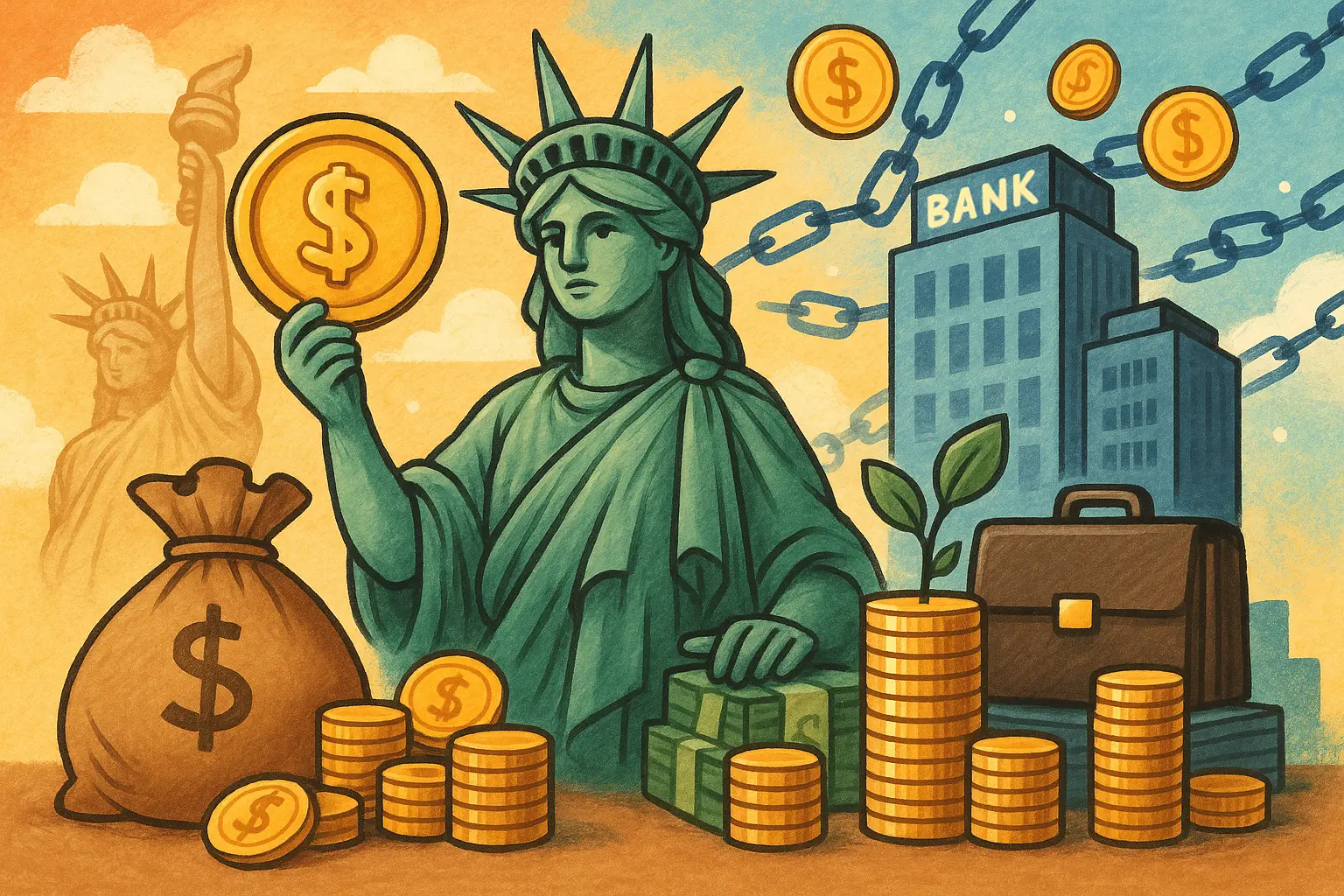
World Liberty Financial launches the World Liberty Markets lending platform, with a core stablecoin USD1 circulating at $3.4 billion. Smart contracts manage loans, allowing users to collateralize ETH, BTC to borrow USD1. The platform supports cryptocurrencies and stablecoins, plans to incorporate RWA, and has applied for OCC licensing.
USD1 Stablecoin: From Payment Tool to Lending Core
World Liberty Financial is a new player in the decentralized finance (DeFi) space. The project is associated with the Trump family in the United States and entered the crypto lending market through the launch of World Liberty Markets. World Liberty Markets is an on-chain lending platform centered around the project’s USD1 stablecoin backed by the US dollar. Currently, USD1 has a circulating supply of about $3.4 billion. The project positions the stablecoin as a payment tool while also making it a key component of a blockchain-based credit market.
Before launching the lending program, USD1 was already used for cross-border transfers, focusing on the financial operations of crypto companies, and liquidity pools on decentralized exchanges. The rapid growth of USD1 supply indicates it is not only used as a trading pair but also as a settlement asset for broader financial activities. This liquidity is now expanding into on-chain credit markets via World Liberty Markets. The growth from 0 to $3.4 billion is astonishing, showing strong market demand for the stablecoin endorsed by the Trump family.
USD1 plays a central role in the World Liberty ecosystem. Users can provide volatile assets such as Ethereum (ETH) or tokenized Bitcoin (BTC) and borrow USD1, gaining liquidity without selling these assets. This model is similar to traditional secured loans, where borrowers collateralize assets for cash, but it operates entirely on blockchain systems. Stablecoin-based lending also supports advanced financial activities, including leverage trading, hedging strategies, and funding for crypto-focused enterprises.
Three Main Functions of USD1 in the World Liberty Ecosystem
Payment Tool: Settlement currency for cross-border transfers and daily transactions
Lending Core: Main lending currency and valuation unit for the platform
Liquidity Asset: Underlying asset for DEX trading pairs and DeFi protocols
Stablecoins play a crucial role in crypto lending markets because they provide a stable accounting unit, are less volatile compared to crypto collateral, and facilitate easier integration of payments and off-chain finance. World Liberty’s choice to build its own stablecoin instead of using USDT or USDC may be to maintain ecosystem control and earn issuance revenue from stablecoin issuance (by investing reserves in government bonds and earning interest).
Smart Contract Lending Replaces Centralized Intermediaries
The core of World Liberty Markets is a collateralized loan marketplace. Users deposit assets into asset pools, which are available for borrowers. The value of collateral must exceed the loan amount to protect lenders from default risk. The platform uses smart contracts to manage loan terms, replacing centralized intermediaries with transparent, automated risk control visible on the blockchain.
The platform supports a decentralized system for the supply and demand of credit. Its structure is similar to existing DeFi lending protocols like Aave and Compound, with USD1 as the central liquidity asset. Loan terms, collateral ratios, and liquidation thresholds are enforced by automated smart contracts, not relying on off-chain balance sheets or manual approval. Risk parameters are directly visible on the blockchain, accessible and verifiable by anyone.
Supported collateral includes Ethereum (ETH), tokenized Bitcoin (BTC), and stablecoins such as USDC and USD1. Interest rates fluctuate based on supply and demand within each asset pool. When collateral value falls below a set threshold, automatic liquidation may occur to maintain solvency. In DeFi, interest rates change block-by-block, meaning borrowing costs can update every few seconds on faster blockchains. This differs from traditional loans, where interest rates are often fixed for months or years.
World Liberty has also announced plans to support tokenized real-world assets (RWA), allowing tokens linked to real estate or treasury bonds to be used as collateral. If implemented, this would expand on-chain credit beyond purely crypto-native markets. RWA integration is part of World Liberty’s long-term vision but presents challenges related to asset verification, legal enforceability, and cross-border regulation.
OCC License Application and Regulatory Compliance Strategy
Before launching its lending operations, World Liberty applied for a national trust bank license from the U.S. Office of the Comptroller of the Currency (OCC). While approval is not guaranteed, this application demonstrates a long-term strategy focused on regulatory compliance. If approved, such a license could enable World Liberty Financial to offer custodial services, combine stablecoin issuance with regulated financial activities, and facilitate partnerships with traditional payment systems.
This approach reflects a broader shift in the crypto industry toward seeking regulated structures rather than operating entirely outside traditional finance. Regulatory clarity around stablecoins and digital asset custody in the U.S. and elsewhere reduces uncertainty for institutions and rekindles interest in blockchain-based credit systems.
The previous failures of crypto lending markets, such as BlockFi and Celsius, were mainly due to excessive leverage by centralized entities, unclear risk controls, and rehypothecation of customer assets. These cases highlight risks inherent in centralized lending models, not flaws in blockchain technology itself. In contrast, DeFi protocols operate with clear collateral ratios, transparent liquidation procedures, and real-time solvency checks. World Liberty Markets adopts this transparent DeFi model.
Despite growing interest in on-chain lending, risks remain, including smart contract vulnerabilities, market shocks triggering rapid liquidations, regulatory uncertainties around stablecoin reserves, and liquidity concentration in a few assets. Some DeFi lending protocols can execute liquidations within seconds—faster than many traditional exchanges pause trading. During volatile crypto markets, automated bots often perform these liquidations swiftly.
While over-collateralization reduces default risk, it also limits access to loans for users with smaller crypto holdings. Currently, on-chain credit mainly serves existing asset holders seeking to improve capital efficiency rather than promoting financial inclusion. Supporting tokenized RWAs could broaden on-chain credit scope but also introduces challenges related to asset verification, legal enforceability, and cross-border regulation.
Disclaimer: The information on this page may come from third parties and does not represent the views or opinions of Gate. The content displayed on this page is for reference only and does not constitute any financial, investment, or legal advice. Gate does not guarantee the accuracy or completeness of the information and shall not be liable for any losses arising from the use of this information. Virtual asset investments carry high risks and are subject to significant price volatility. You may lose all of your invested principal. Please fully understand the relevant risks and make prudent decisions based on your own financial situation and risk tolerance. For details, please refer to
Disclaimer.
Related Articles
Scallop Protocol Exploit Drains 150,000 SUI Tokens on April 28
According to the Sui Foundation and Scallop developers, the Scallop lending protocol on the Sui network experienced a targeted security exploit on April 28, 2026, resulting in the unauthorized drainage of approximately 150,000 SUI tokens from a rewards liquidity pool, valued at around $140,000.
GateNews16m ago
RWA Trading Platform BRIC Opens Mainnet Whitelist Registration Today
According to ChainCatcher, RWA trading platform BRIC officially opened mainnet whitelist registration today. Early-bird participants will receive priority access to the mainnet launch, along with benefits including trading fee discounts, future ecosystem rewards, and notifications for new asset list
GateNews27m ago
WLFI Token Falls 13% as World Liberty Opens 62B-Token Unlock Governance Vote
According to The Block, World Liberty Financial officially opened voting today on a controversial governance proposal to unlock 62 billion WLFI tokens, with the token falling 13% to $0.064 from $0.073 ahead of the vote.
The proposal would release tokens subject to a two-year cliff and vesting
GateNews42m ago
Visa Expands Stablecoin Pilot to 9 Blockchains, Reaches $7B Annualized Settlement Run Rate
Visa has expanded its stablecoin settlement pilot to nine blockchains, including Polygon, Base, Canton Network, Arc and Tempo, alongside previously supported networks such as Ethereum, Solana, Avalanche and Stellar. The programme has reached a US$7 billion annualized run rate, representing 50%
GateNews1h ago
PayPal reorganizes its three business segments, with cryptocurrency and PYUSD listed as core departments
PayPal officially announced a strategic reorganization on April 30, simplifying its business structure into three main core segments: checkout solutions and PayPal, consumer finance services and Venmo, and payment services and crypto; within this, the payment services and crypto segment was established separately, integrating Braintree, SMB processing, value-added services, and crypto business (including the stablecoin PYUSD).
MarketWhisper2h ago
OKX Launches Agent Payments Protocol for AI Bot Commerce
Crypto exchange OKX introduced its Agent Payments Protocol (APP) on Wednesday, an open standard designed to enable AI agents to conduct full business cycles including payments, negotiations, and dispute resolution. The protocol follows similar offerings from competitors including x402, incubated by
CryptoFrontier3h ago


