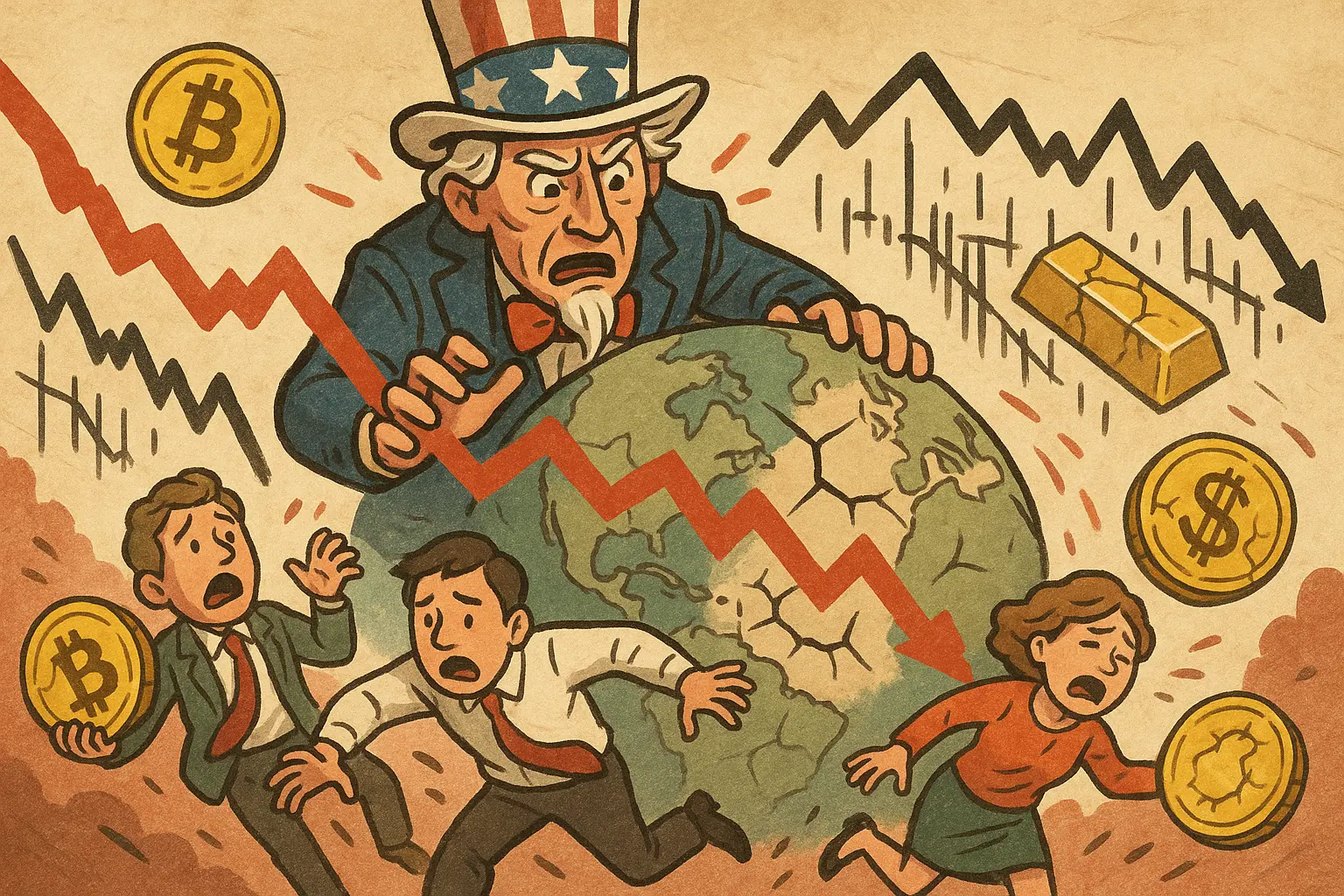
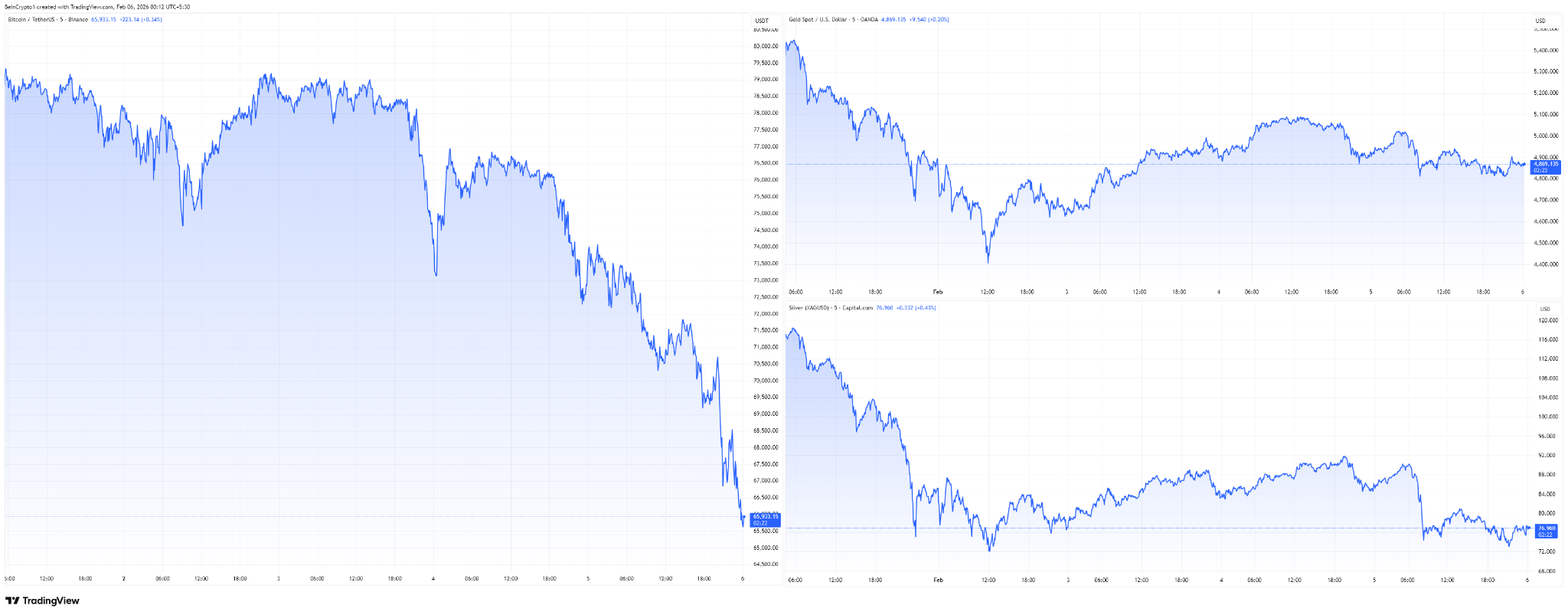
Global markets are experiencing a synchronized sell-off, with crypto stocks, gold, and silver all falling simultaneously, indicating liquidity shocks rather than individual asset weakness. Bitcoin leads the decline, with gold and silver experiencing their largest weekly drops in months. The Federal Reserve paused quantitative tightening (QT) in December to stabilize bank reserves but did not cut interest rates or encourage risk-taking. U.S. job openings decreased, hiring slowed, layoffs increased, consumer confidence hit a 2014 low, yet unemployment remains low and inflation has not declined, trapping the economy in a dual dilemma of growth slowdown and a tight monetary environment.
Liquidity Exhaustion Triggers Mechanical Liquidation
(Source: Trading View)
Under normal circumstances, tensions in the crypto market tend to push capital into gold or cash. However, this time, investors sold all assets they could. This pattern typically occurs during deleveraging events. Traders facing margin calls will first sell liquid assets, including Bitcoin, gold, and silver. This type of sell-off is mechanical, not driven by ideology.
The global market crash this week was not because investors suddenly lost faith in crypto or gold, but because they needed cash. When leverage in banks or hedge funds triggers margin calls, they must raise cash quickly or face forced liquidation. In such emergencies, long-term asset values are irrelevant; liquidity is the only concern. Although Bitcoin, gold, and silver differ in nature, all are highly liquid and can be liquidated within hours, making them the preferred assets to sell.
Crypto assets declined more sharply because they sit at the bottom of the liquidity hierarchy. When deleverage occurs, cryptocurrencies are sold first. Data on Bitcoin derivatives shows that long positions have been increasing over the past few weeks. As prices fall, liquidations accelerate. Meanwhile, ETF inflows slow, reducing demand. The combination of “buying disappearing and selling surging” creates a waterfall decline.
Order of Liquidation by Liquidity Hierarchy
First layer: Cryptocurrencies (high liquidity but volatile, first to be sacrificed)
Second layer: Gold and silver (traditional safe havens but still need to be liquidated for cash)
Third layer: Stocks (especially overvalued tech stocks)
Last layer: Core safe assets like U.S. Treasuries (usually not sold, or even increased)
Why do gold and silver fall along with crypto? Despite increased uncertainty, investors need cash, so gold and silver prices also decline. Earlier this year, these assets surged strongly, making them convenient liquidity sources. Additionally, real yields remain high, and the dollar strengthened during the sell-off. These factors together eroded short-term support for precious metals.
Why the Fed’s Pause on QT Is Ineffective
(Source: Johns Hopkins)
The core of this turmoil lies in the chaos of U.S. monetary conditions. The Federal Reserve paused quantitative tightening (QT) last December and began purchasing short-term government bonds to stabilize bank reserves. By halting QT, the Fed stopped actively draining cash from the financial system. For banks, this means reserve levels are no longer declining. For households and businesses, it reduces the risk of sudden liquidity pressures in the banking system.
Through purchasing short-term government debt, the Fed ensures banks have enough cash to meet daily financing needs and keeps money markets stable. These measures aim to maintain normal financial system functioning, not to influence market prices. They neither lower consumer borrowing costs nor mortgage rates, nor do they encourage risk-taking. Long-term interest rates remain high, and the financial environment remains tight.
Therefore, markets interpret this move as potential stress rather than relief. Pausing QT and buying bonds, historically, has been seen as easing, boosting risk assets. But this time, the market reaction is the opposite: investors see it as “worse than expected, the Fed has to step in to stabilize the financial system.” This negative interpretation reflects fragile market confidence, where any policy action can be misread as a crisis signal.
The key issue is that stopping QT supports the financial system, not risk assets or borrowing costs. Increased bank reserves do not automatically translate into more business loans or consumer spending. When economic outlooks are uncertain, banks tend to hold cash rather than lend, and firms and consumers prefer debt repayment over new borrowing for investment or consumption. This “liquidity trap” prevents the Fed’s actions from transmitting to the real economy.
Dual Dilemma of Slowing Employment and Sticky Inflation
Employment data has not provided clear guidance but has increased pressure. This week’s U.S. labor market data heightened uncertainty. Job openings continued to decline, recruitment slowed, layoffs rose, and consumer confidence hit its lowest since 2014. These indicators show the economy is decelerating but not in recession—caught in a limbo of “neither dead nor alive.”
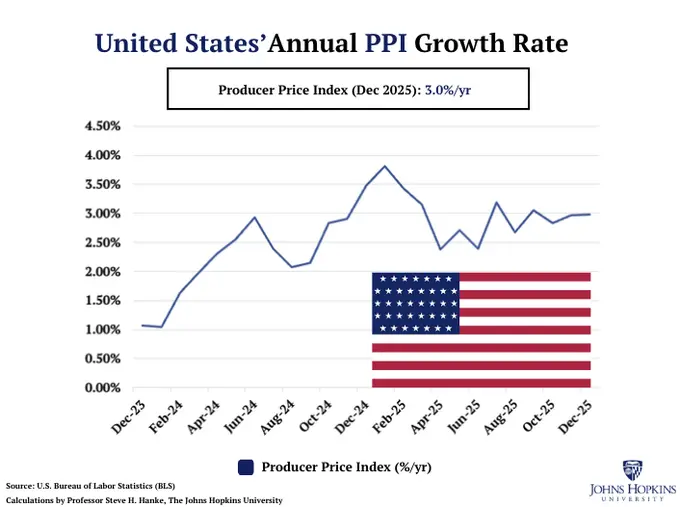
Meanwhile, unemployment remains relatively low, and inflation has not cooled enough to justify rapid rate cuts. This creates a dual dilemma: slowing growth and tightening financial conditions. The Fed faces a dilemma: lowering rates to counteract slowdown risks reigniting inflation; maintaining high rates to fight inflation risks causing recession. This policy deadlock is the least desirable scenario, as it implies prolonged uncertainty.
The past two weeks’ movements reflect a common theme: markets have prematurely priced in easing conditions. Liquidity expansion has been insufficient to support these expectations. As a result, risk assets have synchronized in a correction. This reset repositions crypto, stocks, and commodities. Though painful, it may be necessary. When markets are overly optimistic and valuations inflated, adjustments are needed to restore rationality.
This Is Not a Crypto Crisis, But a Systemic Liquidity Crisis
This sell-off does not mean Bitcoin or gold as long-term hedges have failed. It reflects a short-term liquidity crunch, which often occurs before policy or macroeconomic clarity emerges. Driven by liquidity stress rather than asset-specific weakness, crypto, gold, and stocks are forced to deleverage and sell off in unison.
The market remains fragile. Until liquidity expectations stabilize or economic data clearly deteriorate, volatility may persist. For investors, the key is not to judge the long-term value of Bitcoin or gold but to assess whether they can withstand ongoing volatility and potential margin calls. If using leverage, the current environment is extremely risky—reducing leverage or deleveraging is advisable. If holding spot positions, evaluate your time horizon: long-term investors might see this as an opportunity; short-term traders or those needing liquidity should consider reducing holdings.
U.S. labor market weakness combined with no rate cuts has led to a scenario of slowing growth and still-tight financial conditions, intensifying market volatility. This “stagflation prelude” environment is unfavorable for all assets; holding cash may be the safest strategy for now.


