


Futures
Access hundreds of perpetual contracts
TradFi
Gold
One platform for global traditional assets
Options
Hot
Trade European-style vanilla options
Unified Account
Maximize your capital efficiency
Demo Trading
Futures Kickoff
Get prepared for your futures trading
Futures Events
Join events to earn rewards
Demo Trading
Use virtual funds to experience risk-free trading
Launch
CandyDrop
Collect candies to earn airdrops
Launchpool
Quick staking, earn potential new tokens
HODLer Airdrop
Hold GT and get massive airdrops for free
Launchpad
Be early to the next big token project
Alpha Points
Trade on-chain assets and earn airdrops
Futures Points
Earn futures points and claim airdrop rewards





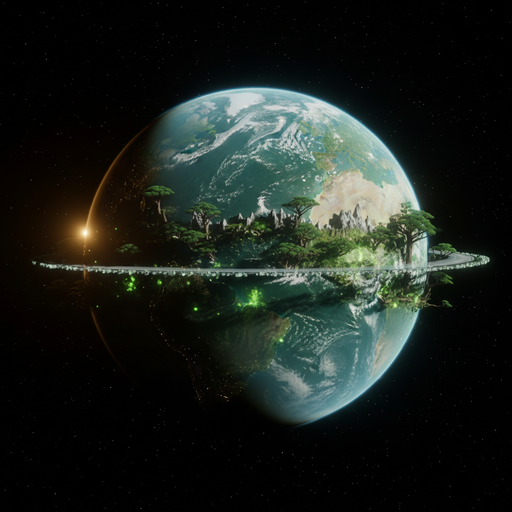
When Will Earth End? Scientists Project Timeline Beyond a Billion Years
The question of when humanity’s home planet will become uninhabitable has long fascinated researchers and philosophers alike. Now, according to NASA and scientific research conducted at Japanese academic institutions, we have a surprisingly specific answer. Earth could reach the point of becoming completely uninhabitable around the year 1,000,002,021 — roughly one billion years from now. While this timeline may seem almost incomprehensibly distant, the mechanisms driving this fate are already set in motion and warrant our attention today.
The Sun’s Expansion: Earth’s Greatest Long-Term Threat
Contrary to popular belief, our planet’s ultimate demise won’t result from an asteroid collision. Instead, the primary threat originates from the celestial body closest to us — the sun. Over the coming billion years, our star will continue its natural evolutionary cycle, growing progressively hotter and larger. Eventually, this expansion will intensify to such a degree that Earth’s oceans will evaporate completely, leaving behind a scorched, barren wasteland incapable of supporting any form of life.
Current climate phenomena such as global warming and greenhouse gas accumulation offer early glimpses of this trajectory. While these present-day challenges stem from human activity, they foreshadow the far more dramatic thermal transformation that solar evolution will impose on our planet. The difference is a matter of timescale — centuries versus billions of years — but the direction remains the same.
Solar Activity Observations: Recent Warnings From NASA
Beyond the distant threat of solar expansion, recent research has identified more immediate concerns. In the years following 2024, NASA documented powerful solar events including intense solar flares and coronal mass ejections — sudden bursts of electromagnetic energy from the sun’s surface. These phenomena can significantly disrupt Earth’s upper atmosphere, potentially lower oxygen concentrations, and accelerate planetary warming in shorter timeframes.
These observations underscore that the sun’s influence on our world operates across multiple timescales. While the long-term evolutionary transformation spans eons, the shorter-term fluctuations in solar activity present measurable impacts within human lifespans. This duality demands that humanity prepare for both immediate challenges and distant horizons.
Mars as Humanity’s Backup Plan: The SpaceX Vision
With Earth’s ultimate fate sealed by cosmological processes, scientists and entrepreneurs increasingly focus on securing humanity’s survival through extraplanetary settlement. Mars has emerged as the leading candidate for establishing an alternative human habitat. SpaceX, under Elon Musk’s direction, has made Mars colonization central to its mission, with Musk frequently stating that enabling human settlement on Mars would represent his most significant life achievement.
However, transitioning to Martian existence presents extraordinary obstacles. The financial investment required would be measured in hundreds of billions of dollars. The technological hurdles remain formidable, and the psychological and physical challenges of creating a functioning society on an alien world are nearly as daunting as the technical ones.
Technology and Artificial Habitats: Our Best Hope
Rather than abandoning Earth before its natural terminus, some researchers propose that advanced technology could enable humanity to persist through artificial containment systems. Engineered habitats equipped with climate control, water recycling, and food production systems might allow populations to thrive even as the external environment becomes hostile. Such enclosed ecosystems could theoretically sustain human civilization for extended periods despite planetary degradation.
Yet fundamental questions persist: How long can humanity truly survive in artificial environments divorced from nature’s processes? Can artificial systems remain functional and maintainable across centuries or millennia? These uncertainties reveal the philosophical boundaries of our technological ambitions.
Today’s Choices Shape Tomorrow’s Reality
While contemplating a timeline spanning a billion years might seem abstract or irrelevant to contemporary concerns, the reality demands reconsideration. The decisions humanity makes now — regarding climate change mitigation, technological development, space exploration investment, and resource stewardship — collectively determine whether future generations inherit either a dying Earth or pathways to continued survival elsewhere. The endpoint of Earth’s habitability may lie in the distant future, but the timeline for meaningful action is measured in decades. This paradox defines the central challenge of our era.