

Trade
Basic
Futures
Futures
Hundreds of contracts settled in USDT or BTC
TradFi
Gold
Trade global traditional assets with USDT in one place
Options
Hot
Trade European-style vanilla options
Unified Account
Maximize your capital efficiency
Demo Trading
Futures Kickoff
Get prepared for your futures trading
Futures Events
Participate in events to win generous rewards
Demo Trading
Use virtual funds to experience risk-free trading
Earn
Launch
CandyDrop
Collect candies to earn airdrops
Launchpool
Quick staking, earn potential new tokens
HODLer Airdrop
Hold GT and get massive airdrops for free
Launchpad
Be early to the next big token project
Alpha Points
Trade on-chain assets and enjoy airdrop rewards!
Futures Points
Earn futures points and claim airdrop rewards
Investment
Simple Earn
Earn interests with idle tokens
Auto-Invest
Auto-invest on a regular basis
Dual Investment
Buy low and sell high to take profits from price fluctuations
Soft Staking
Earn rewards with flexible staking
Crypto Loan
0 Fees
Pledge one crypto to borrow another
Lending Center
One-stop lending hub
VIP Wealth Hub
Customized wealth management empowers your assets growth
Private Wealth Management
Customized asset management to grow your digital assets
Quant Fund
Top asset management team helps you profit without hassle
Staking
Stake cryptos to earn in PoS products
Smart Leverage
New
No forced liquidation before maturity, worry-free leveraged gains
GUSD Minting
Use USDT/USDC to mint GUSD for treasury-level yields

More


Trending Topics
View More79.56K Popularity
6.4K Popularity
1.92K Popularity
2.95K Popularity
7.42K Popularity



Pin
System Imbalance Under New Stock Market Highs: Multiple Signals Reveal Hidden Risks
Recently, the stock market has hit record highs, but several technical indicators are sending mixed signals. When the S&P 500 first broke through the 7,000-point threshold, a thought-provoking phenomenon emerged—the most sensitive warning signals in the market are flashing.
This contradiction between superficial prosperity and hidden risks is raising alertness among professional investors. The steady climb of stock indices seems to be at odds with the true underlying fundamentals.
Contradictory Signals Behind the New Highs in Stock Indices
The breakthrough of the S&P 500 past 7,000 points is indeed a historic milestone worth noting. However, a closer look at weekly and daily charts reveals an unsettling trend—bear market divergence is gradually forming. The movements of Nasdaq and Dow Jones are similarly concerning; although they are nominally high, their underlying momentum is weakening.
Auxiliary technical analysis indicators (including momentum metrics, volume analysis, and multi-dimensional assessment tools) are already hinting at a market losing its strength. The convergence of these signals paints a worrying picture—the market is masking declining internal strength with rising prices.
False Prosperity Driven by Dollar Depreciation
What truly warrants attention is that gold (PAXG) is also reaching new highs. These two assets, which typically move inversely, are advancing together, defying basic market logic. The only explanation behind this is the ongoing depreciation of the US dollar.
When the dollar weakens, all dollar-pegged assets theoretically appreciate accordingly—this explains why stocks and gold can rise simultaneously. This synchronicity itself is a systemic risk signal. The Federal Reserve’s decision to keep interest rates unchanged, in this context, appears particularly perplexing.
Historical Warnings and Present Risks
The market crash during the 2008 mortgage crisis bears a striking resemblance to the current scenario—prices are artificially maintained at high levels, liquidity is repeatedly injected, yet fundamentals continue to deteriorate. That crisis inflicted deep wounds on the global economy, and history often repeats itself in more severe forms.
The longer the market is supported by various policies “lifting” it, the greater the potential decline. A 30-60% correction might be a conservative estimate. As investor Michael Burry has said, while market crashes can be predicted, “the trend will turn before your funds are exhausted”—a reminder that accurate judgment and patience are indispensable.
The Dilemma of Crypto Asset Correlation
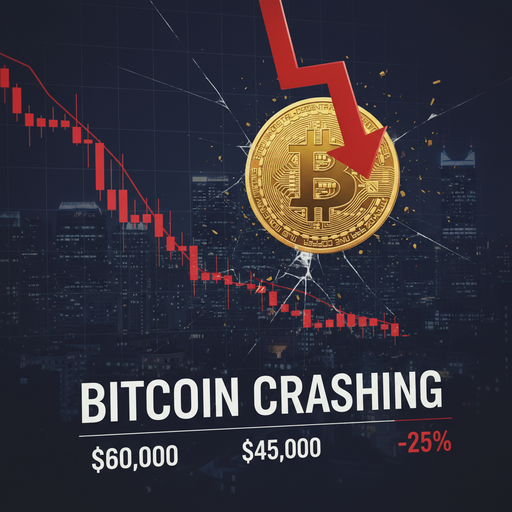
Bitcoin’s latest movements further confirm this point. When BTC declines in tandem with the dollar, it prompts deeper reflection on the true valuation of crypto assets. (Data as of February 5, 2026: BTC at $71,450, down 7.27% in 24 hours) Is crypto truly establishing an independent value foundation, or is it merely an extension of dollar substitutes? This question is becoming increasingly urgent.
The trajectories of gold, stocks, and crypto assets are all influenced by the dollar’s depreciation. When this correlation determines the direction of all assets, the market’s ability to price assets accurately comes into question.
The Dilemma of Protecting Risk Assets
In such a market environment, investors face a dilemma. Precious metals are traditional hedging tools, but during a real crisis, gold and other assets often sell off simultaneously—at which point, gold prices may be high, but liquidity is at its worst.
There is no certainty about when the market will crash; it could be tomorrow or years from now. But what is certain is that this imbalance cannot last forever. Multi-layered technical divergences, systemic dollar depreciation, and increasingly intangible asset valuations have combined into a complex and dangerous situation.
In this period of uncertainty, deep market observation and cautious attitude are more valuable than any aggressive prediction.