

Trade
Basic
Futures
Futures
Hundreds of contracts settled in USDT or BTC
TradFi
Gold
Trade global traditional assets with USDT in one place
Options
Hot
Trade European-style vanilla options
Unified Account
Maximize your capital efficiency
Demo Trading
Futures Kickoff
Get prepared for your futures trading
Futures Events
Participate in events to win generous rewards
Demo Trading
Use virtual funds to experience risk-free trading
Earn
Launch
CandyDrop
Collect candies to earn airdrops
Launchpool
Quick staking, earn potential new tokens
HODLer Airdrop
Hold GT and get massive airdrops for free
Launchpad
Be early to the next big token project
Alpha Points
Trade on-chain assets and enjoy airdrop rewards!
Futures Points
Earn futures points and claim airdrop rewards
Investment
Simple Earn
Earn interests with idle tokens
Auto-Invest
Auto-invest on a regular basis
Dual Investment
Buy low and sell high to take profits from price fluctuations
Soft Staking
Earn rewards with flexible staking
Crypto Loan
0 Fees
Pledge one crypto to borrow another
Lending Center
One-stop lending hub
VIP Wealth Hub
Customized wealth management empowers your assets growth
Private Wealth Management
Customized asset management to grow your digital assets
Quant Fund
Top asset management team helps you profit without hassle
Staking
Stake cryptos to earn in PoS products
Smart Leverage
New
No forced liquidation before maturity, worry-free leveraged gains
GUSD Minting
Use USDT/USDC to mint GUSD for treasury-level yields

More


# BTCMiningDifficultyDrops
2.51K
Crypto_Exper
#BTCMiningDifficultyDrops
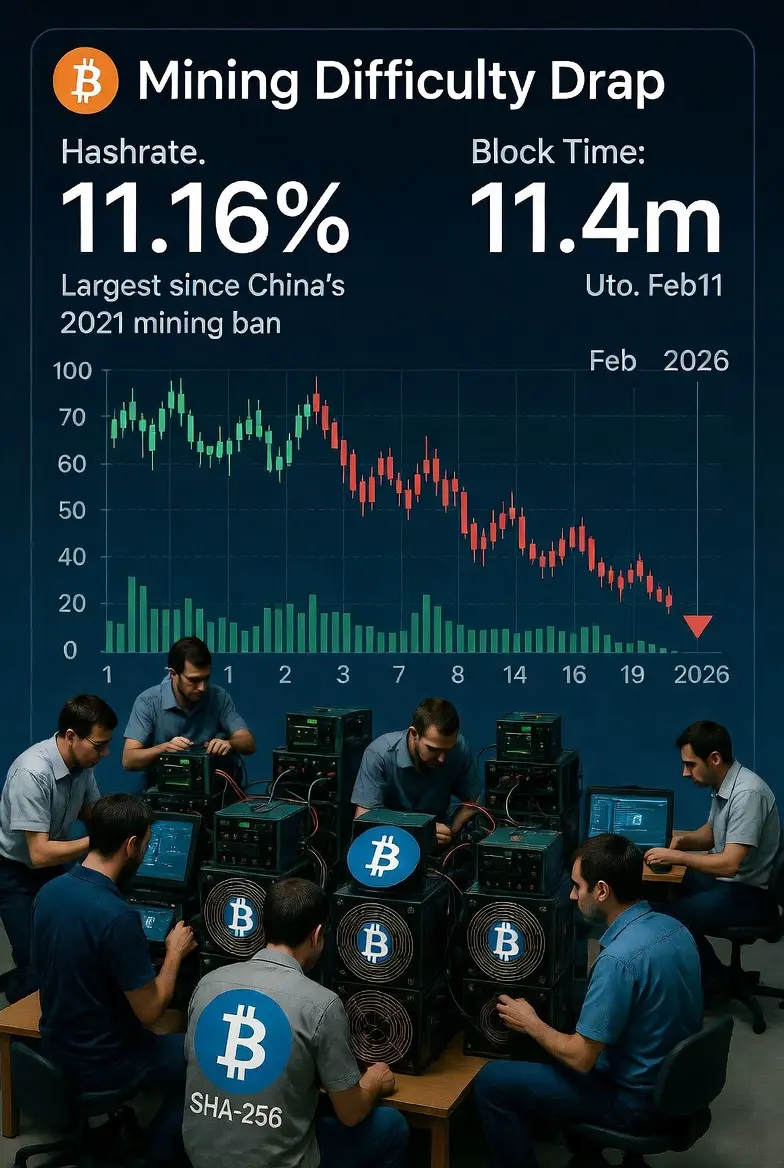
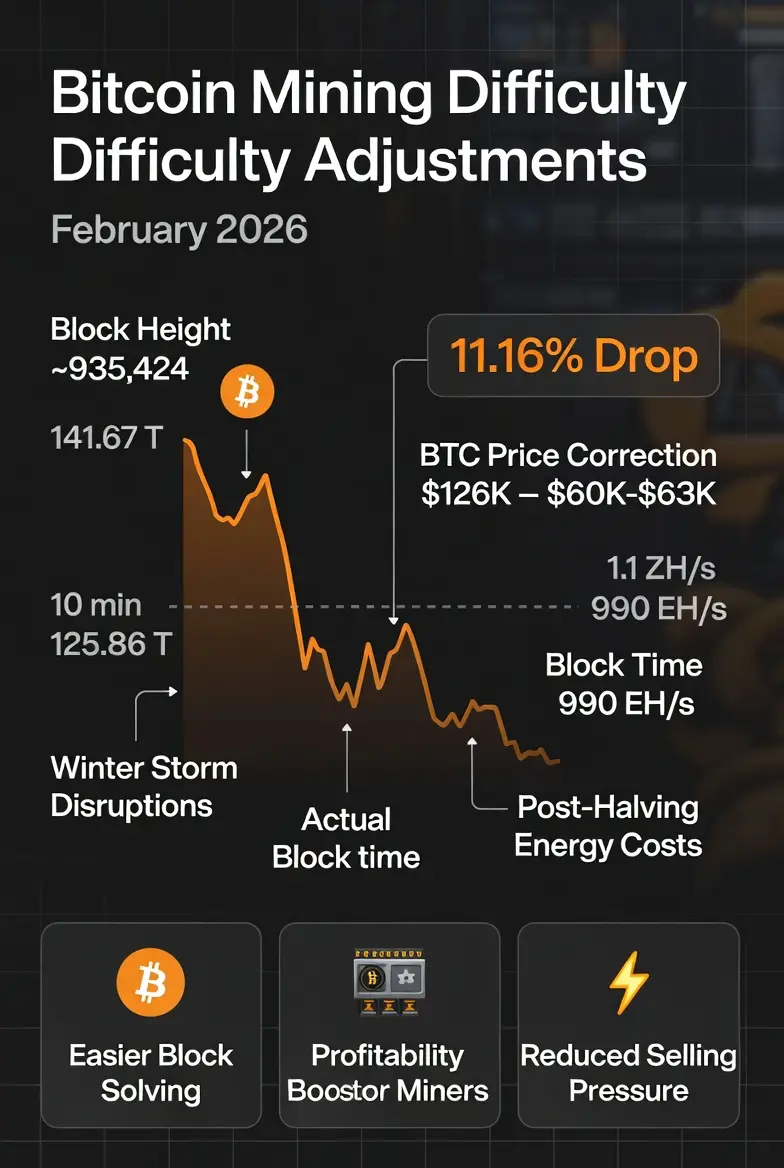
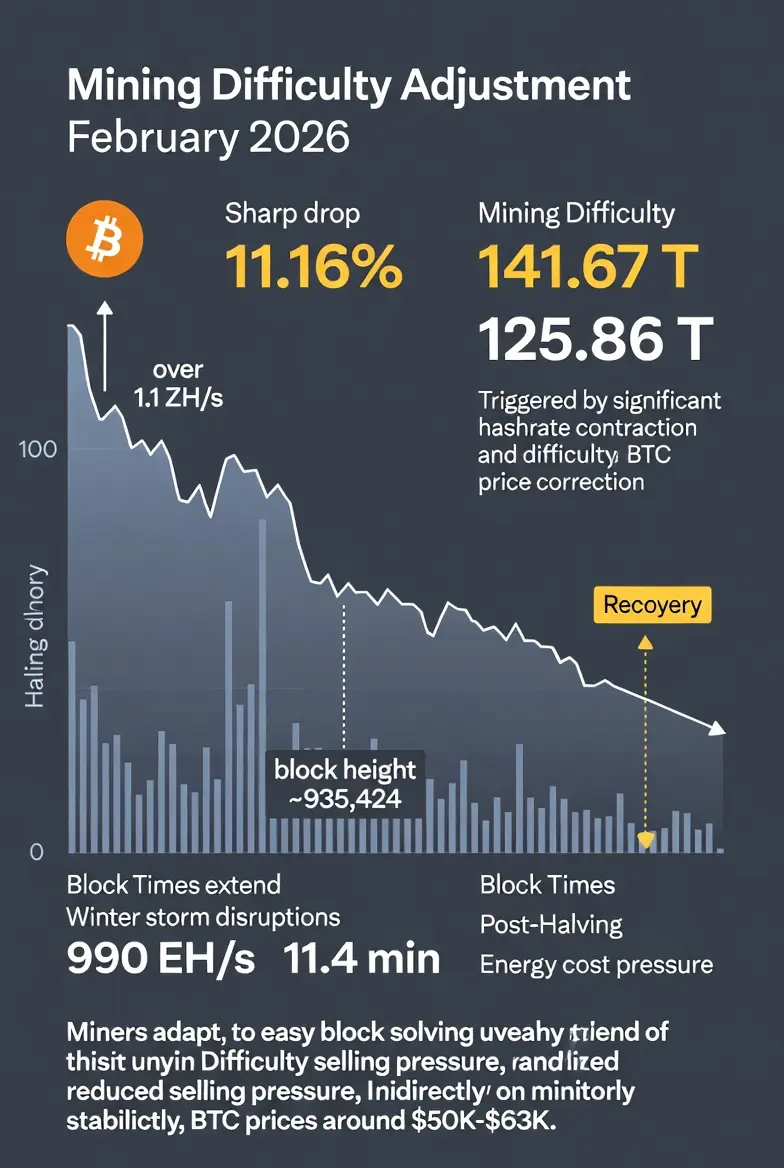
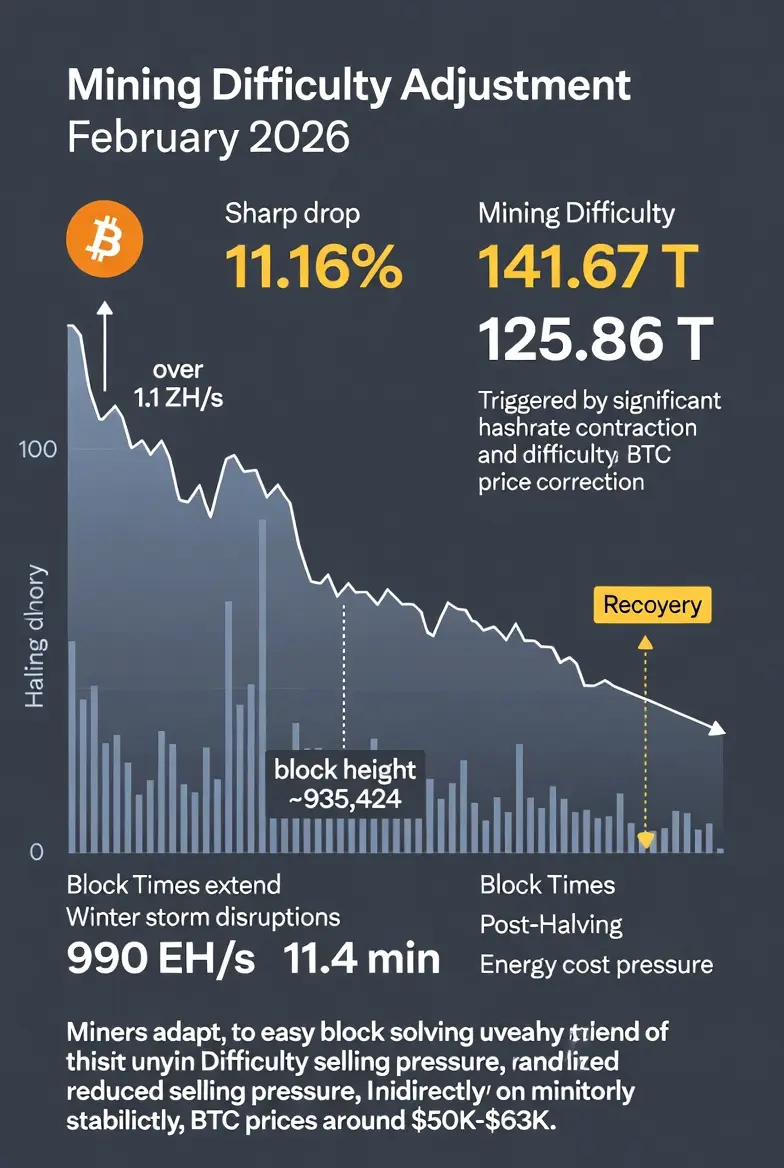
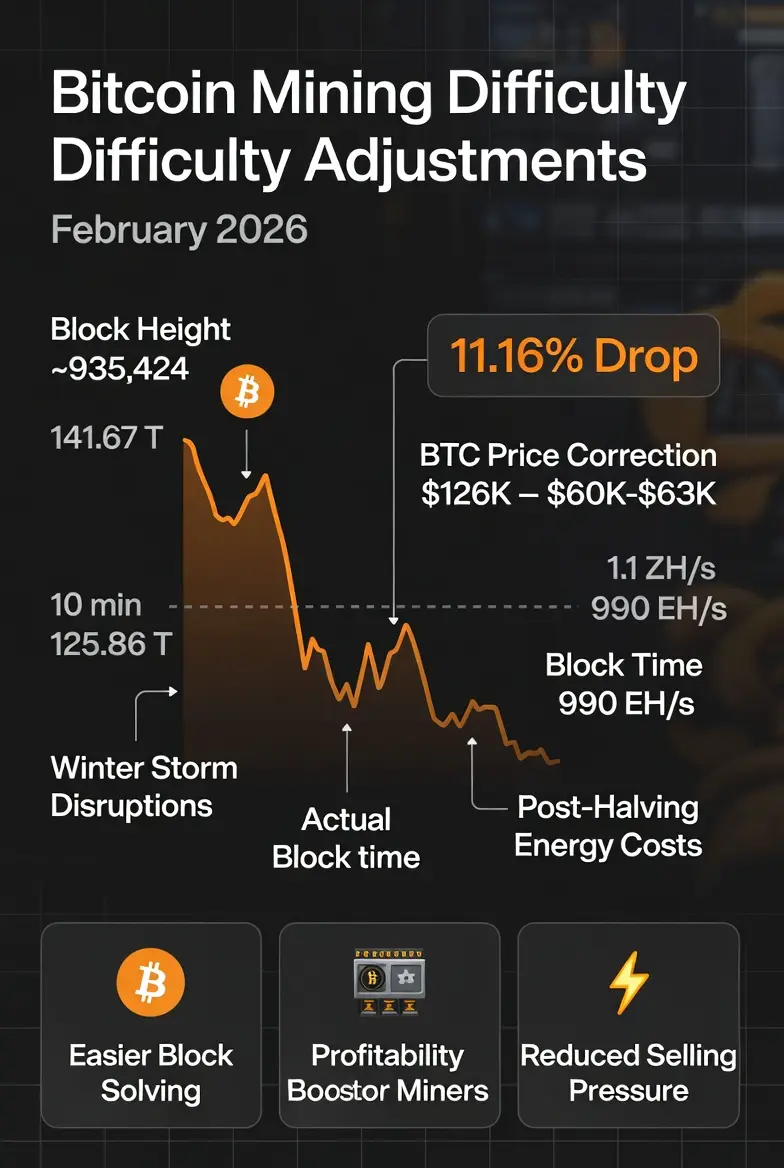
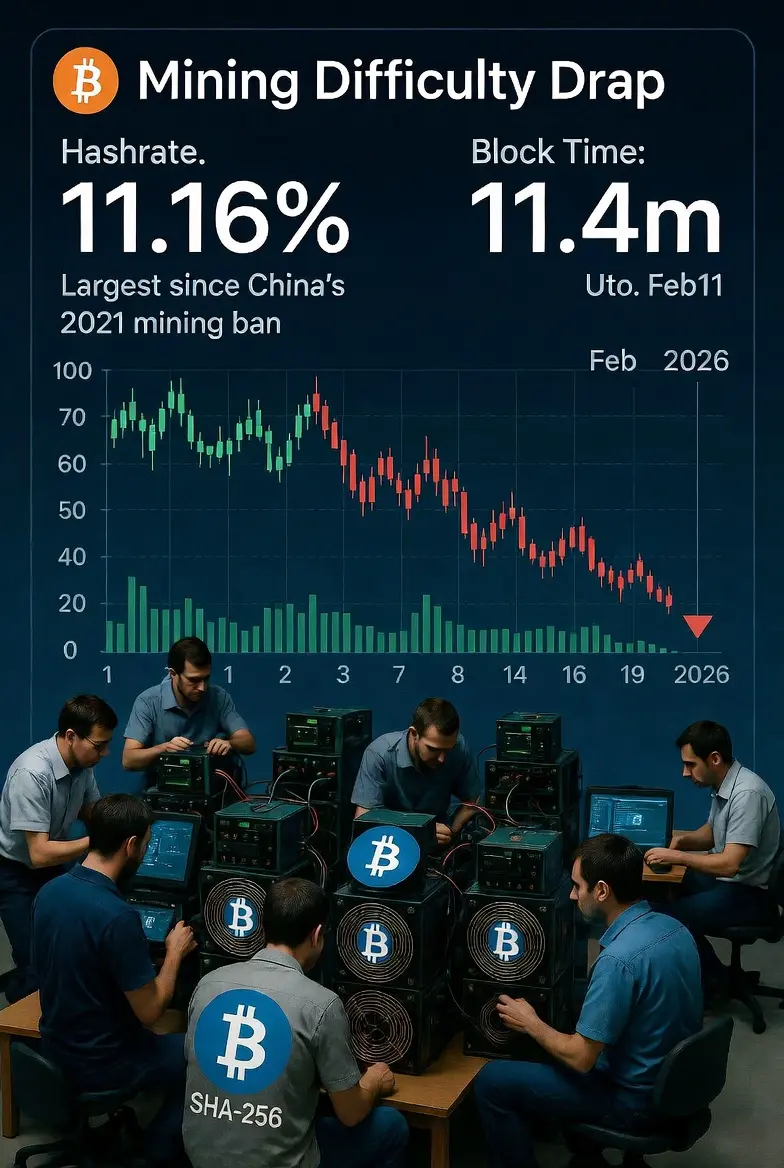
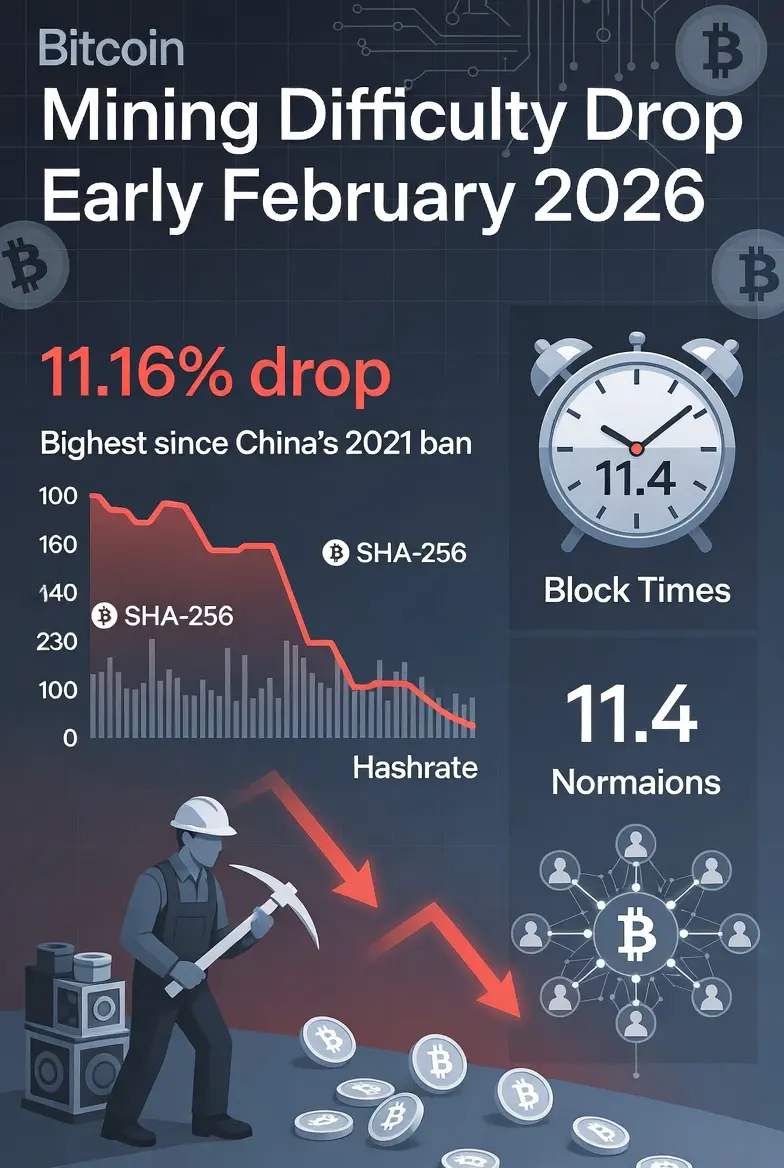
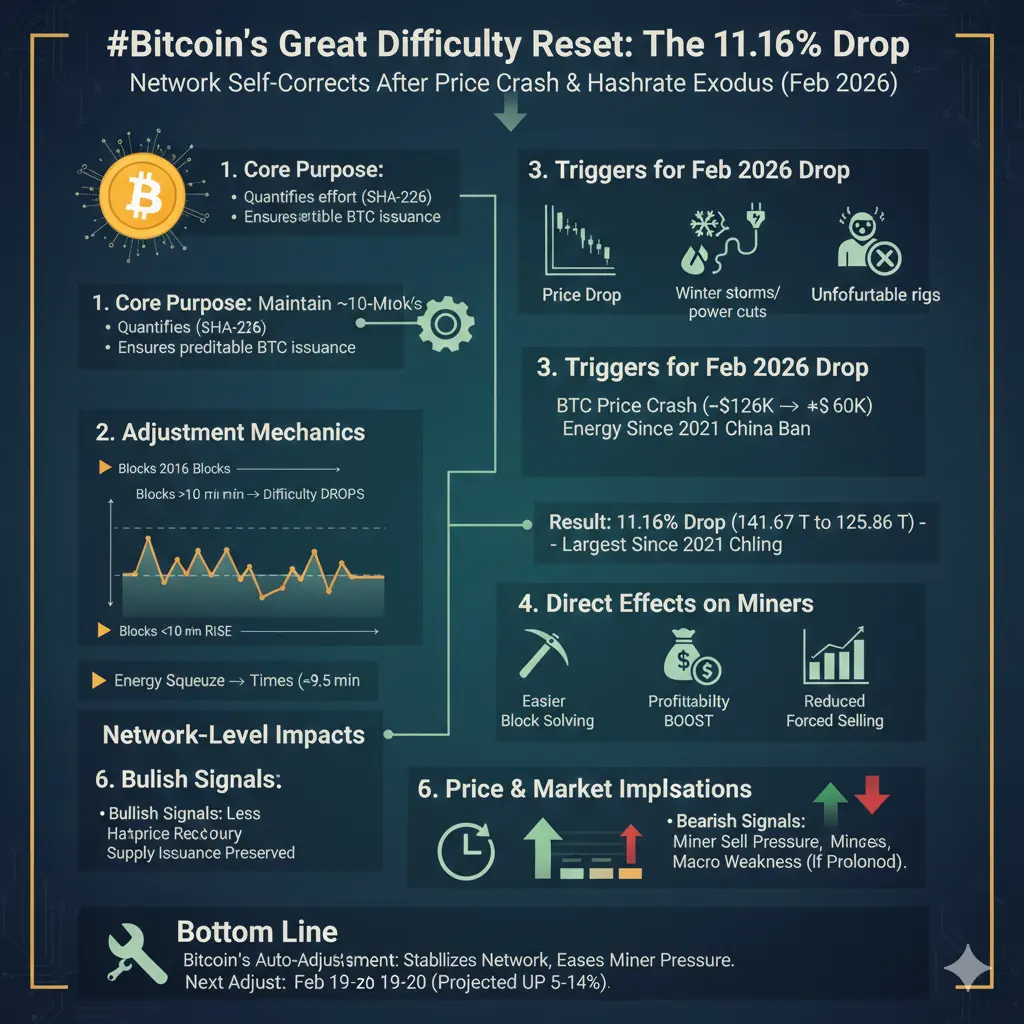
Bitcoin’s mining difficulty dropped sharply by 11.16% in early February 2026 — the biggest single drop since China’s 2021 mining ban. Here’s a simple, clear breakdown of what it is, why it happened, and why it matters.
1. What Is Mining Difficulty?
Mining difficulty measures how hard it is to mine a new Bitcoin block.
Purpose: Keep block times around 10 minutes so Bitcoin issuance remains steady (~450 BTC/day post-2024 halving).
Think of it as the network’s “speed limiter” for block production.
2. How Difficulty Adjusts
Automatically recalculated every 2016 blocks (~
Bitcoin’s mining difficulty dropped sharply by 11.16% in early February 2026 — the biggest single drop since China’s 2021 mining ban. Here’s a simple, clear breakdown of what it is, why it happened, and why it matters.
1. What Is Mining Difficulty?
Mining difficulty measures how hard it is to mine a new Bitcoin block.
Purpose: Keep block times around 10 minutes so Bitcoin issuance remains steady (~450 BTC/day post-2024 halving).
Think of it as the network’s “speed limiter” for block production.
2. How Difficulty Adjusts
Automatically recalculated every 2016 blocks (~
BTC-3,16%
- Reward
- 2
- 1
- Repost
- Share
ybaser :
:
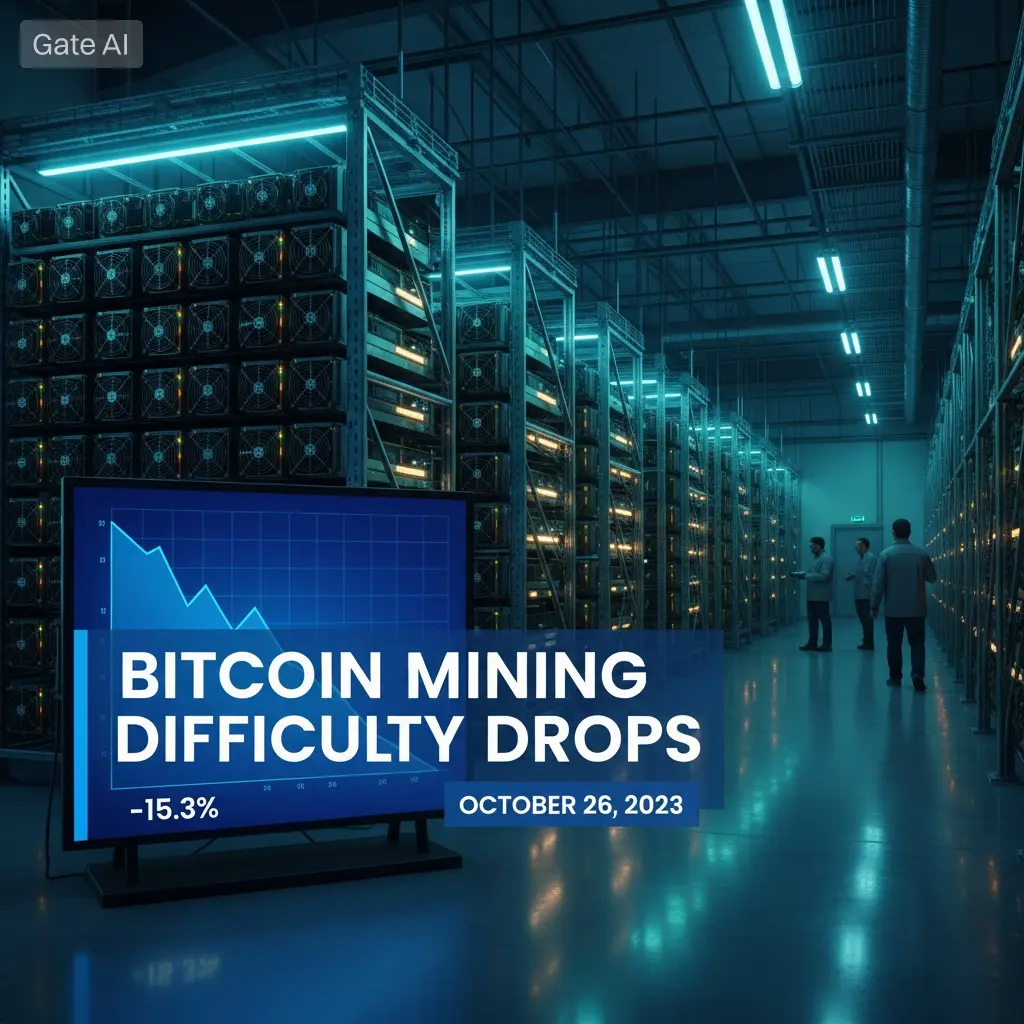
Buy To Earn 💎:#BTCMiningDifficultyDrops Bitcoin’s mining difficulty just dropped ~11.16%, the largest single adjustment since China’s 2021 crypto mining ban. This isn’t just a number — it’s a structural recalibration with big implications for miners, network security, and market sentiment.
💡 What’s Happening:
Mining difficulty adjusts automatically every ~2 weeks (2,016 blocks) to maintain ~10-min block times.
A drop happens when hashrate declines, making mining easier and block rewards more achievable.
Recent hashrate declined ~15–20% due to lower BTC prices, reduced profitability, and external disruption
💡 What’s Happening:
Mining difficulty adjusts automatically every ~2 weeks (2,016 blocks) to maintain ~10-min block times.
A drop happens when hashrate declines, making mining easier and block rewards more achievable.
Recent hashrate declined ~15–20% due to lower BTC prices, reduced profitability, and external disruption
BTC-3,16%
- Reward
- 1
- 1
- Repost
- Share
Discovery:
2026 GOGOGO 👊:#BTCMiningDifficultyDrops
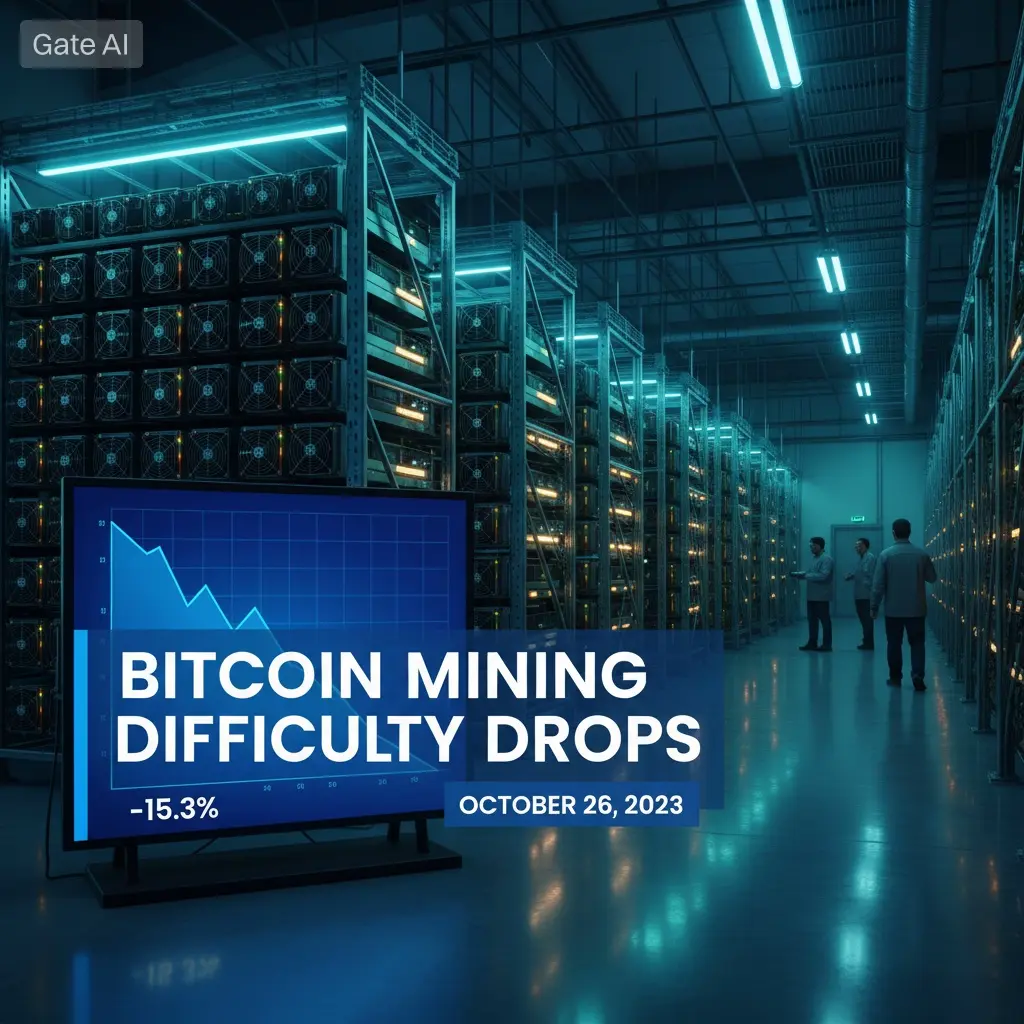
🚀The recent movement in Bitcoin’s protocol metrics has brought renewed attention to a rarely discussed yet fundamentally important part of the Bitcoin ecosystem: mining difficulty, and how its drop reflects broader economic and network dynamics. The hashtag #BTCMiningDifficultyDrops captures one of the most significant technical adjustments in recent Bitcoin history a drop of roughly 11.16% in mining difficulty marking the largest single drop since China’s sweeping crypto mining ban in 2021. This isn’t a small fluctuation; it is a structural recalibration that has m
🚀The recent movement in Bitcoin’s protocol metrics has brought renewed attention to a rarely discussed yet fundamentally important part of the Bitcoin ecosystem: mining difficulty, and how its drop reflects broader economic and network dynamics. The hashtag #BTCMiningDifficultyDrops captures one of the most significant technical adjustments in recent Bitcoin history a drop of roughly 11.16% in mining difficulty marking the largest single drop since China’s sweeping crypto mining ban in 2021. This isn’t a small fluctuation; it is a structural recalibration that has m
BTC-3,16%
- Reward
- 2
- 3
- Repost
- Share
Discovery:
2026 GOGOGO 👊:View More
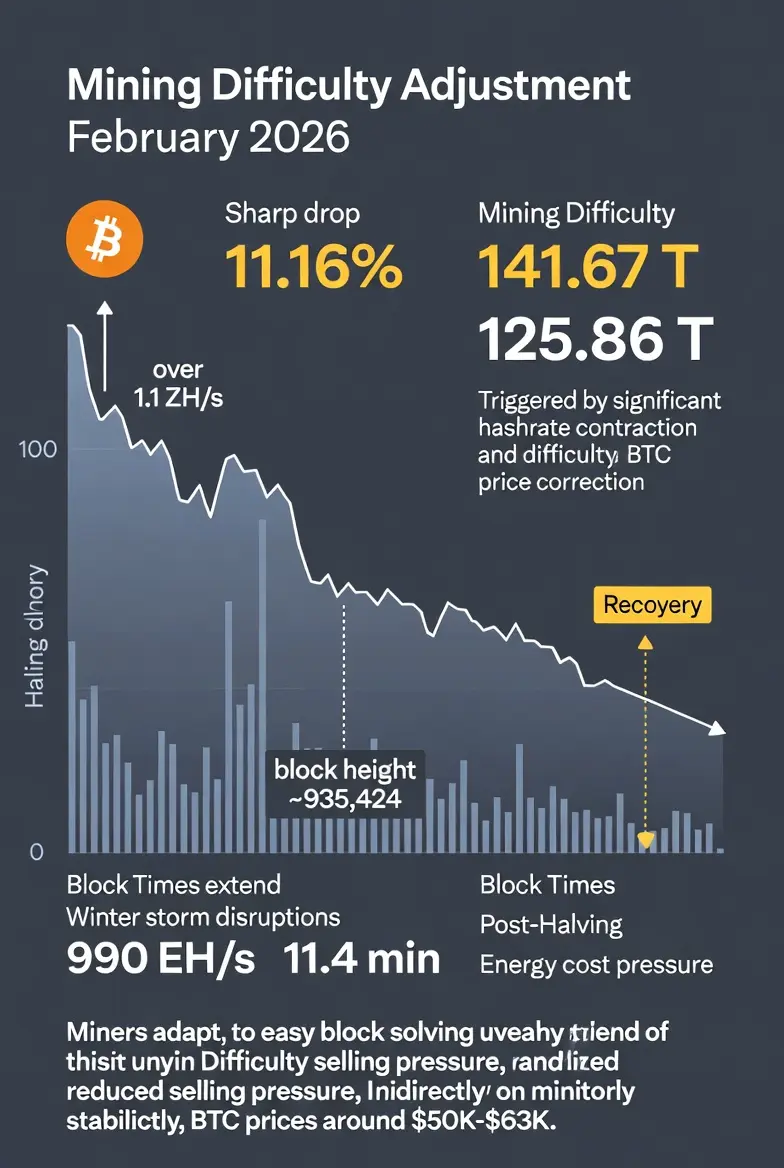
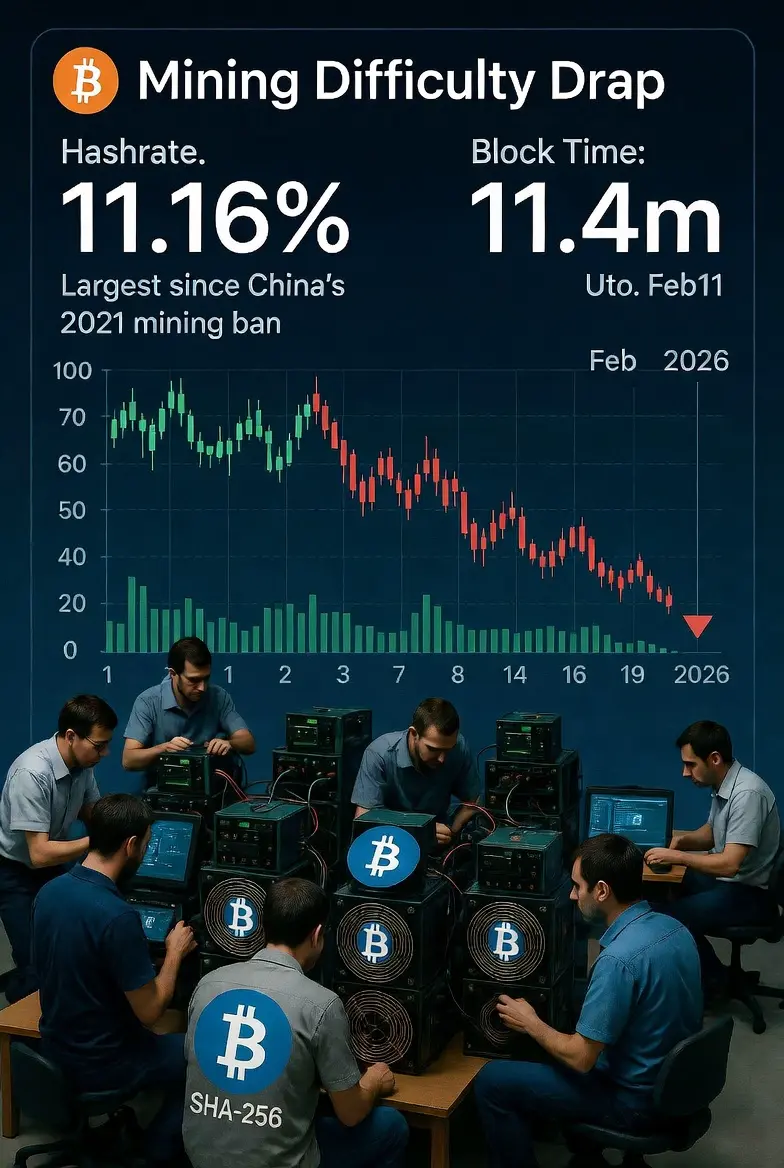
#BTCMiningDifficultyDrops: What It Means for Miners and the Market
Bitcoin mining difficulty has recently dropped, catching the attention of miners, traders, and long-term investors alike. While this metric doesn’t always make headlines like price movements do, changes in mining difficulty often reveal important signals about the health of the Bitcoin network and the broader crypto market.
Bitcoin mining difficulty adjusts roughly every two weeks to ensure that new blocks are added to the blockchain at an average pace of one every 10 minutes. When difficulty drops, it usually means that some m
Bitcoin mining difficulty has recently dropped, catching the attention of miners, traders, and long-term investors alike. While this metric doesn’t always make headlines like price movements do, changes in mining difficulty often reveal important signals about the health of the Bitcoin network and the broader crypto market.
Bitcoin mining difficulty adjusts roughly every two weeks to ensure that new blocks are added to the blockchain at an average pace of one every 10 minutes. When difficulty drops, it usually means that some m
BTC-3,16%
- Reward
- 2
- 3
- Repost
- Share
Xavi1:
Stay strong and HODL💎Stay strong and HODL💎Stay strong and HODL💎Stay strong and HODL💎Stay strong and HODL💎Stay strong and HODL💎:View More
#BTCMiningDifficultyDrops
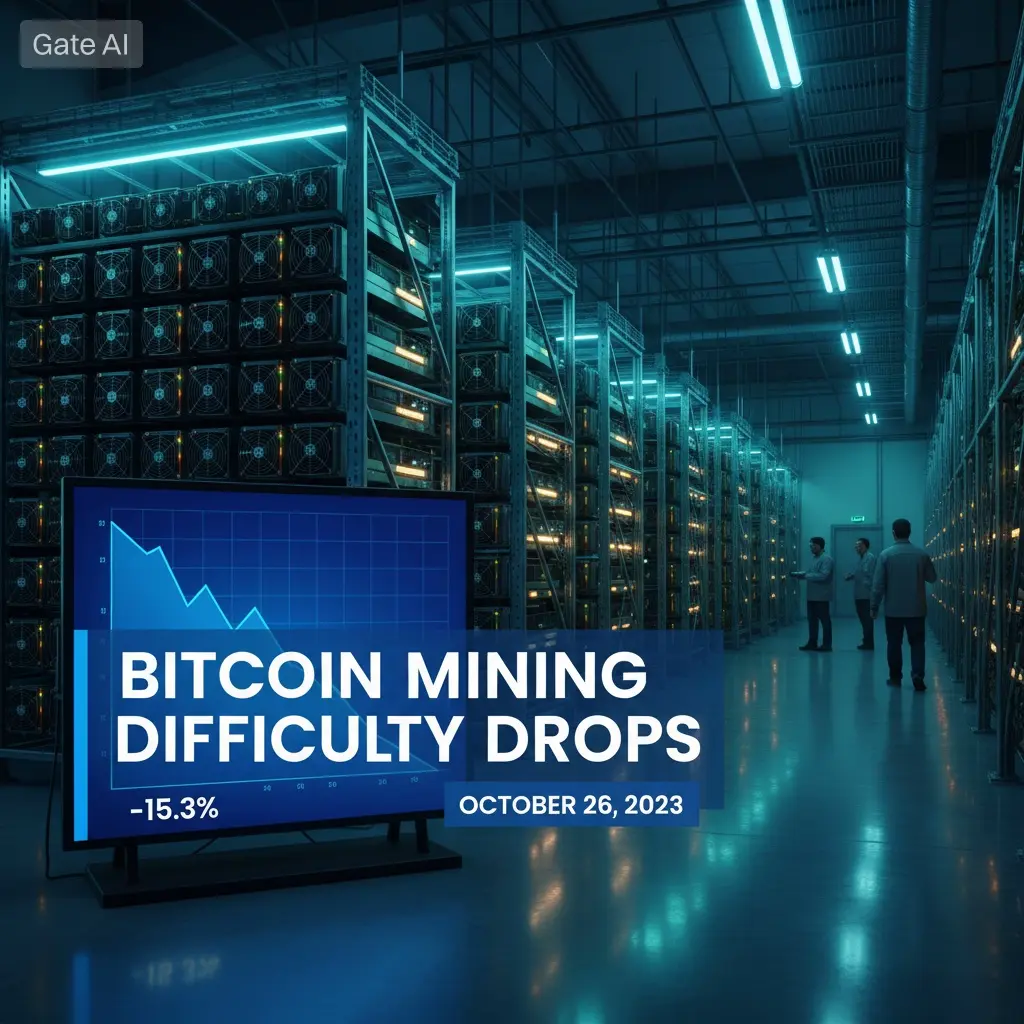
The recent movement in Bitcoin’s protocol metrics has brought renewed attention to a rarely discussed yet fundamentally important part of the Bitcoin ecosystem: mining difficulty, and how its drop reflects broader economic and network dynamics. The hashtag #BTCMiningDifficultyDrops captures one of the most significant technical adjustments in recent Bitcoin history a drop of roughly 11.16% in mining difficulty marking the largest single drop since China’s sweeping crypto mining ban in 2021. This isn’t a small fluctuation; it is a structural recalibration that has mea
The recent movement in Bitcoin’s protocol metrics has brought renewed attention to a rarely discussed yet fundamentally important part of the Bitcoin ecosystem: mining difficulty, and how its drop reflects broader economic and network dynamics. The hashtag #BTCMiningDifficultyDrops captures one of the most significant technical adjustments in recent Bitcoin history a drop of roughly 11.16% in mining difficulty marking the largest single drop since China’s sweeping crypto mining ban in 2021. This isn’t a small fluctuation; it is a structural recalibration that has mea
BTC-3,16%
- Reward
- 5
- 9
- Repost
- Share
MasterChuTheOldDemonMasterChu :
:
Stay strong and HODL💎:View More
#BTCMiningDifficultyDrops
Bitcoin’s mining difficulty dropped sharply by 11.16% in early February 2026 — the biggest single drop since China’s 2021 mining ban. Here’s a simple, clear breakdown of what it is, why it happened, and why it matters.
1. What Is Mining Difficulty?
Mining difficulty measures how hard it is to mine a new Bitcoin block.
Purpose: Keep block times around 10 minutes so Bitcoin issuance remains steady (~450 BTC/day post-2024 halving).
Think of it as the network’s “speed limiter” for block production.
2. How Difficulty Adjusts
Automatically recalculated every 2016 blocks (~
Bitcoin’s mining difficulty dropped sharply by 11.16% in early February 2026 — the biggest single drop since China’s 2021 mining ban. Here’s a simple, clear breakdown of what it is, why it happened, and why it matters.
1. What Is Mining Difficulty?
Mining difficulty measures how hard it is to mine a new Bitcoin block.
Purpose: Keep block times around 10 minutes so Bitcoin issuance remains steady (~450 BTC/day post-2024 halving).
Think of it as the network’s “speed limiter” for block production.
2. How Difficulty Adjusts
Automatically recalculated every 2016 blocks (~
BTC-3,16%
- Reward
- 15
- 16
- Repost
- Share
repanzal:
Buy To Earn 💎:View More
#BTCMiningDifficultyDrops
Bitcoin’s recent mining difficulty drop has generated significant attention across the market, serving as both a technical network indicator and a signal for broader market and miner behavior. Mining difficulty, which adjusts approximately every two weeks to maintain the average 10-minute block interval, is an essential metric for network stability, miner profitability, and investor sentiment. A decrease in difficulty typically reflects a short-term decline in hash rate, miner capitulation, or strategic operational adjustments, and carries implications for both on-ch
Bitcoin’s recent mining difficulty drop has generated significant attention across the market, serving as both a technical network indicator and a signal for broader market and miner behavior. Mining difficulty, which adjusts approximately every two weeks to maintain the average 10-minute block interval, is an essential metric for network stability, miner profitability, and investor sentiment. A decrease in difficulty typically reflects a short-term decline in hash rate, miner capitulation, or strategic operational adjustments, and carries implications for both on-ch
BTC-3,16%
- Reward
- 3
- 1
- Repost
- Share
ybaser:
2026 GOGOGO 👊:#BTCMiningDifficultyDrops
Bitcoin’s recent mining difficulty drop has generated significant attention across the market, serving as both a technical network indicator and a signal for broader market and miner behavior. Mining difficulty, which adjusts approximately every two weeks to maintain the average 10-minute block interval, is an essential metric for network stability, miner profitability, and investor sentiment. A decrease in difficulty typically reflects a short-term decline in hash rate, miner capitulation, or strategic operational adjustments, and carries implications for both on-ch
Bitcoin’s recent mining difficulty drop has generated significant attention across the market, serving as both a technical network indicator and a signal for broader market and miner behavior. Mining difficulty, which adjusts approximately every two weeks to maintain the average 10-minute block interval, is an essential metric for network stability, miner profitability, and investor sentiment. A decrease in difficulty typically reflects a short-term decline in hash rate, miner capitulation, or strategic operational adjustments, and carries implications for both on-ch
BTC-3,16%

- Reward
- 5
- 4
- Repost
- Share
MasterChuTheOldDemonMasterChu:
Hold on tight, we're about to take off 🛫:View More
Mining Difficulty Decline Is Both a Stress Test and an Industry Checkup
Every adjustment in Bitcoin mining difficulty serves as an industry health check for miners. Many people's first reaction is to think about hash rate retreat or miner capitulation, but from a mechanism design perspective, difficulty adjustment is an automatic balancing system that helps Bitcoin maintain network stability. When hash rate drops, difficulty decreases, and block times return to normal—this is a self-repair at the protocol level, not a systemic crisis.
What truly matters is who is exiting. Usually, small miners
Every adjustment in Bitcoin mining difficulty serves as an industry health check for miners. Many people's first reaction is to think about hash rate retreat or miner capitulation, but from a mechanism design perspective, difficulty adjustment is an automatic balancing system that helps Bitcoin maintain network stability. When hash rate drops, difficulty decreases, and block times return to normal—this is a self-repair at the protocol level, not a systemic crisis.
What truly matters is who is exiting. Usually, small miners
BTC-3,16%
[The user has shared his/her trading data. Go to the App to view more.]
- Reward
- like
- Comment
- Repost
- Share
Reevaluating Bitcoin's "Invisible Value Anchor" through Cost
Many traditional assets have valuation models, but Bitcoin is often considered to lack an anchor. In reality, mining costs have long served as an invisible reference for value. When difficulty decreases, it indicates that some high-cost hash power is exiting the market, prompting a reassessment of production costs.
Simply put, the marginal production cost of Bitcoin is changing. If the price remains below most miners' costs for an extended period, hash power will gradually clear out until supply and demand reach a new equilibrium. Th
Many traditional assets have valuation models, but Bitcoin is often considered to lack an anchor. In reality, mining costs have long served as an invisible reference for value. When difficulty decreases, it indicates that some high-cost hash power is exiting the market, prompting a reassessment of production costs.
Simply put, the marginal production cost of Bitcoin is changing. If the price remains below most miners' costs for an extended period, hash power will gradually clear out until supply and demand reach a new equilibrium. Th
BTC-3,16%
[The user has shared his/her trading data. Go to the App to view more.]
- Reward
- 2
- 2
- Repost
- Share
CoinWay:
Hold on tight, we're about to take off 🛫:View More
Load More
Join 40M users in our growing community
⚡️ Join 40M users in the crypto craze discussion
💬 Engage with your favorite top creators
👍 See what interests you
Trending Topics
183.97K Popularity
44.15K Popularity
5.74K Popularity
4.59K Popularity
3.75K Popularity
2.51K Popularity
3.97K Popularity
291 Popularity
13.82K Popularity
2.37K Popularity
1.8K Popularity
1.77K Popularity
18.72K Popularity
17.98K Popularity
37.39K Popularity
News
View MoreBitcoin Treasury Company ProCap repurchases approximately $135 million in convertible bonds today
3 m
Tom Lee's Bitmine Adds 40,613 ETH Worth $82.85M, Total Holdings Reach 4.3M ETH
3 m
A certain whale persisted for 70 days before closing their Ethereum long position, incurring a loss of 8.8 million USD.
8 m
Empery Digital sold 357.7 Bitcoins last week, and the total holdings decreased to 3,723.7 Bitcoins.
10 m
Polymarket Chief Legal Officer: Filed a lawsuit against Massachusetts in federal court
20 m
Pin