

Trade
Basic
Futures
Futures
Hundreds of contracts settled in USDT or BTC
TradFi
Gold
Trade global traditional assets with USDT in one place
Options
Hot
Trade European-style vanilla options
Unified Account
Maximize your capital efficiency
Demo Trading
Futures Kickoff
Get prepared for your futures trading
Futures Events
Participate in events to win generous rewards
Demo Trading
Use virtual funds to experience risk-free trading
Earn
Launch
CandyDrop
Collect candies to earn airdrops
Launchpool
Quick staking, earn potential new tokens
HODLer Airdrop
Hold GT and get massive airdrops for free
Launchpad
Be early to the next big token project
Alpha Points
Trade on-chain assets and enjoy airdrop rewards!
Futures Points
Earn futures points and claim airdrop rewards
Investment
Simple Earn
Earn interests with idle tokens
Auto-Invest
Auto-invest on a regular basis
Dual Investment
Buy low and sell high to take profits from price fluctuations
Soft Staking
Earn rewards with flexible staking
Crypto Loan
0 Fees
Pledge one crypto to borrow another
Lending Center
One-stop lending hub
VIP Wealth Hub
Customized wealth management empowers your assets growth
Private Wealth Management
Customized asset management to grow your digital assets
Quant Fund
Top asset management team helps you profit without hassle
Staking
Stake cryptos to earn in PoS products
Smart Leverage
New
No forced liquidation before maturity, worry-free leveraged gains
GUSD Minting
Use USDT/USDC to mint GUSD for treasury-level yields

More


# EthereumWarnsonAddressPoisoning
12.39K
The Ethereum community has urged wallets to stop truncating addresses after a $50M USDT phishing incident linked to lookalike addresses. Do you always verify full addresses? How can such incidents be prevented?
DAOdreamer
$12.3M Ethereum Theft Exposes Address Poisoning Risks
A recent security incident has brought renewed attention to one of the most deceptive threats facing cryptocurrency users: the $12.3 million Ethereum theft through a sophisticated address poisoning scheme. According to security analysts at Cyvers Alerts, the targeted user attempted to send funds to
ETH-1,02%
- Reward
- like
- Comment
- Repost
- Share
#EthereumWarnsOnAddressPoisoning Market Reality Check December 25, 2025
As the crypto market moves into the final days of 2025, sentiment is cautiously stabilizing, liquidity is thinner, and large on-chain transfers are increasing as institutions and high-net-worth traders rebalance positions. In this exact environment, a critical security threat has resurfaced with devastating consequences: address poisoning and it has already cost users nearly $50 million in USDT.
This is not theoretical. This is not rare. This is happening now, in live market conditions.
A $50 Million Mistake That Shook
As the crypto market moves into the final days of 2025, sentiment is cautiously stabilizing, liquidity is thinner, and large on-chain transfers are increasing as institutions and high-net-worth traders rebalance positions. In this exact environment, a critical security threat has resurfaced with devastating consequences: address poisoning and it has already cost users nearly $50 million in USDT.
This is not theoretical. This is not rare. This is happening now, in live market conditions.
A $50 Million Mistake That Shook
- Reward
- 27
- 9
- Repost
- Share
BabaJi :
:
Christmas Bull Run! 🐂:View More
#EthereumWarnsonAddressPoisoning A $50M Loss Exposes a Systemic Crypto Security Failure
A recent $50 million USDT address poisoning attack on Ethereum has exposed one of the most dangerous and overlooked security flaws in the crypto ecosystem: wallet UX and address verification vulnerabilities that exploit basic human trust in interface design. This incident wasn’t the result of a hacker breaking into a protocol or exploiting a smart contract — instead, it relied on a deceptively simple technique that targets how wallets display and store addresses, turning routine user behavior into a catastr
A recent $50 million USDT address poisoning attack on Ethereum has exposed one of the most dangerous and overlooked security flaws in the crypto ecosystem: wallet UX and address verification vulnerabilities that exploit basic human trust in interface design. This incident wasn’t the result of a hacker breaking into a protocol or exploiting a smart contract — instead, it relied on a deceptively simple technique that targets how wallets display and store addresses, turning routine user behavior into a catastr

- Reward
- 14
- 10
- Repost
- Share
Yajing :
:
Christmas Bull Run! 🐂:View More
#EthereumWarnsonAddressPoisoning
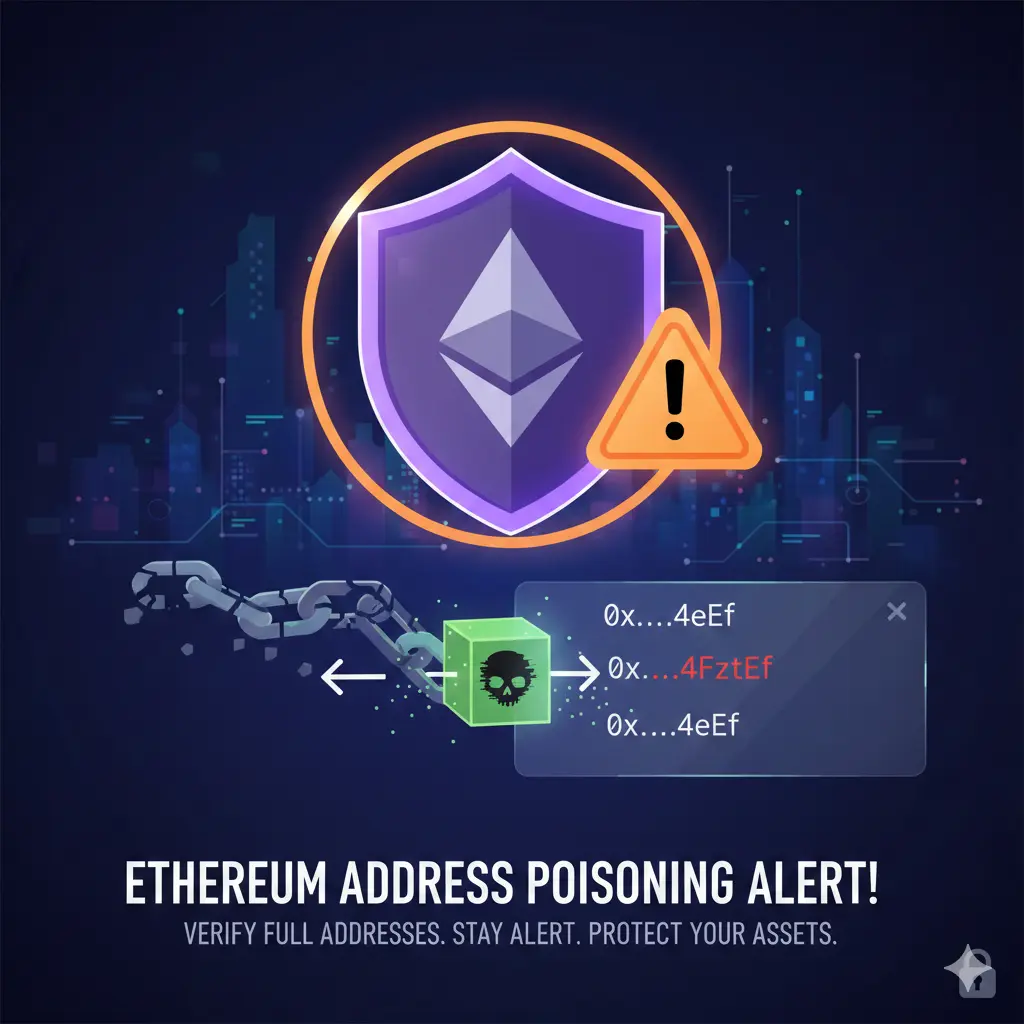
#EthereumWarnsOnAddressPoisoning 🚨 | Staying Safe in a Smart Way
The Ethereum ecosystem has issued an important warning about address poisoning, a deceptive scam where attackers send tiny transactions from wallet addresses that look almost identical to trusted ones. The intention is to trick users into copying the wrong address from their transaction history, which can result in permanent loss of funds once a transfer is made.
In this fast-moving crypto environment, early awareness is critical, and this is where platforms like Gate.io stand out. Gate.io consi
#EthereumWarnsOnAddressPoisoning 🚨 | Staying Safe in a Smart Way
The Ethereum ecosystem has issued an important warning about address poisoning, a deceptive scam where attackers send tiny transactions from wallet addresses that look almost identical to trusted ones. The intention is to trick users into copying the wrong address from their transaction history, which can result in permanent loss of funds once a transfer is made.
In this fast-moving crypto environment, early awareness is critical, and this is where platforms like Gate.io stand out. Gate.io consi
ETH-1,02%
- Reward
- 29
- 15
- Repost
- Share
BabaJi:
Merry Christmas ⛄:View More
#EthereumWarnsonAddressPoisoning
December 24, 2025 An Urgent Alert for All Crypto Users
As 2025 comes to a close, the crypto community has received a serious wake-up call. Between December 20–21, 2025, a major address poisoning incident led to the loss of nearly $50 million in USDT all because of a single wallet address mistake. This was not a smart-contract bug or a network failure. It was a simple human error, exploited with precision.
This incident makes one thing clear: address poisoning is no longer a hypothetical threat. It is actively happening and targeting real users right now.
How O
December 24, 2025 An Urgent Alert for All Crypto Users
As 2025 comes to a close, the crypto community has received a serious wake-up call. Between December 20–21, 2025, a major address poisoning incident led to the loss of nearly $50 million in USDT all because of a single wallet address mistake. This was not a smart-contract bug or a network failure. It was a simple human error, exploited with precision.
This incident makes one thing clear: address poisoning is no longer a hypothetical threat. It is actively happening and targeting real users right now.
How O
ETH-1,02%
- Reward
- 6
- 15
- Repost
- Share
Luna_Star:
HODL Tight 💪:View More
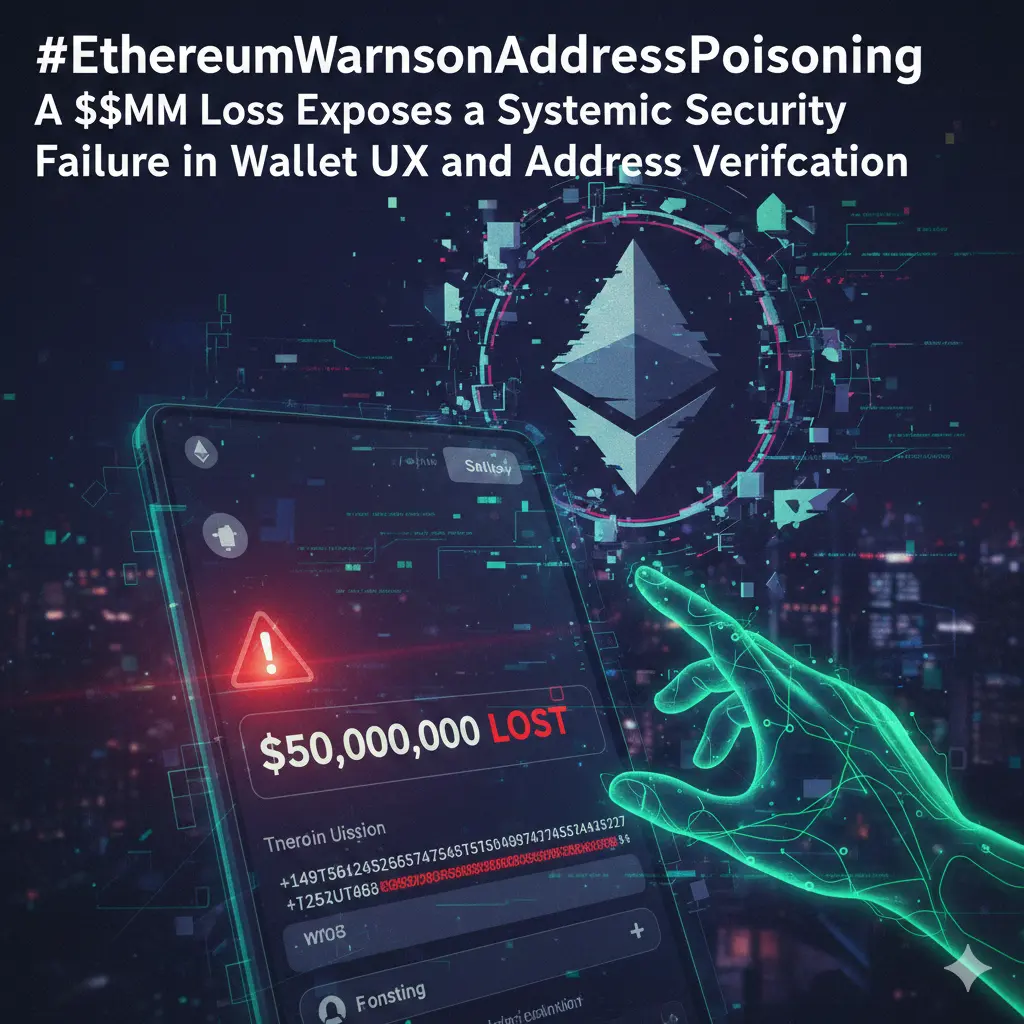
#EthereumWarnsonAddressPoisoning A $50M Loss Exposes a Systemic Security Failure in Wallet UX and Address Verification
A recent $50 million USDT address poisoning scam on Ethereum has highlighted one of the most dangerous security flaws facing crypto users and institutions. In this incident, a large transfer intended for a known wallet was mistakenly sent to a lookalike address that had been “poisoned” into the victim’s transaction history via small, carefully crafted dust transactions. The attacker generated a wallet address sharing the same first and last characters as the intended recipient
A recent $50 million USDT address poisoning scam on Ethereum has highlighted one of the most dangerous security flaws facing crypto users and institutions. In this incident, a large transfer intended for a known wallet was mistakenly sent to a lookalike address that had been “poisoned” into the victim’s transaction history via small, carefully crafted dust transactions. The attacker generated a wallet address sharing the same first and last characters as the intended recipient
- Reward
- 10
- 6
- Repost
- Share
Ryakpanda:
Merry Christmas, let's get bullish! 🐂:View More
#EthereumWarnsonAddressPoisoning
The $50M USDT phishing incident caused by lookalike Ethereum addresses has exposed a systemic problem in crypto security that goes beyond simple user error: truncated wallet addresses are inherently unsafe in adversarial environments, and the ecosystem has relied on this dangerous practice for far too long. Most wallets display only the first few and last few characters of an address something like implicitly training users to assume that verifying just the visible segments is sufficient. Attackers exploit this predictability by generating addresses that share
The $50M USDT phishing incident caused by lookalike Ethereum addresses has exposed a systemic problem in crypto security that goes beyond simple user error: truncated wallet addresses are inherently unsafe in adversarial environments, and the ecosystem has relied on this dangerous practice for far too long. Most wallets display only the first few and last few characters of an address something like implicitly training users to assume that verifying just the visible segments is sufficient. Attackers exploit this predictability by generating addresses that share
- Reward
- 12
- 8
- Repost
- Share
Deranc:
nice:View More
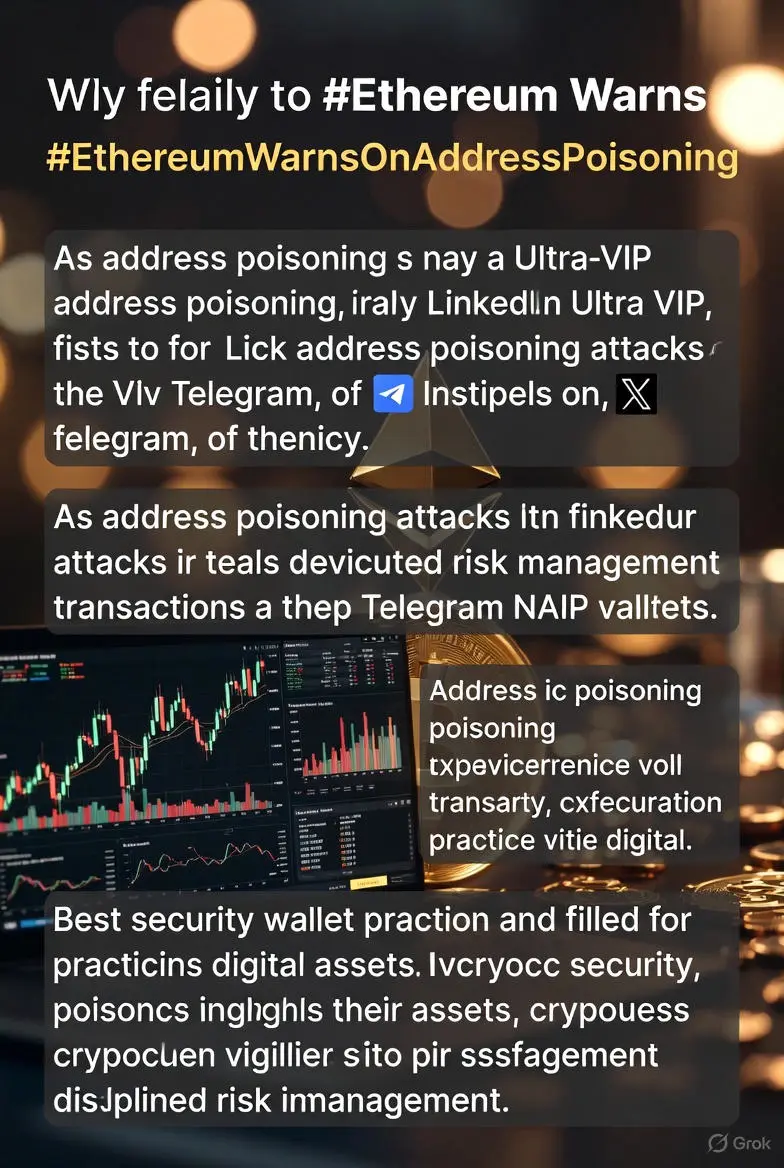
🔥 #EthereumWarnsOnAddressPoisoning – ULTRA VIP ALERT 🔥
Ethereum has issued a critical warning regarding address poisoning attacks, an advanced threat targeting wallets, smart contracts, and users. Address poisoning involves maliciously crafted addresses that appear legitimate but can redirect, freeze, or steal funds without any visible warning. VIP traders and portfolio managers must act immediately to safeguard capital.
📌 10 Critical Topics Every VIP Must Know:
1️⃣ What is Address Poisoning?
A sophisticated attack where malicious addresses mimic legitimate ones.
Exploits both human error a
Ethereum has issued a critical warning regarding address poisoning attacks, an advanced threat targeting wallets, smart contracts, and users. Address poisoning involves maliciously crafted addresses that appear legitimate but can redirect, freeze, or steal funds without any visible warning. VIP traders and portfolio managers must act immediately to safeguard capital.
📌 10 Critical Topics Every VIP Must Know:
1️⃣ What is Address Poisoning?
A sophisticated attack where malicious addresses mimic legitimate ones.
Exploits both human error a
ETH-1,02%

- Reward
- 8
- 13
- Repost
- Share
ybaser:
Merry Christmas ⛄:View More
#EthereumWarnsonAddressPoisoning
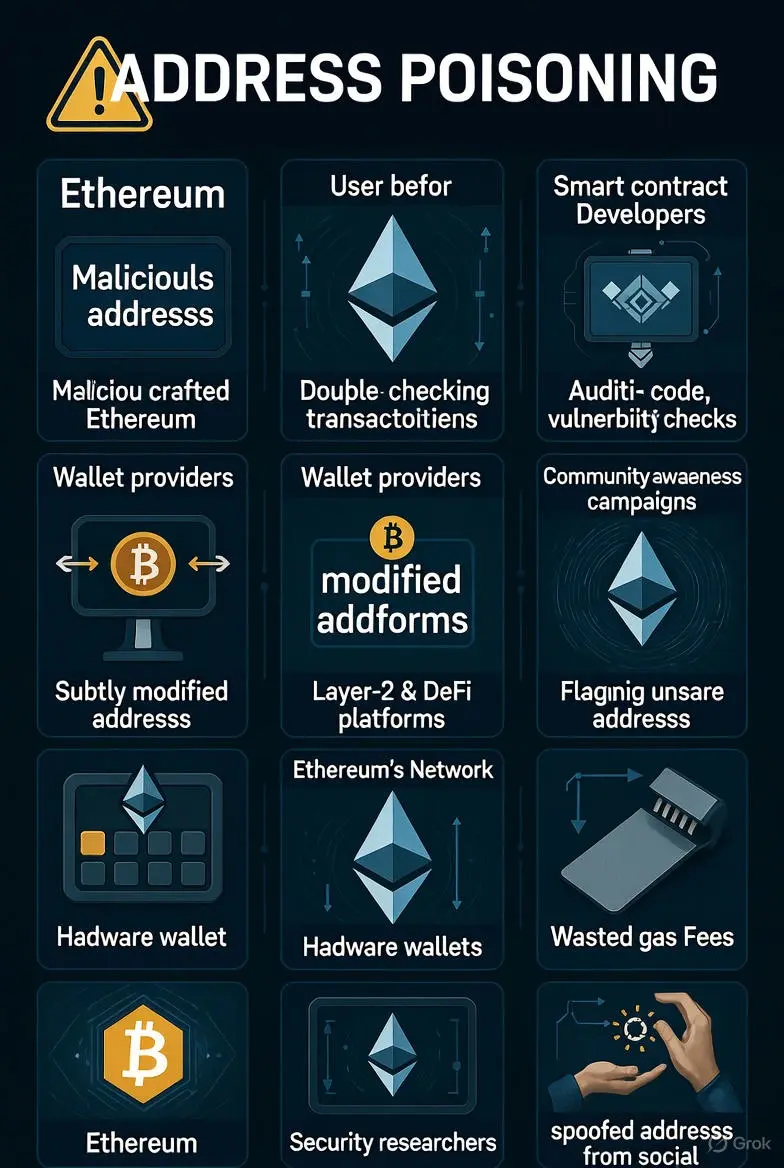
#EthereumWarnsOnAddressPoisoning
Ethereum has issued a warning regarding address poisoning attacks, highlighting the risks of maliciously crafted addresses in transactions.
Address poisoning occurs when attackers create addresses that exploit wallet or smart contract vulnerabilities, potentially locking funds or causing transaction failures.
Users are advised to double-check addresses before sending any funds, especially when interacting with new or unverified contracts.
Smart contract developers should audit their code to prevent unexpected behavior from mal
#EthereumWarnsOnAddressPoisoning
Ethereum has issued a warning regarding address poisoning attacks, highlighting the risks of maliciously crafted addresses in transactions.
Address poisoning occurs when attackers create addresses that exploit wallet or smart contract vulnerabilities, potentially locking funds or causing transaction failures.
Users are advised to double-check addresses before sending any funds, especially when interacting with new or unverified contracts.
Smart contract developers should audit their code to prevent unexpected behavior from mal
ETH-1,02%


MC:$3.55KHolders:1
0.00%
- Reward
- 9
- 6
- Repost
- Share
Crypto_Buzz_with_Alex:
😎 “Crypto community energy is unmatched 🔥” Xmas:View More
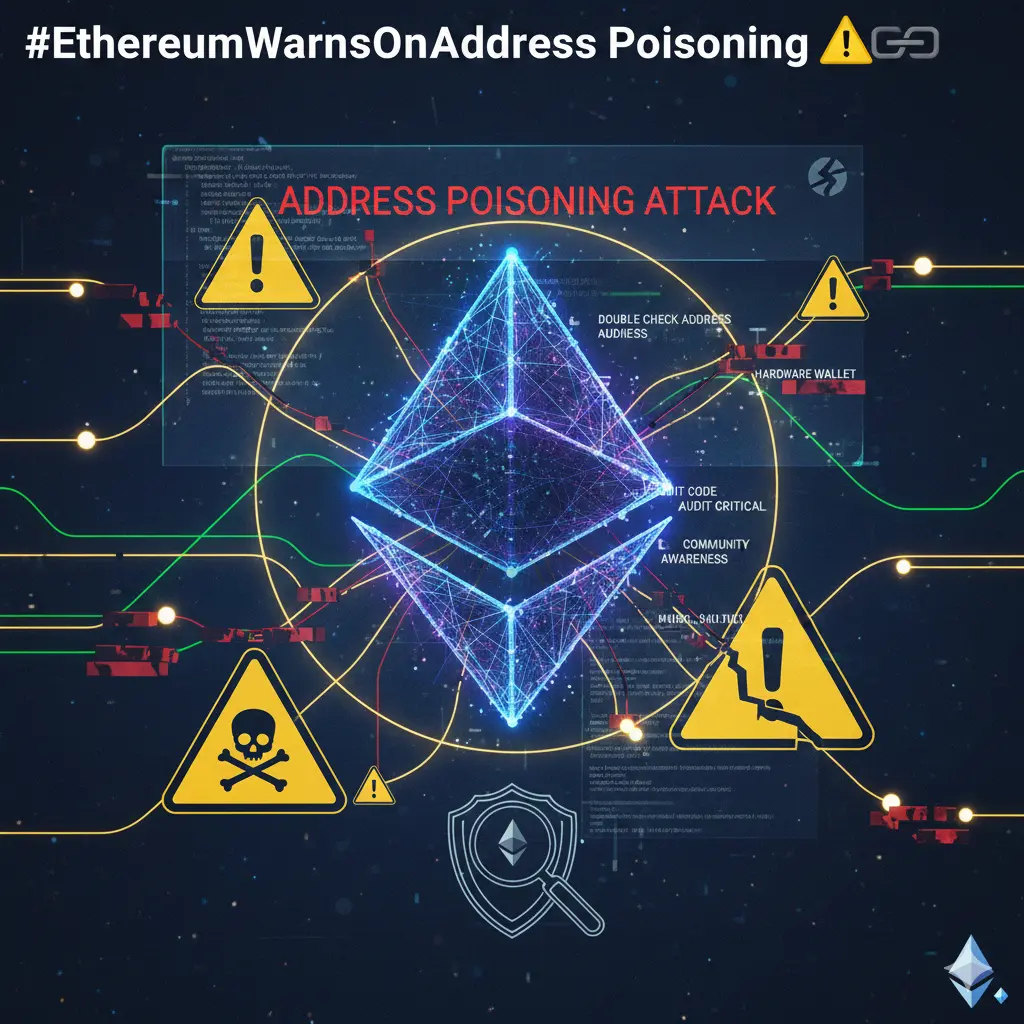
#CryptoMarketMildlyRebounds #EthereumWarnsonAddressPoisoning
#EthereumWarnsOnAddressPoisoning
Ethereum has issued a warning regarding address poisoning attacks, highlighting the risks of maliciously crafted addresses in transactions.
Address poisoning occurs when attackers create addresses that exploit wallet or smart contract vulnerabilities, potentially locking funds or causing transaction failures.
Users are advised to double-check addresses before sending any funds, especially when interacting with new or unverified contracts.
Smart contract developers should audit their code to prevent
#EthereumWarnsOnAddressPoisoning
Ethereum has issued a warning regarding address poisoning attacks, highlighting the risks of maliciously crafted addresses in transactions.
Address poisoning occurs when attackers create addresses that exploit wallet or smart contract vulnerabilities, potentially locking funds or causing transaction failures.
Users are advised to double-check addresses before sending any funds, especially when interacting with new or unverified contracts.
Smart contract developers should audit their code to prevent
ETH-1,02%
- Reward
- like
- 1
- Repost
- Share
GateUser-57f74483:
isisiskskskskskoskskskskskskskskskskskwk:Load More
Join 40M users in our growing community
⚡️ Join 40M users in the crypto craze discussion
💬 Engage with your favorite top creators
👍 See what interests you
Trending Topics
42.63K Popularity
71.27K Popularity
16.7K Popularity
42.67K Popularity
256.06K Popularity
190.53K Popularity
9.05K Popularity
7.33K Popularity
5.47K Popularity
6.85K Popularity
122.44K Popularity
27.89K Popularity
24.18K Popularity
9.24K Popularity
4.42K Popularity
News
View MoreJiuzi Holdings receives $60 million investment, to be injected in the form of equivalent cryptocurrency assets
9 m
AI giants invest $50 million to support "light regulation" candidates
9 m
Mixin Hacker Moves $117M in ETH After Two Years of Dormancy
10 m
U.S. Treasury Secretary Yellen: Inflation May Fall Back to Near 2% by Mid-Year
13 m
Forward Industries Financial Report: Holds approximately 6,962,000 SOL as of the end of 2025
14 m
Pin