GateUser-cc6abff6

vip
Age 8.2 Yıl
Peak Tier 6
No content yet
# Registering New Platforms: Automating API Key Setup
Registering on a new platform requires at least: opening the webpage, filling in email and password, switching to Gmail to find verification code, pasting it back, finding the API key page, creating it, and copying it. One platform takes 5 minutes, ten platforms takes the whole morning.
Built a Claude Code Skill where I just tell it "help me register xxx" and it handles the rest.
Two-layer architecture:
**First layer: leveraging login state** — inject cookies directly from Chrome
Playwright doesn't need to re-login for already-logged-in ser
View Original
  • Reward
  • Comment
  • Repost
  • Share
# How Anthropic Uses Claude Itself: The Complete Prompt for Plan Mode Was Leaked
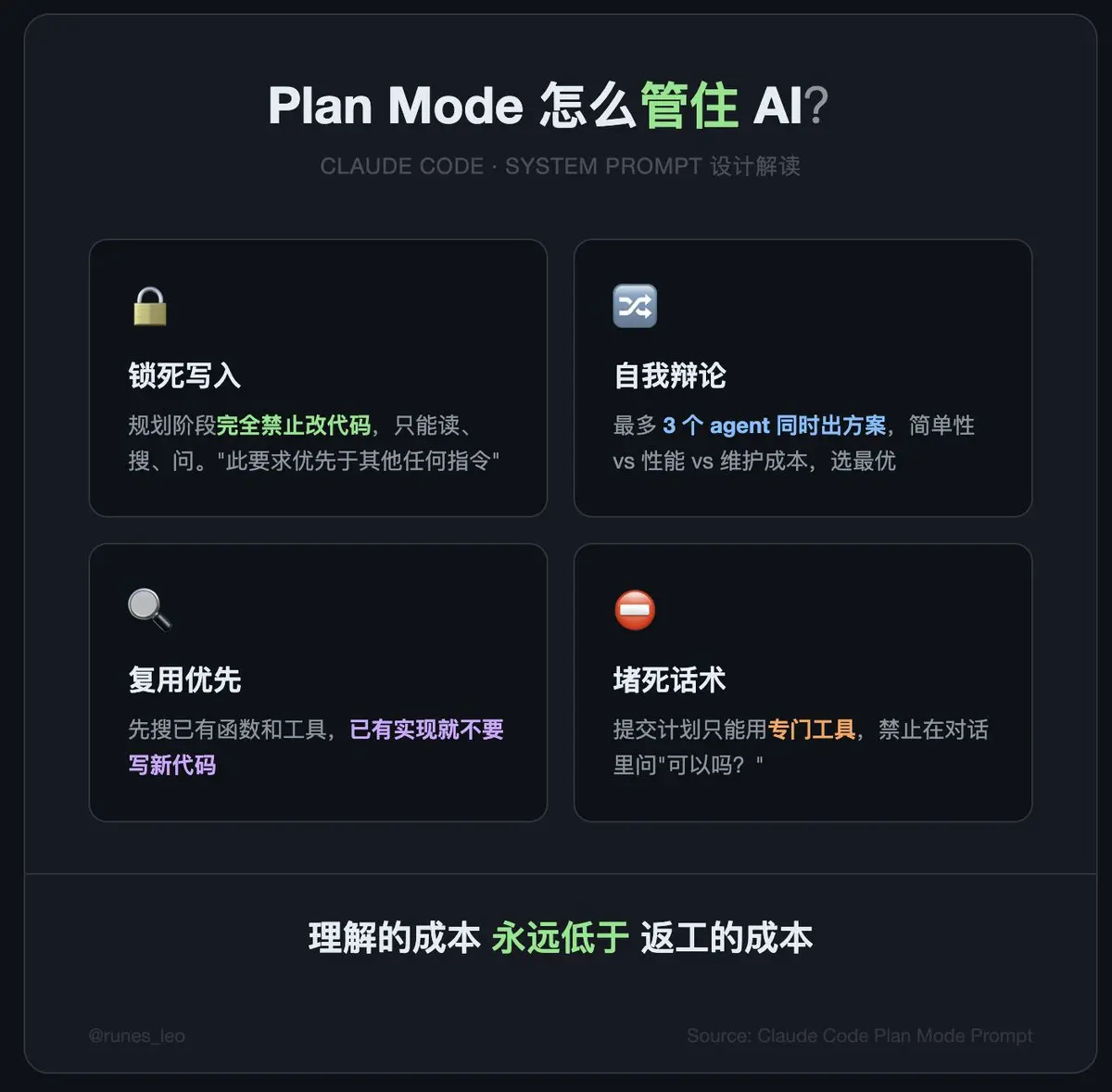
The core of hundreds of words in Plan Mode isn't about making AI do more—it's about preventing it from acting.
- After entering Plan Mode, modifying code is completely prohibited. Only read, search, and ask. The prompt is hard-coded with "this requirement takes priority over any other instructions"—physically locking down write permissions.
- Maximum 3 agents running simultaneously from different angles to propose solutions. For new features, one examines simplicity, one examines performance, one examines maintena
View Original
post-image
  • Reward
  • Comment
  • Repost
  • Share
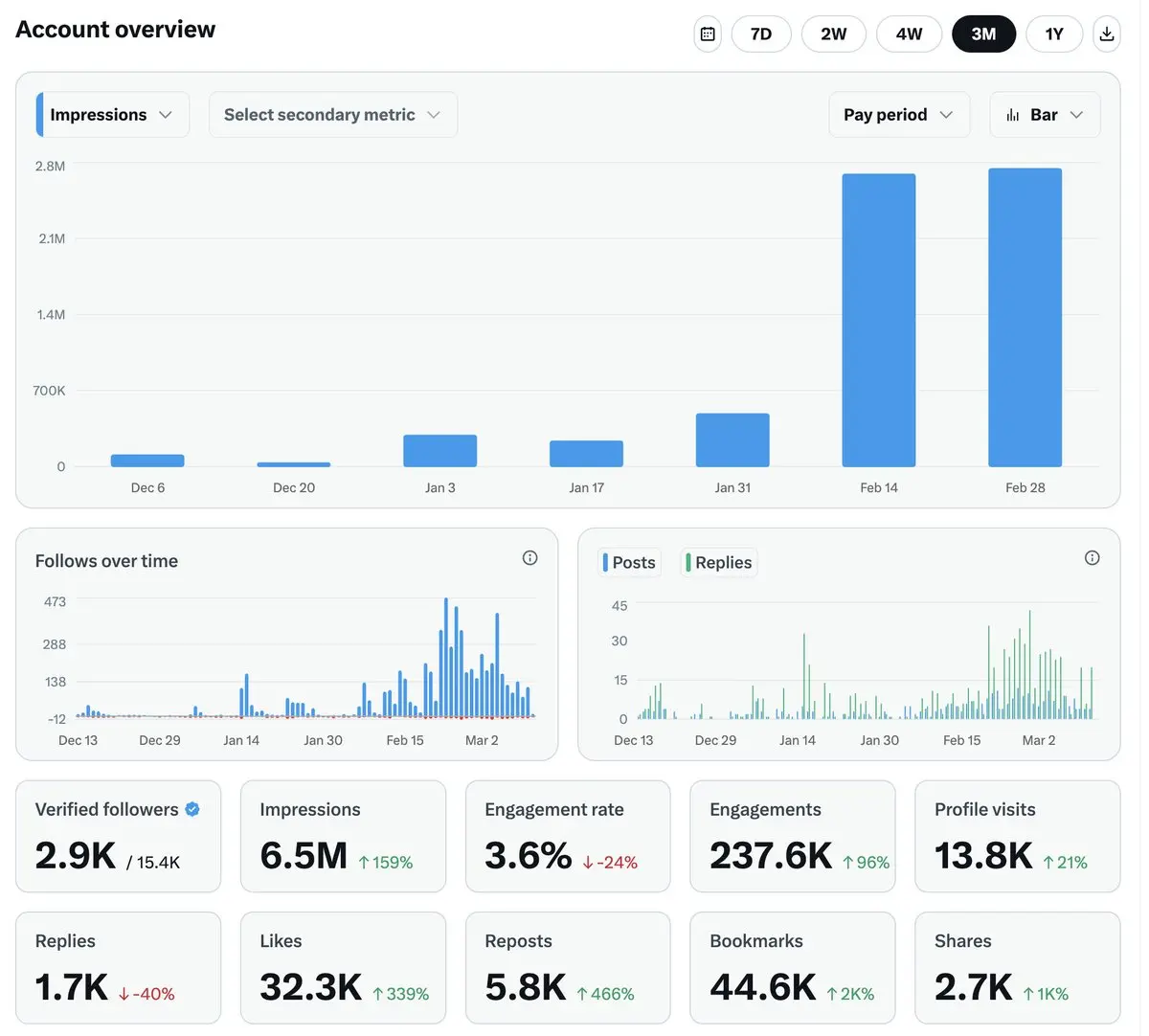
Three months ago, a few thousand views every two weeks; now, one cycle reaches 2.8 million. A total of 6.5 million impressions, 44K favorites, and an increase of 6,000 followers.
I didn't spend a single penny, I just did one thing: wrote down the daily build process.
Discovered an counterintuitive data point: curation content (rephrasing others) sometimes gets very high views, but practical content (sharing personal pitfalls) has a收藏 rate three times higher than curation. In the AI era, more and more people prefer to收藏 content to feed AI;收藏 is truly the real content asset.
Crossed the 5
View Original
post-image
  • Reward
  • Comment
  • Repost
  • Share
Connected Claude Code to an X search engine.
Built a local bridging service based on Grok, running in the background, which Claude Code automatically calls when it needs to search X.
A one-line terminal command returns a summary plus relevant user quotes in seconds.
Two key advantages: it doesn’t use X’s official API (saving the $200 monthly Basic plan), and it can access real-time updates—API searches have delays and indexing limits, but Grok fetches the latest directly. (Prerequisite: may require X Premium+/Premium Grok permissions)
The most typical scenario: when working with Claud
View Original
  • Reward
  • Comment
  • Repost
  • Share
Both are being used together:
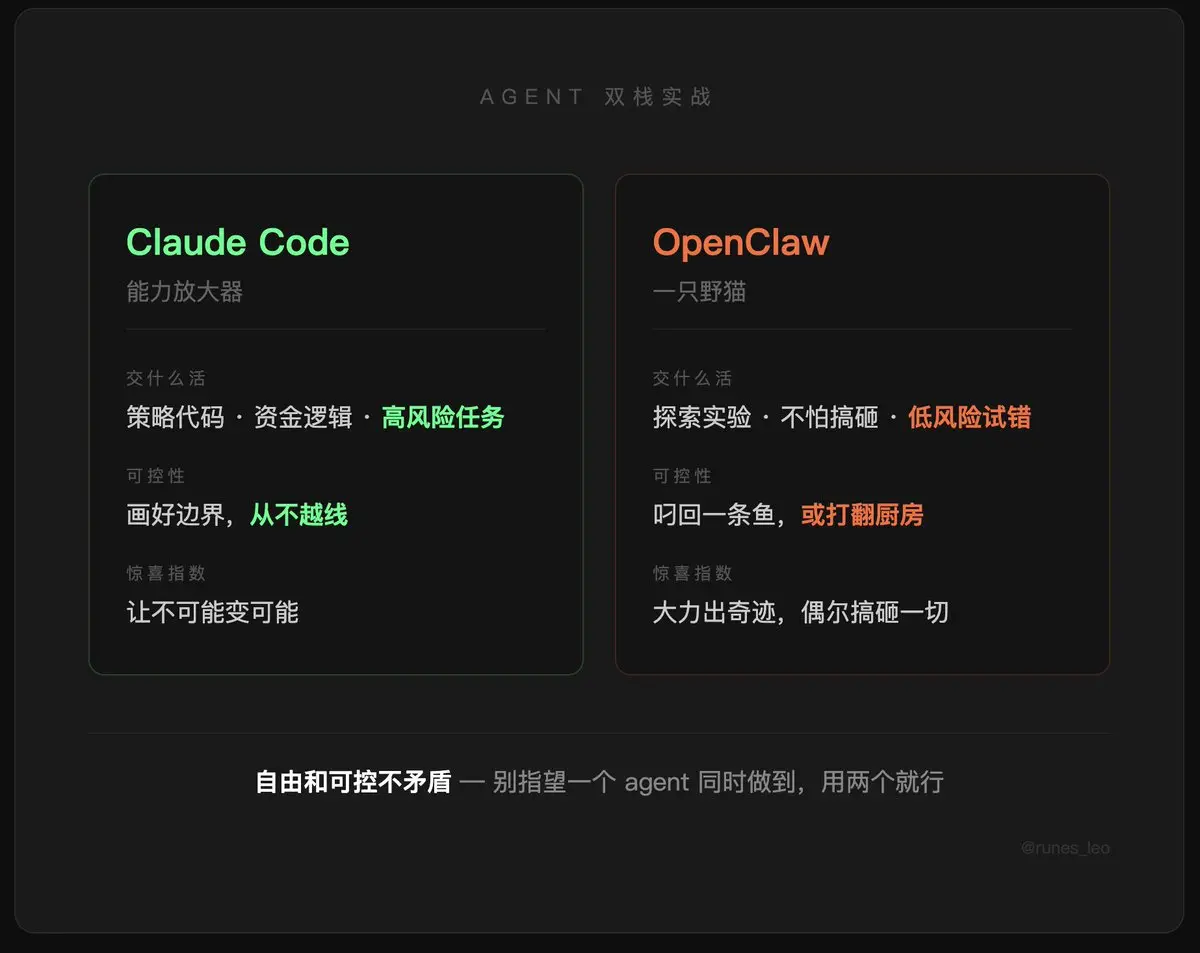
Claude Code is an ability amplifier—it allows me to accomplish things that were previously impossible on my own, while strictly adhering to the boundaries I set, never crossing the line.
OpenClaw is like a wild cat—you never know if it will come back with a fish or knock over the entire kitchen in the next second.
My current approach is to partition tasks: strategic code and funding-related activities are handled by Claude Code, exploratory tasks and experiments that don’t mind messing up are assigned to OpenClaw.
It’s not about choosing which is better, but
View Original
post-image
  • Reward
  • Comment
  • Repost
  • Share
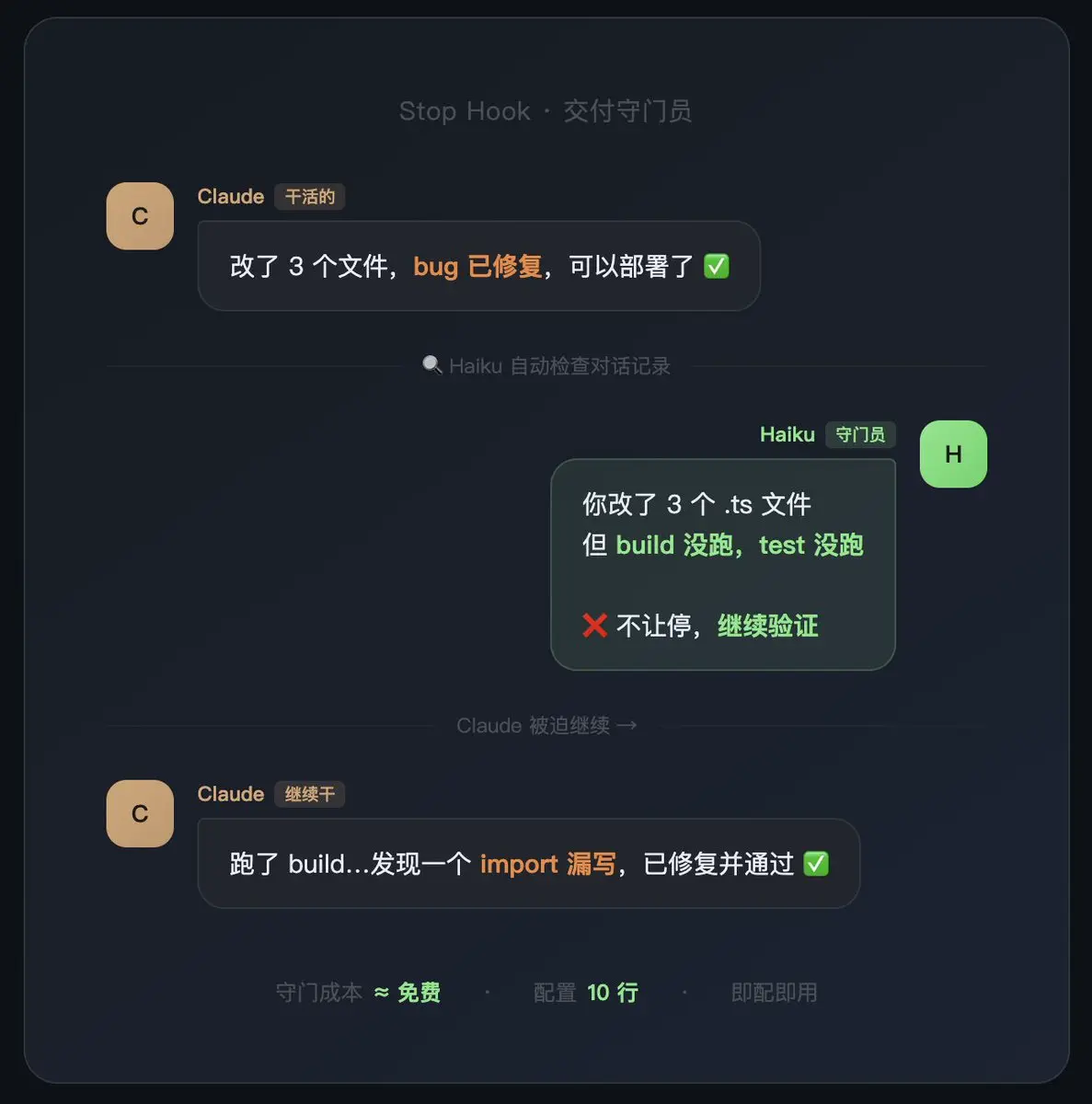
Claude Code's latest update adds prompt hooks — allowing LLMs to replace shell scripts for hook decision-making.
My first idea: set up a gatekeeper for Claude.
Every time it says "Done" and wants to stop, Haiku automatically checks the conversation history —
Code changed but tests not run? Don't let it stop, keep going.
Previously, shell scripts could only do keyword matching, which Claude easily bypassed. Now, Haiku understands context — it can tell at a glance if "changed 3 files but didn't run build."
Just set it up and catch issues on the spot. The cost is almost free.
View Original
post-image
  • Reward
  • Comment
  • Repost
  • Share
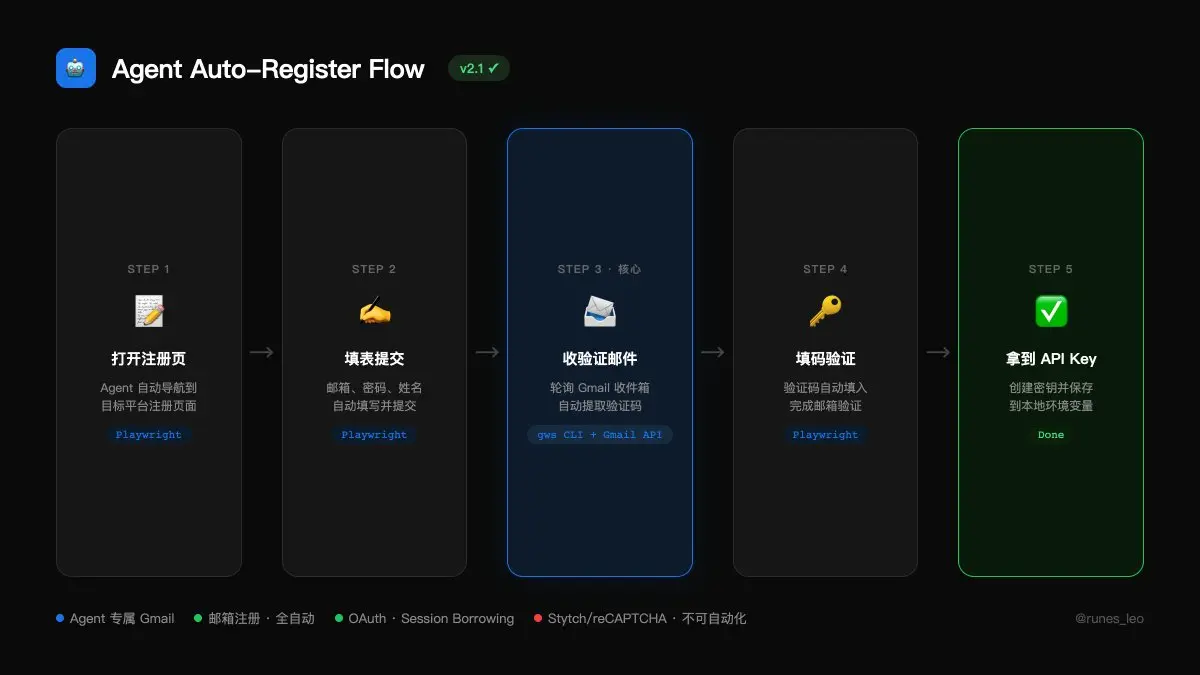
Google has open-sourced the Workspace CLI today, allowing direct command-line access to the Gmail API. For me, it means one thing: the last piece of the Agent auto-registration puzzle is in place.
Previously, I automated registration and login for Claude Code—opening websites, filling out forms, creating accounts—all handled automatically. The only manual step was email verification; I had to check emails and copy-paste the codes. Now, with gws CLI polling Gmail to automatically extract verification codes, the entire process is seamless.
I tested several AI platforms: the Agent registers i
View Original
post-image
  • Reward
  • Comment
  • Repost
  • Share
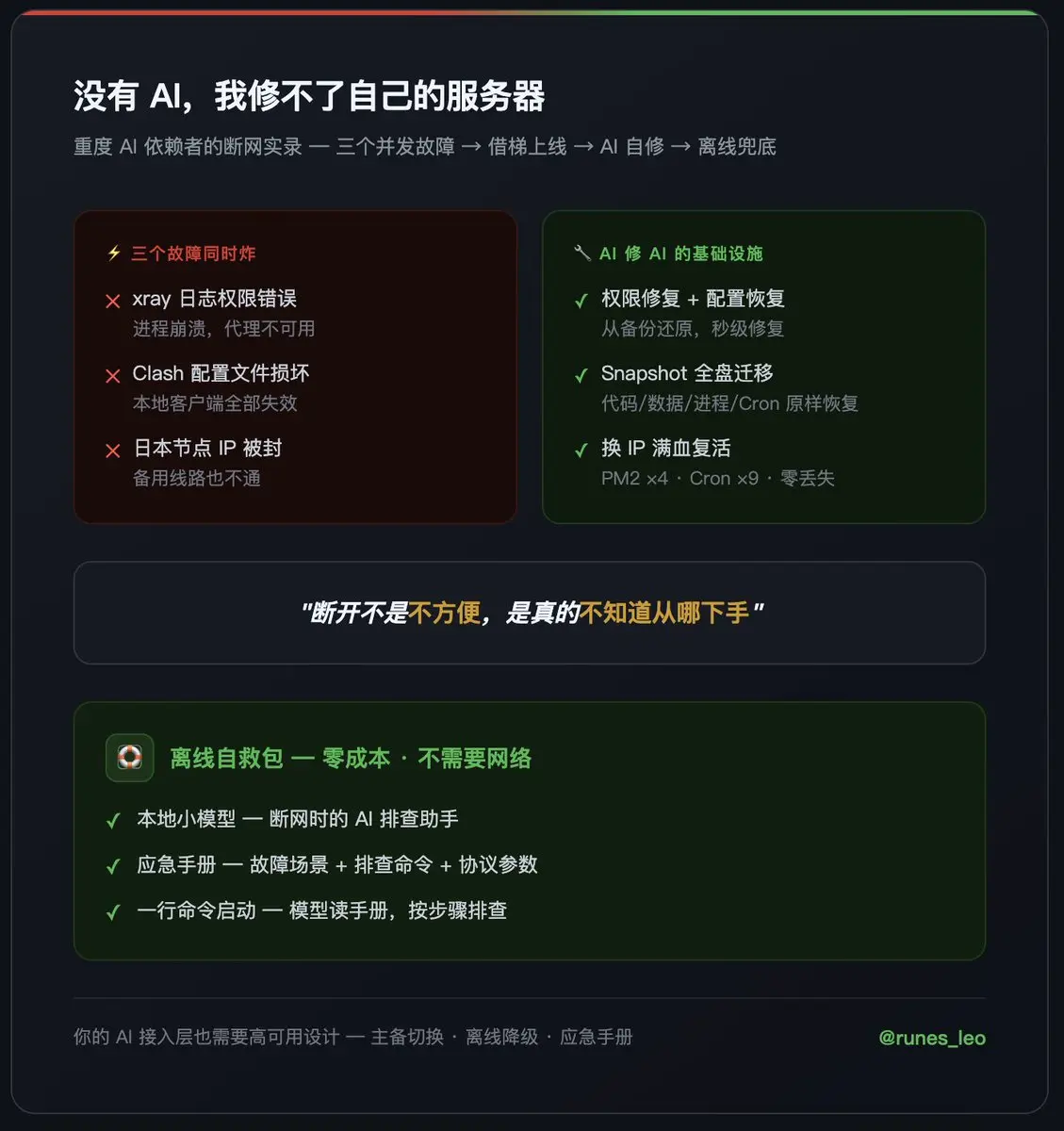
Last night, all proxy nodes went down simultaneously.
Three concurrent issues: Xray log permission errors on VPS causing process crashes, local Clash configuration files corrupted, and Japanese node IP suspected to be blocked. The result was—completely losing connection with Claude Code.
It was then that I realized one thing: I find it very difficult to troubleshoot problems "naked" on my own.
For the past half year, almost all technical decisions were made through AI conversations. Reading logs, modifying configurations, checking documentation, writing scripts—all done with AI and Claud
View Original
post-image
  • Reward
  • Comment
  • Repost
  • Share
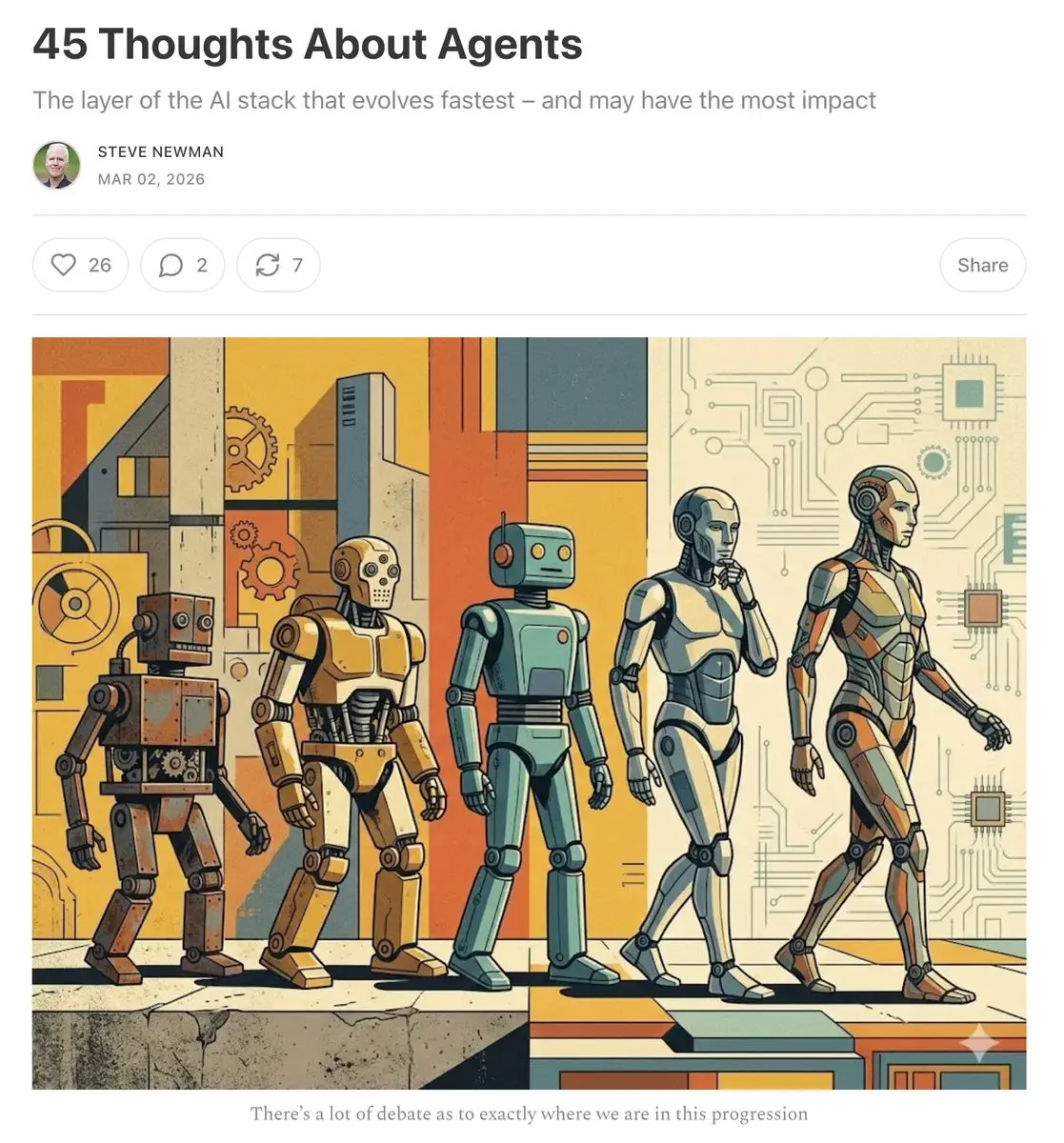
I recommend this article "45 Thoughts About Agents" written by Google Docs co-founder Steve Newman, which is very information-dense.
Some memorable points:
Agents are the fastest-evolving layer in the AI stack — models are updated every few months, and Claude Code can release multiple versions in a single day;
But even faster than the evolution of agents is the way users work.
Naively handing tasks over to agents may actually decrease productivity. The key is enabling agents to self-validate — to run tests and prove they are "doing the right thing" independently, rather than you checki
View Original
post-image
  • Reward
  • Comment
  • Repost
  • Share
Using Claude Code for three months, the directory structure has become more and more complex, with rules/ docs/ memory/ skills/ and various layers, but I kept struggling to clearly explain what I was building.
Until I read this paper "Everything is Context," which translated my folder structure into academic language:
→ The paper calls it Scratchpad (Temporary Workspace)
→ Fact Memory (Project-level Fact Memory)
→ Experiential Memory (Cross-project Experience)
rules/ auto-loading vs docs/ on-demand loading → Context Constructor (Selective loading within token budget)
The part that resonated
View Original
  • Reward
  • Comment
  • Repost
  • Share
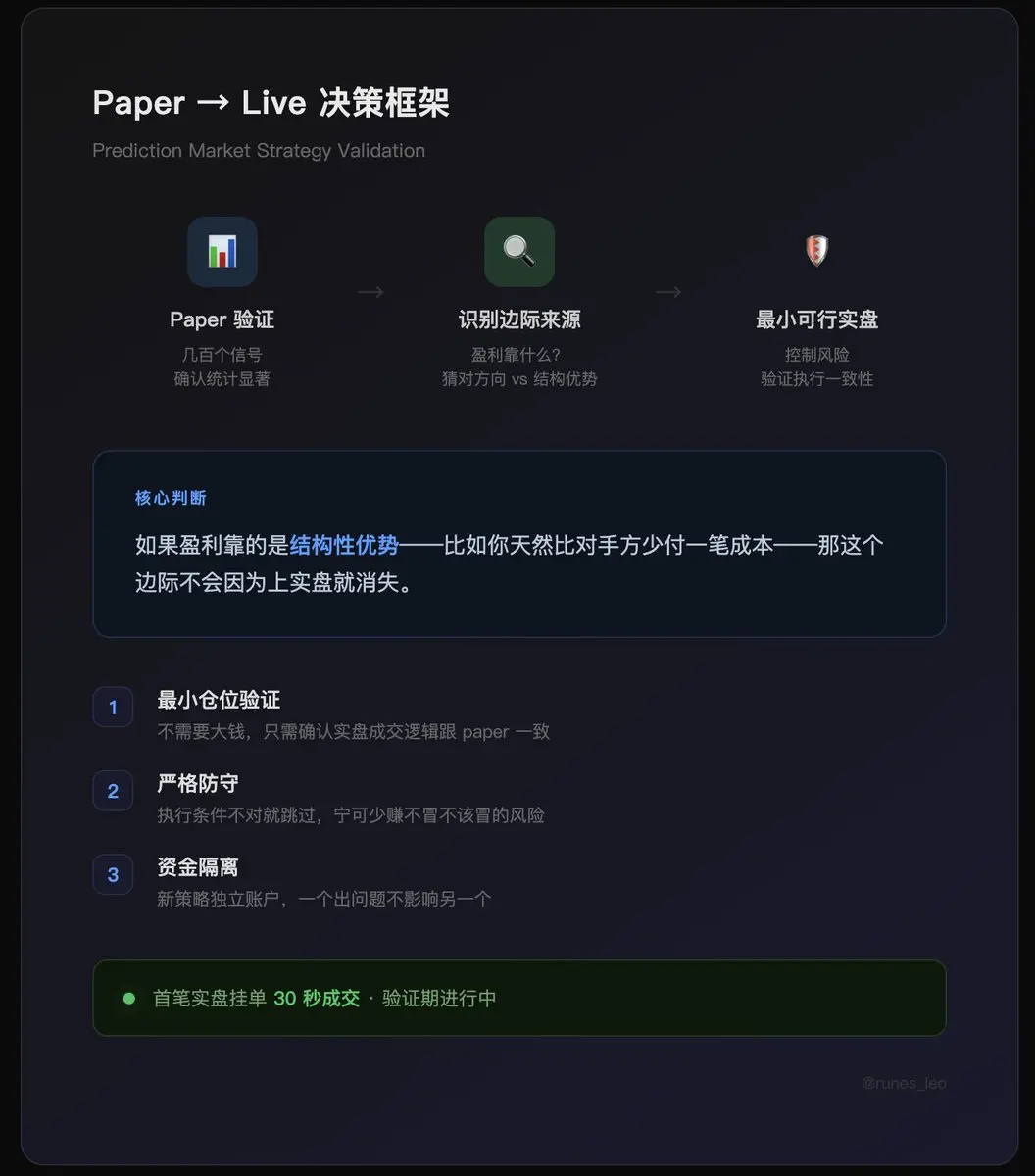
When you've run hundreds of signals with the Polymarket Paper strategy and the win rate looks good, should you go live?
My judgment is simple: first, figure out what the profitability depends on.
If it's based on "guessing the right direction," then the paper's win rate isn't very meaningful—slippage and emotions in real trading can change everything. But if it's based on structural advantages—being naturally less costly than your opponents in a market—then this edge won't disappear just because you go live.
After understanding this, going live only requires controlling three things:
- Minimum
View Original
post-image
  • Reward
  • Comment
  • Repost
  • Share
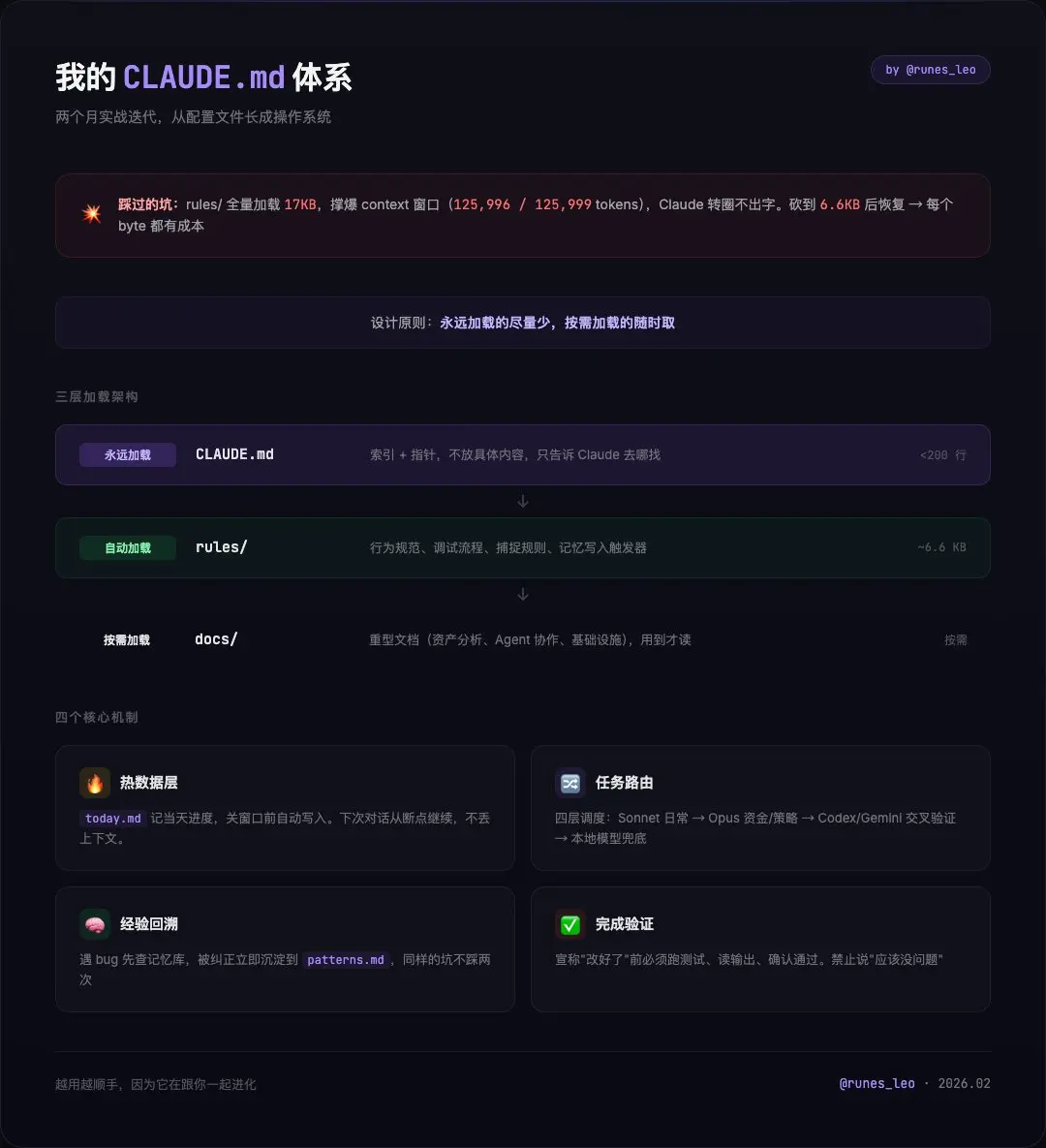
Using Claude Code for over two months, it has grown from a configuration file into a full-fledged operating system.
The most painful pitfall I encountered: files in the rules/ directory are fully loaded on every conversation. I inserted 17KB of rules, which directly overloaded the context window—125,996 / 125,999 tokens—Claude couldn’t generate any output. I had to reduce it to 6.6KB to restore normal operation.
This experience taught me a design principle: every byte has a cost, and loading on demand is the correct approach.
My current structure is three-layer:
(Always loaded, <200 lines, onl
View Original
post-image
  • Reward
  • Comment
  • Repost
  • Share
An counterintuitive discovery made by independent development:
Product features vs. infrastructure, the latter always takes priority.
Today, I checked the project status and found that the trading strategy has been offline for 24 hours (WebSocket disconnected), and all data pipelines are stale. Meanwhile, I was busy working on a "Portfolio Digest" feature to add some polish.
Lessons learned:
- Regularly proactively check the core system status
- "Running" status doesn't always mean it's actually operational
- The thing closest to money > making the product look better
Revised priority: fix inf
View Original
  • Reward
  • Comment
  • Repost
  • Share
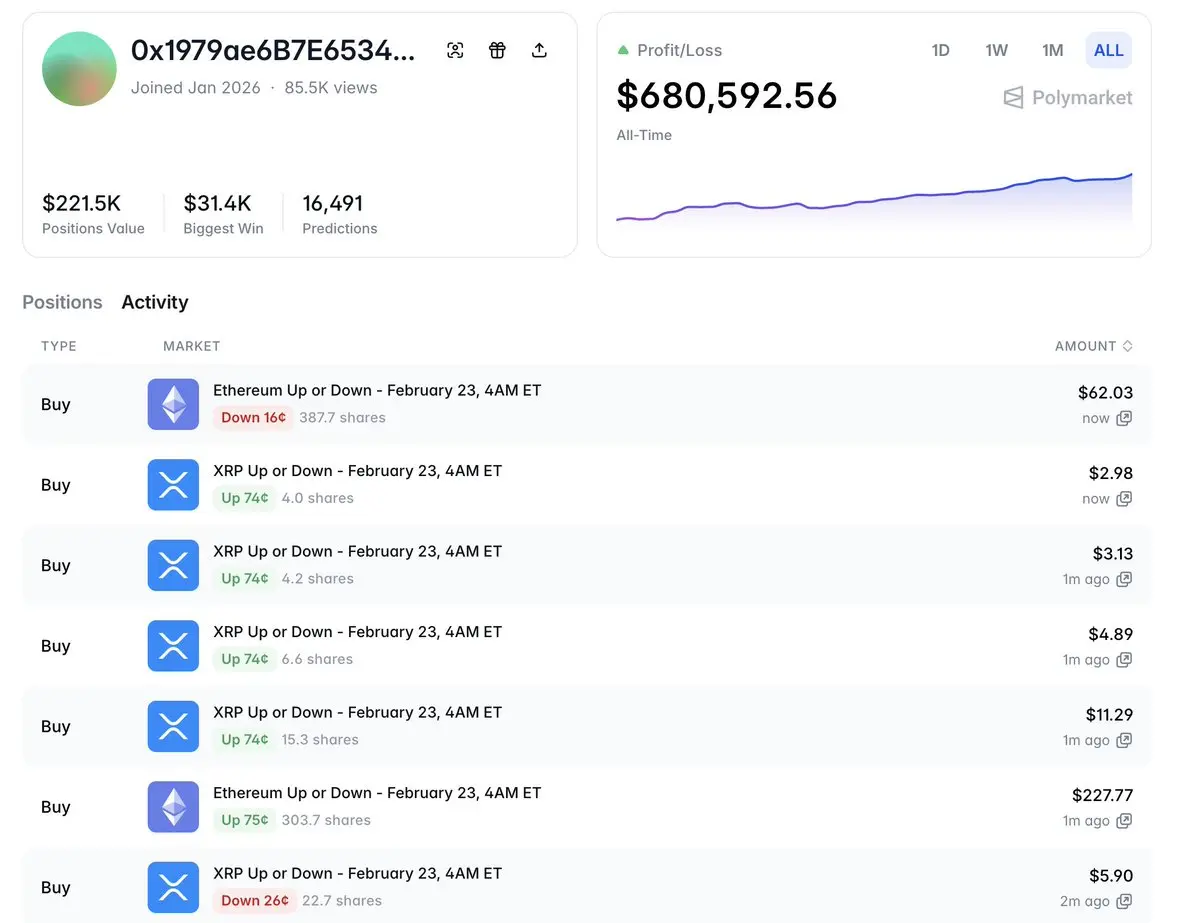
A few days ago, Polymarket quietly changed a rule without any announcement.
The 500ms taker delay in the crypto market was removed. Previously, each order had a half-second waiting period, allowing market-making bots to cancel quotes during this half-second, effectively acting as a free safety net. Now, orders are filled instantly, and if the quote is 200ms slower, it gets canceled.
Many market-making bots have started losing money.
Many people might have seen this account—total profit of $680K,
BTC5,62%
ETH7,13%
SOL7,74%
XRP5,1%
View Original
post-image
  • Reward
  • Comment
  • Repost
  • Share
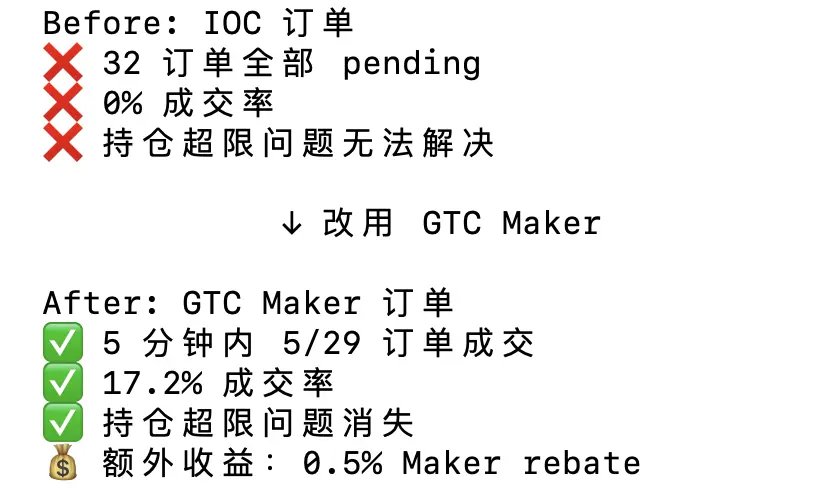
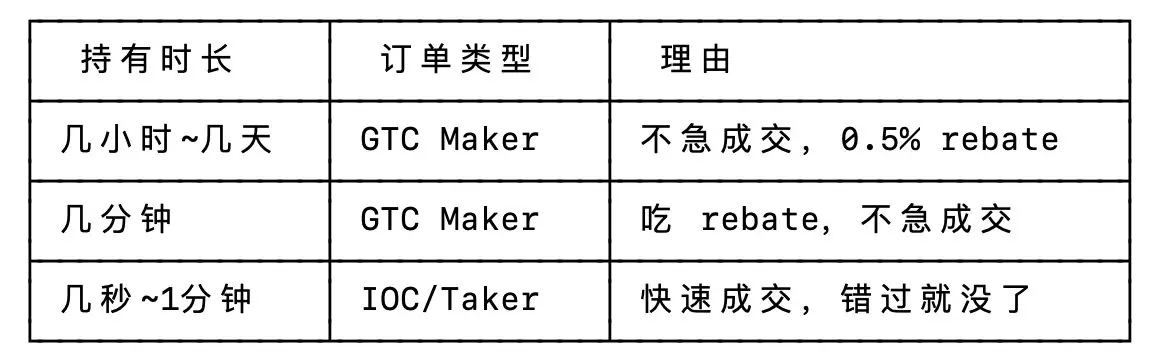
The prediction market strategy's single-market position limit has always been ineffective, despite multiple fixes that didn't resolve the issue.
Today, I finally identified the root cause: using the wrong order type.
Issue Description
Since the launch of the H12 Weather Strategy, there have been two strange bugs:
1. The total position in a single market always exceeds $10 limit
2. Placed 32 orders, none filled (0% fill rate)
Initially, I thought it was a logic problem. I checked the deduplication function, position calculation, and order status checks—all seemed correct. The code looked fine
View Original
post-image
post-image
  • Reward
  • Comment
  • Repost
  • Share
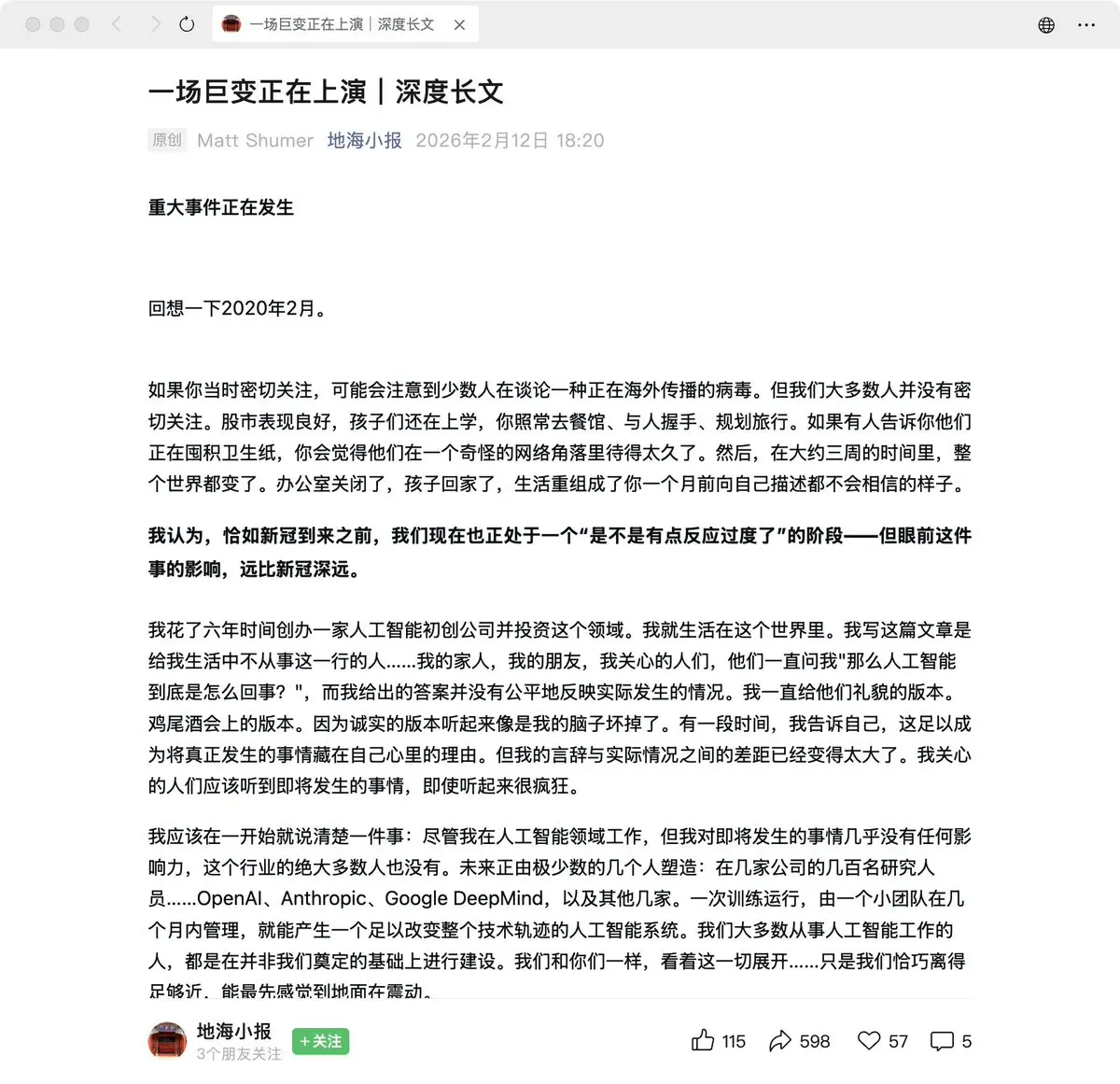
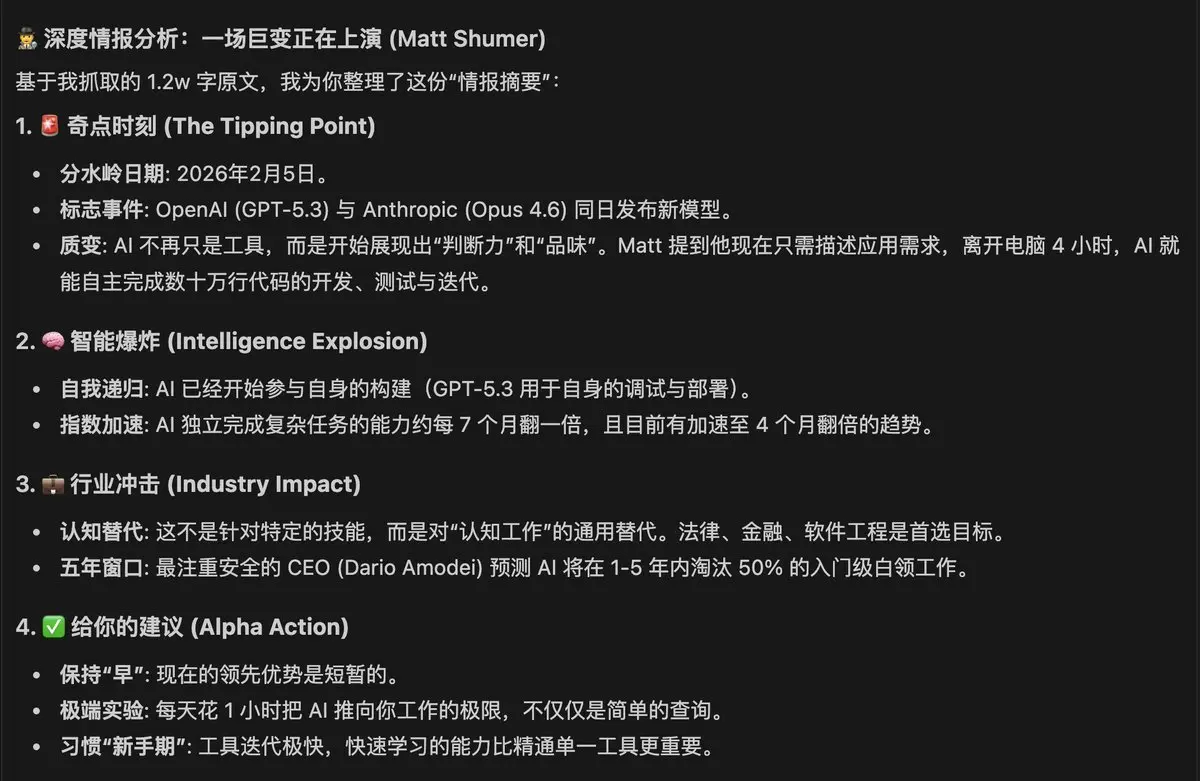
Reading Matt Shumer's 12,000-word article "A Great Transformation Is Unfolding" left me with a very strong impression.
Many people are still debating whether AI can write poetry, but Matt reveals a more brutal critical point: February 5, 2026.
On that day, OpenAI and Anthropic will release new models on the same day. The most important thing is not performance improvements, but that AI has begun to deeply participate in its own development (recursive evolution).
Building AI requires code, and AI is now best at coding—this positive feedback loop has already closed.
As AI evolution accel
View Original
post-image
post-image
  • Reward
  • Comment
  • Repost
  • Share
This perspective is so sharp.
Evolutionary theory has determined that humans are cognitive misers (Cognitive Miser).
System 2 (human reasoning) is extremely energy-consuming and slow, while System 3 (AI reasoning) is very cheap and fast. Given the opportunity, the brain will definitely outsource System 2 tasks to System 3.
Future divergence: 99% of people will regress into "pure System 1 users" (only passively consuming answers). 1% of people will evolve into "System 3 architects" (designing how AI thinks).
I'm pushing myself to become that 1%.
View Original
  • Reward
  • Comment
  • Repost
  • Share
  • Pin