Malik1124

vip
Age 1.2 Yıl
Peak Tier 0
No content yet
#GENIUSImplementationRulesDraftReleased
The Definitive Guide to GENIUS Act Rulemaking & Stablecoin Regulation (2026)
Updated with the latest regulatory developments as of April 2026.
Introduction: Why GENIUS Matters
The Guiding and Establishing National Innovation for U.S. Stablecoins Act (GENIUS Act) represents the first comprehensive federal law in the United States designed to regulate payment stablecoins — digital assets pegged to fiat currency that are used for payments, settlements, and broader financial activity. The law was signed into effect on July 18, 2025, marking a historic turn
Vortex_Kingvip
#GENIUSImplementationRulesDraftReleased
The Definitive Guide to GENIUS Act Rulemaking & Stablecoin Regulation (2026)
Updated with the latest regulatory developments as of April 2026.
Introduction: Why GENIUS Matters
The Guiding and Establishing National Innovation for U.S. Stablecoins Act (GENIUS Act) represents the first comprehensive federal law in the United States designed to regulate payment stablecoins — digital assets pegged to fiat currency that are used for payments, settlements, and broader financial activity. The law was signed into effect on July 18, 2025, marking a historic turning point in how digital currencies intersect with traditional financial regulation.
The GENIUS Act is not merely another policy paper — it is a framework that will shape how stablecoins are issued, managed, supervised, and integrated into the financial system. Over the course of 2025 and early 2026, federal agencies including the Treasury Department, Office of the Comptroller of the Currency (OCC), Federal Deposit Insurance Corporation (FDIC), and National Credit Union Administration (NCUA) have been engaged in drafting and proposing implementing rules — the actual regulations that will bring the law to life.
The recent release of the Draft Implementation Rules — referred to here as #GENIUSImplementationRulesDraftReleased — marks a crucial phase where the public, industry participants, and policymakers can see the practical interpretation of the law and provide feedback. In this post, we explain:
What the GENIUS Act requires
What the Draft Implementation Rules propose
Key regulatory and compliance provisions
Impact on stablecoin issuers and service providers
Industry reactions and controversies
Strategic implications for crypto businesses and financial institutions
1. Overview of the GENIUS Act
1.1 What the Law Is and What It Does
The GENIUS Act establishes a federal regulatory framework for payment stablecoins in the United States. Stablecoins are digital assets that are pegged to fiat currencies (e.g., the U.S. dollar) and are widely used in cryptocurrency markets for trading, payments, remittances, and DeFi protocols.
Key elements of the law include:
A prohibition on any person other than a “permitted payment stablecoin issuer” from issuing a payment stablecoin in the U.S.
A prohibition on digital asset service providers offering or selling stablecoins unless certain conditions are met (e.g., the issuer is approved or foreign issuers meet specific requirements)
A requirement that federal regulators issue implementing regulations within one year of enactment — i.e., by July 18, 2026
The law’s goal is to balance innovation in digital payments with consumer protection, financial stability, and anti-money-laundering (AML) safeguards.
2. The Regulatory Implementation Process
Passing the GENIUS Act was only the first step. The law mandates that multiple federal agencies issue regulations to interpret and enforce its provisions. This includes:
Treasury Department — for overarching guidance and coordination, especially state regulatory frameworks.
OCC (Office of the Comptroller of the Currency) — for federal stablecoin issuer regulation.
FDIC (Federal Deposit Insurance Corporation) — for draft rules on stablecoin applications tied to insured institutions.
NCUA (National Credit Union Administration) — for draft rules on stablecoin issuance by credit unions.
Each agency has been working through Notice of Proposed Rulemaking (NPRM) or draft regulations that lay out how the law will function in practice.
3. Treasury’s Draft Rules & Public Comment Period
One of the most recent developments is the Treasury Department’s notice of proposed rulemaking, which seeks public input on how to implement key aspects of the GENIUS Act.
3.1 State-Level Regulatory Regimes
The Treasury’s proposal focuses on establishing broad principles for determining whether a state-level regulatory regime is “substantially similar” to the federal framework. This is critical because:
Stablecoin issuers with less than $10 billion in outstanding issuance may opt for state regulation instead of full federal oversight — but only if the state regime is certified as substantially similar.
This creates a federal-state regulatory partnership model where states can regulate smaller issuers — but under principles set by the federal government.
3.2 Public Comment & Participation
The Treasury’s NPRM invites comments from all stakeholders, and the public comment period is open for 60 days after publication in the Federal Register. This means industry participants, academics, legal experts, and the general public can influence how stablecoin regulation is shaped.
4. OCC’s Proposed Rulemaking for Stablecoin Issuers
The OCC’s draft rule — a major piece of the implementation puzzle — was issued in early 2026. This proposed rule would:
Define what constitutes a permitted payment stablecoin issuer (PPSI) under federal law.
Clarify the types of entities that can be PPSIs (national banks, federal savings associations, foreign issuers meeting specific requirements, etc.).
Specify restrictions on custody, issuance, and operational activities related to stablecoins.
A key takeaway is that the rule generally limits stablecoin issuance to PPSIs — effectively eliminating unregulated issuance and placing stablecoin creation under the supervision of federal regulators.
5. FDIC & NCUA Draft Rules
In parallel with Treasury and OCC activity:
The FDIC released draft rules for stablecoin applications tied to insured institutions, providing guidance on how banks can participate in stablecoin issuance under GENIUS.
The NCUA unveiled draft rules for credit unions that seek to become stablecoin issuers, further expanding the regulated pathways.
These draft regulations signal that multiple regulatory paths are being developed — but all with strict compliance requirements.
6. Key Regulatory Themes in the Draft Rules
Across the draft regulations from Treasury, OCC, FDIC, and NCUA, several major themes emerge:
6.1 Permitted Payment Stablecoin Issuers (PPSIs)
A central concept is the designation of PPSIs — entities authorized to issue stablecoins. The draft rules propose clear criteria and supervision mechanisms for PPSIs, including capital, risk management, and compliance expectations.
6.2 Prohibitions on Unregulated Issuance
The draft rules reiterate that only PPSIs may issue payment stablecoins in the U.S., and digital asset service providers cannot offer or sell stablecoins unless certain conditions are met.
This has profound implications for exchanges, wallets, and DeFi platforms that currently facilitate stablecoin trading without issuer status.
6.3 Federal vs. State Oversight
The Treasury’s proposed principles for state regulation create a dual-track system where smaller issuers can choose state oversight — but only if the state framework meets federal standards.
6.4 AML, Consumer Protection, and Risk Management
Draft regulations emphasize:
Strong AML/CFT (Anti-Money Laundering/Counter-Terrorist Financing) controls
Consumer protection safeguards
Risk management and operational resilience
These requirements mirror traditional financial regulation but are tailored to digital asset risks.
7. Industry Reactions & Controversies
The regulatory proposals have sparked diverse reactions within the crypto community and broader financial industry.
7.1 Concerns About Innovation
Some stakeholders argue that stringent rules may stifle innovation, especially for nonbank and decentralized entities that have historically driven stablecoin development. Critics say that limiting issuance to PPSIs could centralize stablecoin creation among large financial institutions.
7.2 Yield-Bearing Stablecoins Debate
Another major controversy is the treatment of yield-bearing stablecoins — tokens that pay interest or rewards. The GENIUS Act did not explicitly address this category, leading to regulatory uncertainty and debate in Congress and among regulators.
8. Strategic Implications for Market Participants
The release of the draft implementation rules means that crypto firms, financial institutions, and technology providers must start preparing for compliance:
8.1 For Stablecoin Issuers
Entities that want to issue stablecoins in the U.S. will likely need to:
Apply for PPSI status
Build robust compliance programs
Align with federal or certified state regulatory frameworks
This may involve partnerships with banks or state regulators to meet requirements.
8.2 For Exchanges & Wallets
Platforms that list or facilitate stablecoin transactions will need to:
Verify issuer status
Ensure compliance with AML and consumer protection standards
Adjust product offerings to align with new regulations
9. What’s Next? Timeline & Expectations
The regulatory process is still unfolding:
Public comments on draft rules are ongoing through 2026.
Agencies are expected to finalize regulations by July 18, 2026, per the law’s timeline.
Implementation and compliance phases will continue into 2027 and beyond as enforcement mechanisms and supervisory structures are put in place.
10. Conclusion: A New Era for Stablecoin Regulation
The release of the #GENIUSImplementationRulesDraftReleased marks a watershed moment in digital asset regulation. For the first time, stablecoins — a cornerstone of modern cryptocurrency ecosystems — are being integrated into a comprehensive federal regulatory framework that aims to balance innovation with safety, transparency, and financial stability.
This regulatory evolution will shape how stablecoins operate, how businesses interact with them, and how consumers and institutions use digital assets in the years ahead. The draft rules reflect both the promise and complexity of bringing digital finance into the regulated financial system.
Stakeholders across the crypto and financial sectors should engage with the public comment process, assess compliance requirements, and prepare for a future where stablecoins are a regulated part of mainstream finance.

repost-content-media
  • Reward
  • Comment
  • Repost
  • Share
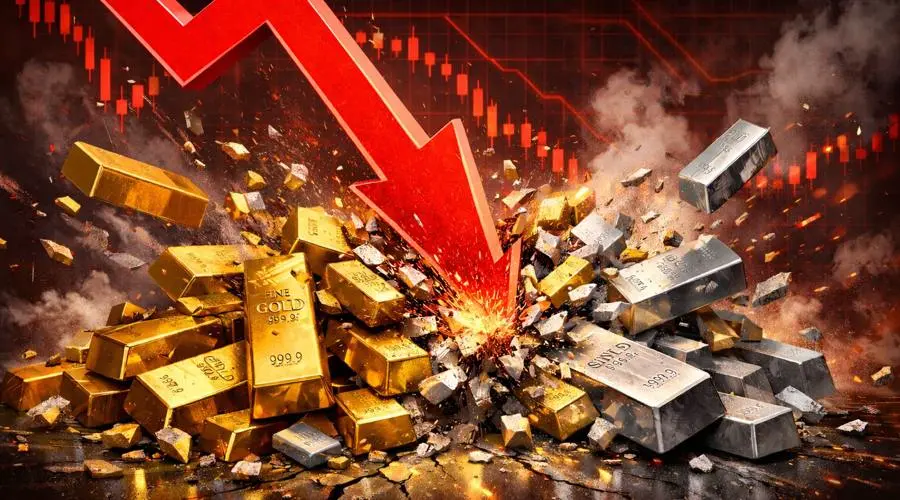
#PreciousMetalsPullBackUnderPressure
The global commodities market is experiencing a powerful shift—and right now, precious metals are under serious pressure.
After one of the strongest rallies in modern history, gold, silver, and other metals are pulling back sharply. What makes this moment so important is not just the decline itself—but why it’s happening.
Because this is not a normal correction.
👉 This is a complex mix of macroeconomics, geopolitics, liquidity flows, and market structure
👉 And understanding it gives you a huge edge as an investor
This
Vortex_Kingvip
#PreciousMetalsPullBackUnderPressure
The global commodities market is experiencing a powerful shift—and right now, precious metals are under serious pressure.
After one of the strongest rallies in modern history, gold, silver, and other metals are pulling back sharply. What makes this moment so important is not just the decline itself—but why it’s happening.
Because this is not a normal correction.
👉 This is a complex mix of macroeconomics, geopolitics, liquidity flows, and market structure
👉 And understanding it gives you a huge edge as an investor
This is your deep, Gate-style 3000-word research and analysis 👇
🔥 1. The Big Picture: From Boom to Pullback
Precious metals had an explosive run leading into 2026.
Gold surged to near record highs
Silver experienced a parabolic rally
Massive inflows from institutions and retail investors
But now…
👉 The market has entered a sharp correction phase
Recent observations show:
Gold has seen one of its steepest monthly declines in years
Silver fell even more aggressively
Platinum and palladium also declined
👉 This is not just profit-taking
👉 This is a multi-layered macro reset
⚠️ 2. The Core Reason: Interest Rates Are Crushing Metals
This is the #1 factor driving the pullback.
Precious metals like gold and silver are non-yielding assets.
That means:
👉 They don’t pay interest
👉 They rely on price appreciation only
Now look at what’s happening:
Inflation concerns remain elevated
Central banks are cautious about cutting rates
Bond yields remain attractive
As a result:
👉 Interest rates stay higher for longer
👉 Cash and bonds become more appealing
And this is negative for metals.
Because investors now prefer:
✔ Yield-generating assets
✔ Safer income streams
Instead of:
❌ Holding non-yielding gold
💵 3. The Dollar Effect: The Silent Killer
The US dollar plays a crucial role in precious metals pricing.
Here’s the relationship:
👉 Strong dollar = Weak metals
👉 Weak dollar = Strong metals
Right now:
Global capital is flowing into USD
Higher interest rates support dollar strength
Investors seek liquidity and safety
This creates:
👉 Downward pressure on gold and silver prices
Because metals become more expensive for non-dollar buyers.
🧠 4. The “Crowded Trade” Problem
One of the most overlooked reasons behind the correction:
👉 Too many investors were already bullish
Before the pullback:
Gold was heavily overbought
Hedge funds were heavily positioned long
Sentiment was extremely optimistic
When markets become crowded:
👉 Even small negative triggers can cause large declines
What happened next:
Profit-taking accelerated
Funds reduced exposure
Selling pressure increased rapidly
⚡ 5. The Liquidity Shock: Why Everything Fell Together
Here’s a key insight:
👉 In times of stress, even safe assets get sold
Why?
Because investors need liquidity.
During volatility:
Margin calls increase
Institutions reduce risk
Cash becomes king
So even gold:
👉 Gets sold to cover losses elsewhere
This explains why metals dropped alongside other assets.
🛢️ 6. Oil, Inflation, and the Paradox
Normally:
👉 Higher inflation = bullish for gold
But currently:
👉 Inflation is driven by energy prices
Oil price increases push inflation higher
Central banks respond by staying hawkish
This leads to:
👉 Higher interest rates
👉 Stronger dollar
👉 Pressure on metals
This creates a paradox:
👉 Inflation rises, but gold falls
📉 7. Silver Is Falling Harder — And Here’s Why
Silver behaves differently from gold.
👉 It has dual roles:
Precious metal
Industrial commodity
Key reasons for its sharper drop:
1. Overextended Rally
Silver rose faster → bigger correction
2. Economic Sensitivity
Industrial demand fears affect price
3. Volatility
Silver naturally moves more aggressively
👉 This makes silver more vulnerable during pullbacks
🏦 8. Central Banks: Still Quietly Buying
While prices fall:
👉 Central banks continue accumulating gold
Reasons include:
Diversification of reserves
Reducing dependence on foreign currencies
Long-term stability
👉 This creates underlying support for gold prices
📊 9. Technical Analysis: Market Structure
From a technical perspective:
Gold is stabilizing near key support levels
Resistance zones remain above current price
Momentum is slowing but not collapsing
Silver:
Showing volatility
Attempting to form a base
Still under resistance pressure
👉 The structure suggests consolidation, not breakdown
🧩 10. Crash or Healthy Correction?
Let’s evaluate both sides:
Bearish Scenario:
Interest rates stay high
Dollar remains strong
Risk sentiment improves
👉 Metals stay weak
Bullish Scenario:
Economic slowdown emerges
Central banks cut rates
Financial stress increases
👉 Metals rebound strongly
👉 Current data suggests this is a correction, not a collapse
🌍 11. Geopolitical Influence
Global tensions remain elevated.
However:
👉 Markets are not reacting in traditional ways
Gold typically rises during crises—but timing matters.
Often:
👉 Initial phase = volatility
👉 Later phase = sustained rally
This suggests:
👉 Metals may strengthen later
🔄 12. Market Psychology
Market sentiment has shifted.
Before:
👉 Greed and optimism
Now:
👉 Uncertainty and caution
This creates:
Short-term volatility
Rapid price swings
Confusion among retail investors
👉 Emotional markets create opportunities
🚀 13. Long-Term Outlook
Despite short-term pressure, long-term fundamentals remain strong.
Key drivers:
✔ Global debt expansion
✔ Currency devaluation risks
✔ Central bank accumulation
✔ Industrial demand (silver)
✔ Geopolitical uncertainty
👉 These factors support future upside
⚠️ 14. Risks to Watch
Investors should monitor:
1. Interest Rate Decisions
Major influence on metals
2. Dollar Strength
Key inverse relationship
3. Inflation Trends
Direction matters
4. Liquidity Conditions
Market stability
5. Global Events
Can trigger sudden moves
🧠 15. Strategy for Investors
❌ Avoid:
Panic selling
Overtrading
Ignoring macro trends
✅ Focus on:
Long-term positioning
Gradual accumulation
Diversification
Risk management
🔥 Final Insight
This pullback reflects a shift in priorities.
👉 Markets are favoring yield over safety
But this is not permanent.
When conditions change:
👉 Metals can regain strength quickly
🧾 Final Conclusion
The pullback in precious metals is driven by:
✔ High interest rates
✔ Strong US dollar
✔ Profit-taking
✔ Liquidity pressures
✔ Inflation dynamics
But underneath:
👉 Structural demand remains intact
📌 Bottom Line
Precious metals are not collapsing.
👉 They are adjusting to new macro conditions
And in financial markets:
👉 Corrections often create the biggest opportunities
VORTEX KING
VORTEX KING
repost-content-media
  • Reward
  • Comment
  • Repost
  • Share
#DriftProtocolHacked
🚨 #DriftProtocolHacked
The crypto market just witnessed one of the biggest shocks of 2026 — and it’s shaking confidence across the entire DeFi ecosystem.
A massive exploit targeting Drift Protocol has resulted in hundreds of millions of dollars stolen, triggering panic, market volatility, and serious questions about DeFi security.
Here’s your deep research + analysis breakdown of what happened, why it matters, and what comes next 👇
🔥 1. What Happened — The Hack Explained
Drift Protocol, a Solana-based DeFi platform, suffered a major exploit
Estimated losses: $200M – $2
SOL-2,53%
ETH-3,71%
Vortex_Kingvip
#DriftProtocolHacked
🚨 #DriftProtocolHacked
The crypto market just witnessed one of the biggest shocks of 2026 — and it’s shaking confidence across the entire DeFi ecosystem.
A massive exploit targeting Drift Protocol has resulted in hundreds of millions of dollars stolen, triggering panic, market volatility, and serious questions about DeFi security.
Here’s your deep research + analysis breakdown of what happened, why it matters, and what comes next 👇
🔥 1. What Happened — The Hack Explained
Drift Protocol, a Solana-based DeFi platform, suffered a major exploit
Estimated losses: $200M – $285M+
Large amounts of funds were transferred to suspicious wallets
Immediately after detecting the breach:
👉 The platform suspended deposits and withdrawals
👉 Users were warned not to deposit funds
👉 Security firms began tracking stolen assets
👉 This is now one of the largest crypto hacks of 2026
💸 2. Where Did the Money Go?
Blockchain tracking shows:
Funds moved to unknown wallet addresses
Converted into major assets like stablecoins and ETH
Bridged across multiple blockchains
Gradually swapped to reduce traceability
👉 Classic laundering pattern:
Bridge → Swap → Obfuscate → Repeat
And here’s the reality:
👉 Transactions are visible
👉 But recovery is extremely difficult
⚠️ 3. How Did the Hack Happen? (Early Analysis)
The exact exploit is still under investigation, but early signs suggest:
🧠 Possible Attack Vectors:
1. Oracle Manipulation
Price feeds may have been manipulated
Fake pricing enabled abnormal borrowing
2. Fake Collateral Attack
Worthless or manipulated tokens used as collateral
Real assets drained against false value
3. Smart Contract Weakness
Logic flaws or overlooked vulnerabilities
👉 Likely a combination of multiple weaknesses rather than a single bug
🧨 4. Why This Hack Is Different
This is not just another exploit.
1. Timing
Occurs during growing institutional interest in DeFi
2. Scale
Hundreds of millions lost
3. Impact
Affects trust across the entire ecosystem
👉 This makes it a system-level event, not just a protocol issue
📉 5. Market Reaction
Immediate effects:
Sharp drop in related token prices
Increased volatility across DeFi assets
Fear spreading in the broader crypto market
👉 One major hack can impact the entire sector
🏦 6. The Bigger Problem: DeFi Security Crisis
This event highlights a core issue:
👉 Innovation is moving faster than security
Key weaknesses:
❌ Complex Smart Contracts
More features increase risk
❌ Oracle Dependencies
External data feeds can be exploited
❌ Governance Risks
Human decision layers can be manipulated
❌ Limited Emergency Controls
Decentralization slows reaction speed
👉 Result: Large-scale vulnerabilities
🔄 7. The Custody Problem
Important insight:
👉 In DeFi, you don’t fully control your funds
Even though wallets are user-controlled:
Funds are locked in smart contracts
Bugs = total loss
👉 This creates a major contradiction:
Decentralization offers freedom—but also full responsibility
⚖️ 8. Regulation Will Accelerate
Events like this push regulators to act faster.
Expected outcomes:
Stricter compliance requirements
Mandatory audits
Security certifications
Pressure for user protection systems
👉 The era of “unregulated DeFi” is fading
🧠 9. Key Lessons for Investors
🚨 1. No Protocol Is 100% Safe
Even large platforms can fail
🚨 2. High Returns Come With High Risk
Yield often reflects underlying danger
🚨 3. Diversification Is Essential
Never rely on a single platform
🚨 4. Stay Informed
Monitoring activity can reduce exposure
🔍 10. What Happens Next?
Key questions:
1. Can Funds Be Recovered?
Very difficult, but tracking continues
2. Will Attackers Be Identified?
Possible through blockchain analysis
3. Will the Platform Recover?
Depends on response and compensation
4. Will Regulation Increase?
Highly likely
⚔️ 11. Impact on the Future of DeFi
This event may lead to:
🔒 Stronger Security Standards
Better audits and protections
🏦 Institutional Frameworks
More structured systems
🧱 Improved Infrastructure
Safer protocol design
👉 Growth will continue—but with stricter rules
🔥 Final Insight
This hack is more than a loss of funds.
👉 It is a critical warning for the entire industry
It reveals:
Structural weaknesses
Security gaps
Systemic risks
At a time when adoption is accelerating
🧾 Final Conclusion
The Drift Protocol exploit shows:
✔ Massive losses can happen instantly
✔ Transparency does not equal safety
✔ DeFi is still evolving
But also:
👉 These events drive improvement and maturity
📌 Bottom Line
This is not the end of DeFi.
👉 But it marks the end of blind trust
The next phase will be:
✔ More secure
✔ More regulated
✔ More institutional
VORTEX KING
VORTEX KING
repost-content-media
  • Reward
  • Comment
  • Repost
  • Share
#OilPricesRise
#OilPricesRise
The global energy market is heating up again—and this time, the move is aggressive, fast, and deeply connected to geopolitics, macroeconomics, and financial flows.
Oil prices are rising sharply, and this isn’t just another short-term fluctuation.
👉 This is a signal
👉 A warning
👉 And potentially the start of a much bigger macro shift
Here’s your deep research + 3000-word Gate-style analysis of what’s really driving oil higher—and what it means for markets 👇
🔥 1. The Big Picture: Why Oil Is Rising Now
Oil doesn’t move randomly.
Every major move reflects:
✔ Sup
Vortex_Kingvip
#OilPricesRise
#OilPricesRise
The global energy market is heating up again—and this time, the move is aggressive, fast, and deeply connected to geopolitics, macroeconomics, and financial flows.
Oil prices are rising sharply, and this isn’t just another short-term fluctuation.
👉 This is a signal
👉 A warning
👉 And potentially the start of a much bigger macro shift
Here’s your deep research + 3000-word Gate-style analysis of what’s really driving oil higher—and what it means for markets 👇
🔥 1. The Big Picture: Why Oil Is Rising Now
Oil doesn’t move randomly.
Every major move reflects:
✔ Supply shocks
✔ Demand expectations
✔ Geopolitical risks
✔ Financial positioning
Right now, all four are aligning.
That’s why oil is rising with strength.
🌍 2. Geopolitics: The #1 Driver
The biggest catalyst behind rising oil prices is:
👉 Geopolitical tension
Key developments:
Conflict risks in major oil-producing regions
Threats to supply routes (especially shipping lanes)
Military tensions increasing uncertainty
Markets react instantly because:
👉 Oil supply is highly concentrated geographically
Even a small disruption can cause:
Price spikes
Supply fears
Panic buying
👉 This creates a risk premium in oil prices
🛢️ 3. Supply Constraints Tightening
Another major factor:
👉 Global oil supply is tightening
Key reasons:
1. Production Cuts
Major oil producers are limiting output
2. Underinvestment
Years of low investment in oil infrastructure
3. Capacity Limits
Some producers are already near maximum output
👉 Result:
Supply cannot quickly respond to rising demand
📈 4. Demand Is Still Strong
Despite economic uncertainty:
👉 Oil demand remains resilient
Drivers include:
Global transportation
Industrial activity
Emerging market consumption
Even with slower growth:
👉 Demand is not collapsing
This creates:
✔ A supply-demand imbalance
✔ Upward pressure on prices
💵 5. The Dollar Factor
Oil is priced in US dollars.
So:
👉 Weak dollar → Oil rises
👉 Strong dollar → Oil pressured
However, right now:
👉 Geopolitical risk is overpowering currency effects
Even with a relatively strong dollar:
👉 Oil is still climbing
This shows how powerful the current drivers are.
⚡ 6. The Risk Premium Explained
This is critical to understand.
When tensions rise:
👉 Traders price in future supply disruptions
Even if supply is currently stable.
This “fear premium” can add:
$5
$10
Even $20+ per barrel
👉 Without any actual shortage
🧠 7. Financial Markets Are Fueling the Rally
Oil is not just a physical commodity.
👉 It is also a financial asset
Institutional players:
Hedge funds
Banks
Commodity traders
Are increasing exposure.
This leads to:
✔ Momentum buying
✔ Trend amplification
✔ Faster price movements
📉 8. Why Oil Rises Even During Uncertainty
Many people assume:
👉 Economic uncertainty = lower oil demand
But here’s the twist:
👉 Supply shocks matter more than demand fears
Right now:
Supply risks are immediate
Demand slowdown is uncertain
👉 Markets prioritize immediate risks
🛢️ 9. OPEC+ Strategy: Silent Power
Oil-producing alliances play a huge role.
They can:
Cut production
Maintain tight supply
Support higher prices
👉 Their strategy often focuses on:
✔ Price stability
✔ Revenue maximization
And right now:
👉 Supply discipline is supporting higher prices
⚠️ 10. Inflation Is Coming Back
Rising oil prices directly impact:
Fuel costs
Transportation
Manufacturing
Consumer goods
👉 This feeds into inflation
And here’s the key:
👉 Oil is one of the strongest inflation drivers
So when oil rises:
👉 Inflation expectations rise
🏦 11. Central Banks Are in Trouble
Higher oil prices create a policy dilemma:
❌ Problem:
Inflation rises again
❌ Challenge:
Economic growth is still fragile
Central banks may be forced to:
👉 Keep interest rates higher for longer
👉 Delay rate cuts
This impacts:
Stocks
Crypto
Bonds
📉 12. Impact on Financial Markets
Rising oil affects all major asset classes:
📊 Stocks
Energy stocks rise
Tech and growth stocks face pressure
🪙 Crypto
Liquidity tightens
Risk appetite decreases
🟡 Gold
Mixed reaction (inflation vs rates)
💵 Dollar
Can strengthen due to inflation expectations
👉 Oil is a macro driver for everything
🌍 13. Global Economic Impact
If oil continues rising:
Negative Effects:
❌ Higher inflation
❌ Slower economic growth
❌ Increased costs for businesses
❌ Reduced consumer spending
Positive Effects:
✔ Stronger energy sector
✔ Increased revenues for oil-exporting countries
👉 Overall impact:
More pressure on the global economy
⚡ 14. The Volatility Factor
Oil markets are extremely volatile.
Because:
Supply shocks happen suddenly
News moves prices instantly
Traders react aggressively
👉 This creates:
✔ Sharp spikes
✔ Sudden drops
✔ Unpredictable movements
🧩 15. What Happens Next? (Scenario Analysis)
🟢 Bullish Scenario
Tensions escalate
Supply disruptions occur
Oil breaks higher
👉 Prices surge significantly
🔴 Bearish Scenario
Ceasefire or stability returns
Supply fears ease
Demand concerns dominate
👉 Prices drop quickly
🟡 Base Case
Ongoing uncertainty
No major disruption
Moderate price increases
👉 Controlled uptrend
🧠 16. Smart Investor Strategy
❌ Avoid:
Chasing late moves
Ignoring macro signals
Overleveraging
✅ Focus on:
Monitoring geopolitics
Watching supply data
Diversifying investments
Managing risk carefully
🔥 Final Insight
Oil is not just rising.
👉 It is sending a message
Markets are saying:
👉 “Risk is increasing”
👉 “Inflation is not over”
👉 “Stability is fragile”
🧾 Final Conclusion
The rise in oil prices is driven by:
✔ Geopolitical tensions
✔ Supply constraints
✔ Strong demand
✔ Financial flows
✔ Risk premiums
And its impact is massive:
👉 Inflation pressure
👉 Central bank challenges
👉 Market volatility
📌 Bottom Line
Oil is one of the most powerful forces in global markets.
When it rises:
👉 Everything feels it
This is not just an energy story.
👉 It’s a global macro shift in motion
VORTEX KING
VORTEX KING
repost-content-media
  • Reward
  • Comment
  • Repost
  • Share
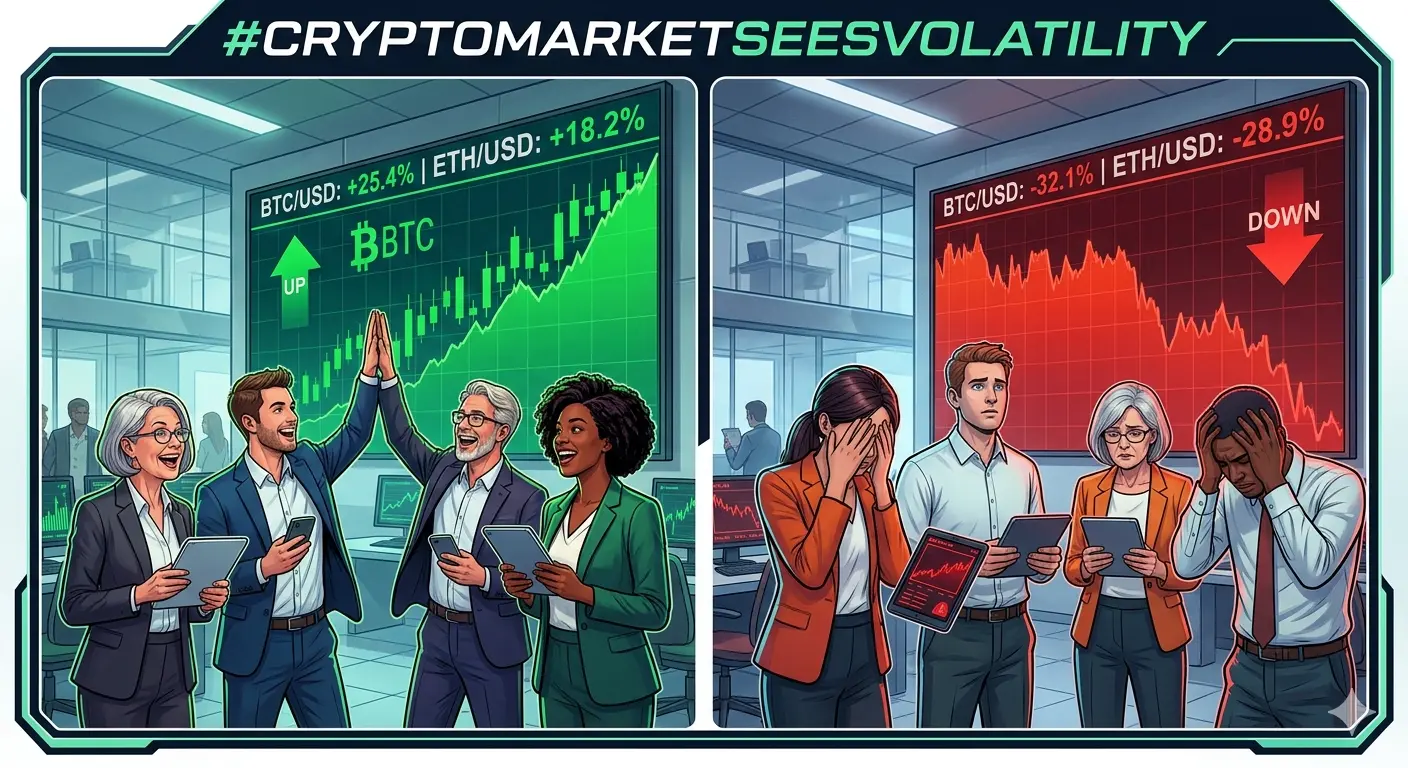
#CryptoMarketSeesVolatility
The crypto market is once again entering a phase that separates experienced investors from emotional traders:
👉 Volatility is back — and it’s stronger than most expected
Prices are swinging sharply. Narratives are shifting daily. Liquidity is rotating fast. And uncertainty is dominating sentiment.
But here’s the truth:
👉 Volatility is not chaos
👉 Volatility is information
It tells you what the market is thinking, where capital is moving, and what may come next.
This is your deep research, high-quality Gate-style analysis of why the cr
DEFI-9,07%
BTC-1,62%
Vortex_Kingvip
#CryptoMarketSeesVolatility
The crypto market is once again entering a phase that separates experienced investors from emotional traders:
👉 Volatility is back — and it’s stronger than most expected
Prices are swinging sharply. Narratives are shifting daily. Liquidity is rotating fast. And uncertainty is dominating sentiment.
But here’s the truth:
👉 Volatility is not chaos
👉 Volatility is information
It tells you what the market is thinking, where capital is moving, and what may come next.
This is your deep research, high-quality Gate-style analysis of why the crypto market is seeing volatility right now—and what it really means 👇
🔥 1. The Current Situation: A Market in Transition
The crypto market is not crashing… and it’s not fully bullish either.
👉 It’s in a transition phase
Key characteristics:
Sharp price swings (up and down)
Sudden liquidations
Rapid sentiment changes
Sector rotation (DeFi, AI, memecoins, etc.)
This kind of behavior usually happens when:
👉 The market is trying to find direction
⚠️ 2. The Core Driver: Macro Uncertainty
Crypto does not exist in isolation anymore.
👉 It is deeply connected to global macro conditions
Right now, macro uncertainty is high:
Interest rates remain elevated
Inflation concerns are still present
Oil prices are rising
Geopolitical tensions are ongoing
This creates:
👉 Uncertainty in liquidity
👉 Uncertainty in risk appetite
And crypto reacts strongly to both.
💵 3. Liquidity Is the Real Engine
If you want to understand crypto volatility, understand this:
👉 Liquidity drives everything
When liquidity is abundant:
✔ Prices rise smoothly
✔ Volatility decreases
When liquidity tightens:
❌ Prices become unstable
❌ Volatility increases
Right now:
Central banks are cautious
Rate cuts are delayed
Financial conditions are tightening
👉 Result: Unstable liquidity = volatile crypto
📉 4. Liquidations Are Fueling the Swings
Crypto markets are heavily leveraged.
This means:
👉 Small price moves can trigger large liquidations
What’s happening now:
Price drops → long positions liquidated
Price rises → short positions liquidated
This creates:
👉 A chain reaction
Known as:
👉 Liquidation cascades
Result:
✔ Fast drops
✔ Sudden spikes
✔ Unpredictable moves
🧠 5. Market Structure Has Changed
Compared to previous cycles:
👉 The crypto market is more complex now
Participants include:
Retail traders
Institutional investors
Algorithmic funds
Market makers
Each reacts differently.
This creates:
👉 Mixed signals
👉 Faster rotations
👉 Higher volatility
⚡ 6. Narrative Rotation Is Accelerating
Crypto is driven by narratives.
Right now, narratives are shifting rapidly:
AI tokens → surge → pullback
DeFi → recovery → uncertainty
Memecoins → hype → collapse
Layer 2 → growth → consolidation
👉 Capital is constantly rotating
This leads to:
✔ Short-lived rallies
✔ Quick reversals
🛢️ 7. External Markets Are Influencing Crypto
Crypto volatility is no longer isolated.
It is reacting to:
Stock market movements
Oil price changes
Bond yield shifts
Currency fluctuations
Example:
👉 Rising oil → inflation fears → risk-off → crypto drops
👉 Falling yields → risk-on → crypto rises
🏦 8. Institutional Behavior Is Changing the Game
Institutions now play a major role.
Their behavior is different:
Risk-managed
Data-driven
Less emotional
But also:
👉 More reactive to macro conditions
They:
Reduce exposure during uncertainty
Increase exposure during stability
👉 This amplifies volatility
⚠️ 9. Fear and Greed Cycle
Crypto is highly emotional.
Right now, the market is shifting between:
👉 Fear ↔ Greed
This creates:
Panic selling
FOMO buying
Fake breakouts
False breakdowns
👉 Emotional markets = volatile markets
📊 10. Technical Factors
From a technical perspective:
Key support and resistance levels are being tested
Breakouts are failing
Trends are unclear
This results in:
👉 Range-bound volatility
Where:
✔ Prices move up and down within a range
🌍 11. Geopolitical Impact
Global tensions are adding uncertainty.
Effects include:
Risk-off sentiment
Capital moving to safe assets
Reduced exposure to crypto
But also:
👉 Sudden reversals when optimism returns
🔄 12. Stablecoins and Capital Flows
Stablecoins are a key indicator.
When volatility rises:
👉 Capital moves into stablecoins
When confidence returns:
👉 Capital flows back into crypto
Monitoring stablecoin supply gives insight into:
👉 Market direction
📉 13. Altcoins vs Bitcoin
Volatility is not equal across the market.
Bitcoin:
More stable
Institutional interest
Altcoins:
Higher risk
Larger swings
👉 During volatility:
Bitcoin dominance often increases
Altcoins suffer more
🚀 14. Opportunities Hidden in Volatility
Volatility is not just risk.
👉 It creates opportunity
For:
✔ Traders (short-term moves)
✔ Investors (discount accumulation)
✔ Institutions (strategic positioning)
But only if managed correctly.
⚠️ 15. Risks to Watch
🚨 1. Over-Leverage
Can cause massive liquidations
🚨 2. Fake Breakouts
Trap inexperienced traders
🚨 3. News Shocks
Sudden market-moving events
🚨 4. Liquidity Drops
Can trigger sharp crashes
🧠 16. Smart Strategy in Volatile Markets
❌ Avoid:
Emotional trading
Overtrading
Chasing pumps
✅ Focus on:
Risk management
Position sizing
Long-term perspective
Watching macro signals
🔥 Final Insight
Volatility is not a problem.
👉 It is a signal
Right now, the market is saying:
👉 “We are uncertain”
👉 “We are repositioning”
👉 “We are preparing for the next move”
🧾 Final Conclusion
The crypto market is volatile due to:
✔ Macro uncertainty
✔ Liquidity tightening
✔ Liquidation cascades
✔ Narrative shifts
✔ Institutional activity
But beneath the noise:
👉 The market is evolving
📌 Bottom Line
Crypto volatility is not the end.
👉 It is the process
A process where:
✔ Weak hands exit
✔ Strong hands accumulate
✔ Smart capital positions early
And when clarity returns…
👉 The next major trend begins
VORTEX KING
VORTEX KING
repost-content-media
  • Reward
  • Comment
  • Repost
  • Share
#GateSquareAprilPostingChallenge
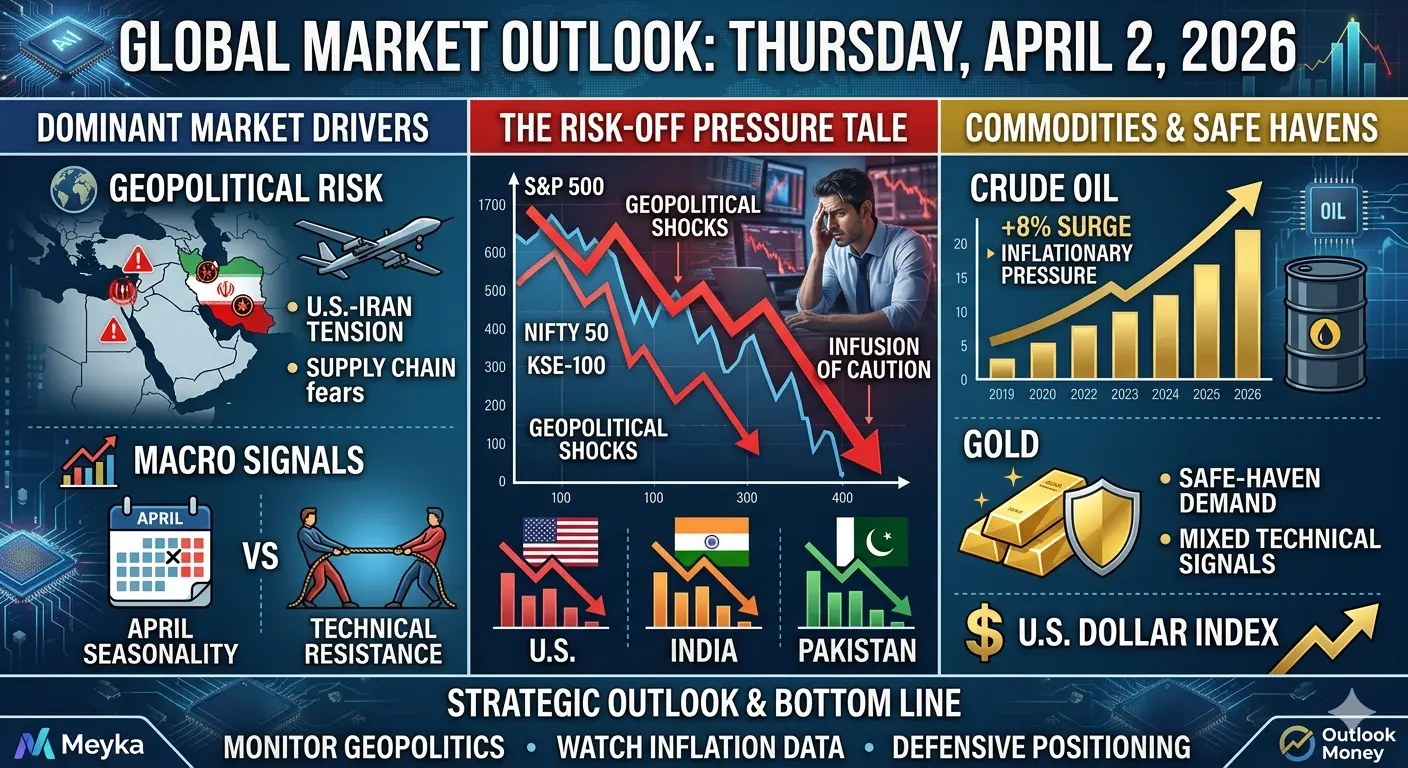
Here’s a comprehensive, deeply researched market outlook for Thursday, April 2, 2026 — written in a clear, human style and suitable for a top-quality financial post. This outlook synthesizes global markets, macroeconomic drivers, regional performance (including Pakistan & India), commodities, FX, and risk factors that traders and investors should watch today. All major points are backed by current market data and news.
Meyka
Outlook Money
Stock market today: Dow, S&P 500, Nasdaq futures fall as Trump signals Iran war not over
Sensex Tanks 1600 Points, Nifty Sl
Vortex_Kingvip
#GateSquareAprilPostingChallenge
Here’s a comprehensive, deeply researched market outlook for Thursday, April 2, 2026 — written in a clear, human style and suitable for a top-quality financial post. This outlook synthesizes global markets, macroeconomic drivers, regional performance (including Pakistan & India), commodities, FX, and risk factors that traders and investors should watch today. All major points are backed by current market data and news.
Meyka
Outlook Money
Stock market today: Dow, S&P 500, Nasdaq futures fall as Trump signals Iran war not over
Sensex Tanks 1600 Points, Nifty Slips Below 22,200 - Why Stock Market Is Falling Today
Today
Today
📉 1. Global Market Mood: Risk-Off Pressure Today
Equity markets are under pressure today as geopolitical tensions intensify and risk sentiment shifts toward safety.
U.S. stock futures were weaker with key indices sliding as geopolitical uncertainty resurfaced, undermining investor confidence.
Indian markets experienced sharp declines, with major indices such as the Sensex and Nifty falling significantly after hawkish geopolitical signals.
Australian equities also closed lower, reflecting broad risk-off sentiment across global markets.
Sector-specific insights highlight areas like energy and materials gaining attention, but overall sentiment is cautious.
Asian markets including Thailand showed mixed performance with regional economic factors in play.
Market takeaway: The immediate mood is risk-averse, with equities retreating as investors reassess geopolitical risk and macro signals.
📊 2. Key Drivers Behind Today’s Market Outlook
🔥 Geopolitical Risk
The U.S.–Middle East conflict dynamics are front and center:
Fresh hawkish rhetoric from Washington has reignited concerns about prolonged conflict, which pressures risk assets like equities and boosts safe-havens like gold and the U.S. dollar.
Crude oil prices have surged sharply, reflecting supply risk and inflation fears — a key driver for inflation expectations and market volatility.
Impact: Heightened geopolitical tension increases volatility and tends to push markets toward defensive positioning.
📈 Macro & Seasonal Market Signals
According to seasonal market research:
April often marks a period of seasonal strength for equities, but current markets are at a critical inflection point where technical resistance and fundamental pressures collide.
The S&P 500 and other benchmarks face resistance near key technical levels, with the potential for reversal or continuation depending on upcoming economic data and geopolitical developments.
Interpretation: Seasonal strength may be challenged by macro pressures, so market direction this month could hinge on inflation data, earnings, and geopolitical resolution.
🌍 3. Regional Market Highlights
🇵🇰 Pakistan (KSE-100)
Pakistan’s benchmark index has pulled back sharply, losing over 2% in recent sessions.
Despite the pullback, the index remains significantly higher year-over-year — indicating longer-term strength but short-term volatility.
What this means: Local investors should watch global risk sentiment and foreign capital flows, as external shocks often amplify domestic volatility.
🇮🇳 India (Sensex & Nifty)
Major Indian indices plunged more than 2% today, led by global risk aversion and crude price fears.
The move reflects sensitivity to global macro drivers, especially in export and financial sectors.
Investor view: A breakout below key support levels could signal deeper correction; conversely, stabilization might attract value buying.
🛢 4. Commodities: Oil & Gold in Focus
🛢 Crude Oil
Oil prices have surged — at times more than 8% — as conflict risk threatens supply and traders reposition.
Higher oil typically feeds into inflationary pressures, affecting consumer sectors and interest rate expectations.
Market implication: Rising oil can dampen equities and boost inflation hedges.
🪙 Gold & Safe Havens
Gold often benefits during risk aversion, though recent data shows mixed technical signals.
With currencies like the U.S. dollar strengthening, precious metals may see sideways movement unless geopolitical risk escalates further.
💱 5. FX & Bonds: Defensive Positioning
The U.S. dollar index has strengthened as investors seek safety.
Currency markets often lead sentiment shifts — a strong dollar can pressure emerging market assets and commodities.
Bonds: Government bond yields may compress as capital flows into safer assets.
📅 6. Economic Data & Upcoming Catalysts
📌 U.S. Economic Indicators
Inflation data and labor reports scheduled this week will be critical for market direction.
Central bank speakers and policy expectations are shaping bond and equity markets.
Key watchpoints:
CPI and jobs data
Fed commentary on rate path
Geopolitical developments
📉 7. Technical Market Themes
Across major indices:
Many are testing key support levels after recent declines.
Breakdowns could confirm deeper corrections; rebounds might signal range-bound markets.
Traders should watch:
Major moving averages
Volatility indicators
Sector rotation patterns
📌 8. Sentiment Snapshot (Community & Traders)
According to market sentiment aggregators:
Sentiment remains mixed, with neutral signals dominating and no clear bullish or bearish consensus.
Short-term technical traders note resistance at key moving averages and geopolitical headlines as catalysts.
📊 9. Strategic Implications for Investors
🟢 Bullish Scenarios
If geopolitical tensions ease and economic data remains strong, markets could resume seasonal gains.
Value sectors and cyclical stocks may benefit from recovery.
🔴 Bearish Scenarios
Escalation in conflict and persistent inflation fears could push markets deeper into correction.
Defensive assets like bonds, gold, and quality equities could outperform.
📌 10. Bottom Line — Today’s Market Outlook
Thursday, April 2, 2026 markets are dominated by risk-off sentiment, driven by geopolitical risk and macro uncertainties. Equity markets globally are pressured, commodities like oil are surging, and safe-haven flows are evident in currencies and bonds. Seasonal strength signals offer potential upside, but technical resistance and geopolitical dynamics pose significant risks. Investors should monitor inflation data, central bank signals, and conflict developments closely.
repost-content-media
  • Reward
  • Comment
  • Repost
  • Share
#GateSquareAprilPostingChallenge
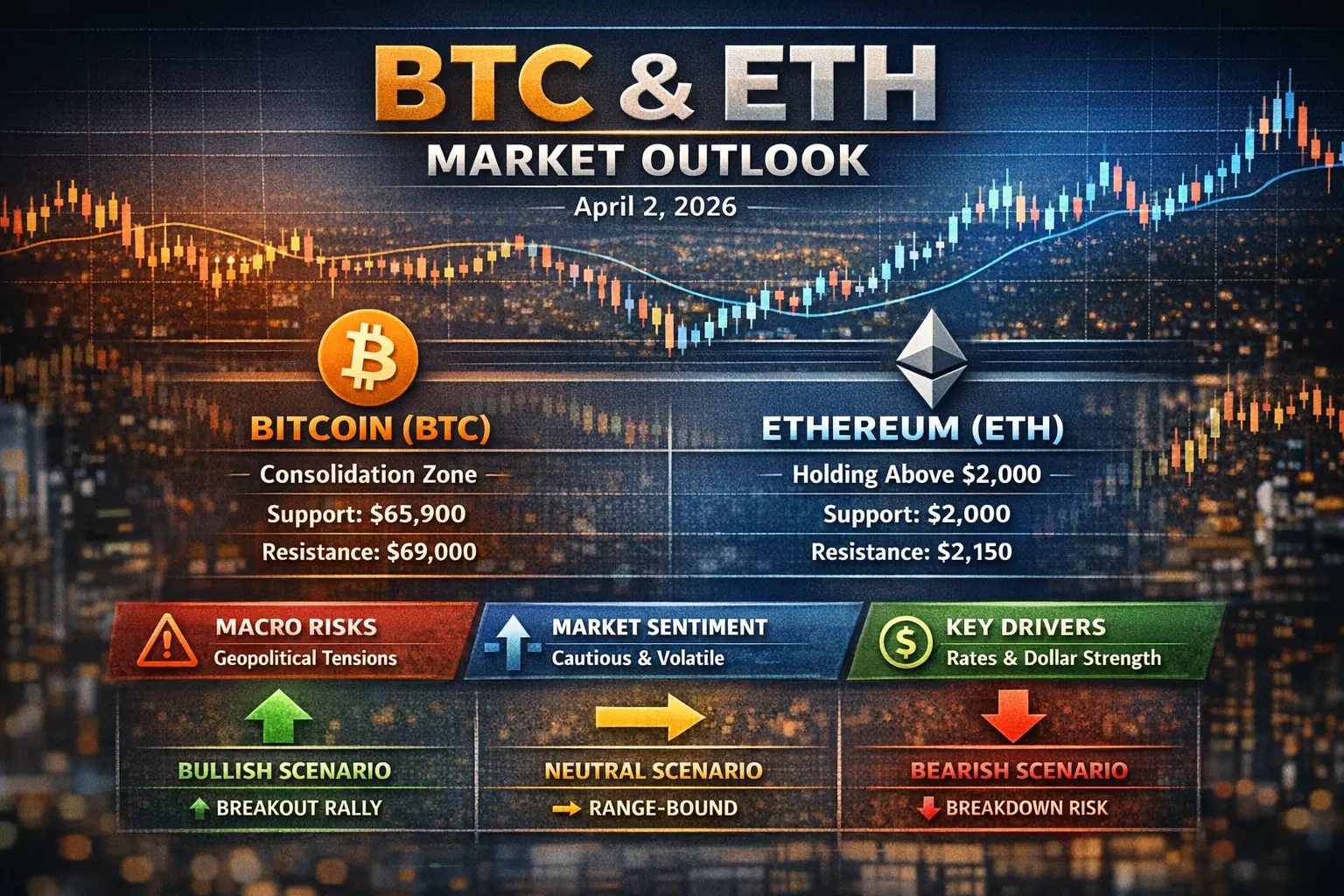
📊 BTC & ETH Market Outlook — April 2, 2026
📌 Current Market Structure
🔹 Bitcoin (BTC)
Bitcoin is currently trading in a volatile consolidation zone after failing to break above key resistance levels. The price has recently hovered around the $68,000 region, with downside pressure emerging due to risk-off sentiment across global markets.
BTC is no longer in a strong trend phase — instead, it is moving in a range-bound structure, where buyers and sellers are actively competing for control.
🔹 Ethereum (ETH)
Ethereum is showing relative strength compared to Bi
BTC-1,62%
ETH-3,71%
Vortex_Kingvip
#GateSquareAprilPostingChallenge
📊 BTC & ETH Market Outlook — April 2, 2026
📌 Current Market Structure
🔹 Bitcoin (BTC)
Bitcoin is currently trading in a volatile consolidation zone after failing to break above key resistance levels. The price has recently hovered around the $68,000 region, with downside pressure emerging due to risk-off sentiment across global markets.
BTC is no longer in a strong trend phase — instead, it is moving in a range-bound structure, where buyers and sellers are actively competing for control.
🔹 Ethereum (ETH)
Ethereum is showing relative strength compared to Bitcoin, holding above the critical $2,000 psychological level.
While ETH is also in consolidation, it is demonstrating better support retention, suggesting slightly stronger underlying demand compared to BTC in the short term.
📉 Market Sentiment Overview
The broader crypto market is currently influenced by:
Global geopolitical uncertainty
Risk-off behavior in equities
Tight liquidity conditions
Increased volatility in commodities like oil
This environment creates pressure on risk assets, including crypto.
Investor sentiment is leaning toward caution, with traders reducing exposure and taking profits after recent volatility.
🧠 Bitcoin (BTC) Technical Outlook
🔻 Key Resistance Levels
Around the $69,000 – $72,000 range
This zone has acted as a strong rejection area multiple times
A confirmed breakout above this level could trigger a bullish continuation
🔺 Key Support Levels
Immediate support near $65,900
Stronger support around $64,000
Losing these levels could lead to accelerated downside pressure
📊 Market Structure
BTC is currently in a consolidation phase
No clear bullish or bearish trend dominance
Price action suggests compression before expansion
🔮 BTC Outlook
Short-term: Neutral to slightly bearish
Breakout scenario: Bullish continuation if resistance breaks
Breakdown scenario: Deeper correction if support fails
🧠 Ethereum (ETH) Technical Outlook
🔻 Key Resistance Levels
Around $2,100 – $2,150
This area represents a short-term ceiling
🔺 Key Support Levels
Strong support near $2,000
Critical support zone between $1,950 – $1,800
📊 Market Structure
ETH is showing higher stability than BTC
Price remains above key moving averages
Structure suggests accumulation rather than distribution
🔮 ETH Outlook
Short-term: Slightly bullish to neutral
ETH could outperform BTC if market stabilizes
Breakdown below $1,800 would shift sentiment bearish
🌍 Macro & External Drivers
🔥 1. Risk Sentiment
Crypto is currently behaving like a high-risk asset class, meaning:
When markets are uncertain → crypto declines
When liquidity improves → crypto rallies
🛢 2. Oil Prices & Inflation
Rising oil prices are:
Increasing inflation expectations
Pressuring central bank policies
Reducing risk appetite globally
💵 3. U.S. Dollar Strength
A stronger dollar typically:
Weakens crypto prices
Pulls capital away from emerging and speculative assets
🏦 4. Interest Rate Expectations
High interest rates reduce liquidity
Lower rates support crypto markets
Current expectations remain a major price driver
📊 Institutional & Market Dynamics
Institutional participation is still present but cautious
Large players are waiting for clear macro direction
Spot demand remains weaker compared to previous bullish phases
Crypto ETFs, custody solutions, and institutional adoption continue to support the long-term structure, but short-term flows are driven by macro conditions.
⚖️ BTC vs ETH Comparison
Factor
Bitcoin (BTC)
Ethereum (ETH)
Trend
Consolidation
Slight strength
Volatility
Moderate
Moderate
Structure
Neutral
Slightly bullish
Key Zone
Near resistance
Holding support
Momentum
Weak
Stable
Conclusion:
Ethereum currently shows relative strength, while Bitcoin is acting as the market leader but facing resistance pressure.
📈 Possible Scenarios Ahead
🟢 Bullish Scenario
BTC breaks above resistance with strong volume
ETH follows with upward momentum
Improved global liquidity
Risk sentiment turns positive
🟡 Neutral Scenario
Market remains range-bound
BTC trades between key support and resistance
ETH continues sideways consolidation
Low volatility environment
🔴 Bearish Scenario
BTC loses support levels
ETH breaks below $1,800
Risk-off sentiment intensifies
Deeper correction across crypto markets
📌 Key Takeaways
Crypto market is currently in a consolidation phase
BTC is facing resistance while ETH is holding stronger
Macro conditions are dominating price action
Volatility is expected to remain high
Breakouts or breakdowns will define next major move
🧾 Final Outlook
The market is at a critical decision point.
Bitcoin and Ethereum are both trapped between strong support and resistance zones, and the next move will likely be driven by:
Global macro developments
Liquidity conditions
Investor sentiment shifts
Institutional capital flows
Until a clear breakout occurs, traders should expect range-bound movement with sharp volatility spikes.
repost-content-media
  • Reward
  • Comment
  • Repost
  • Share
#GateSquareAprilPostingChallenge
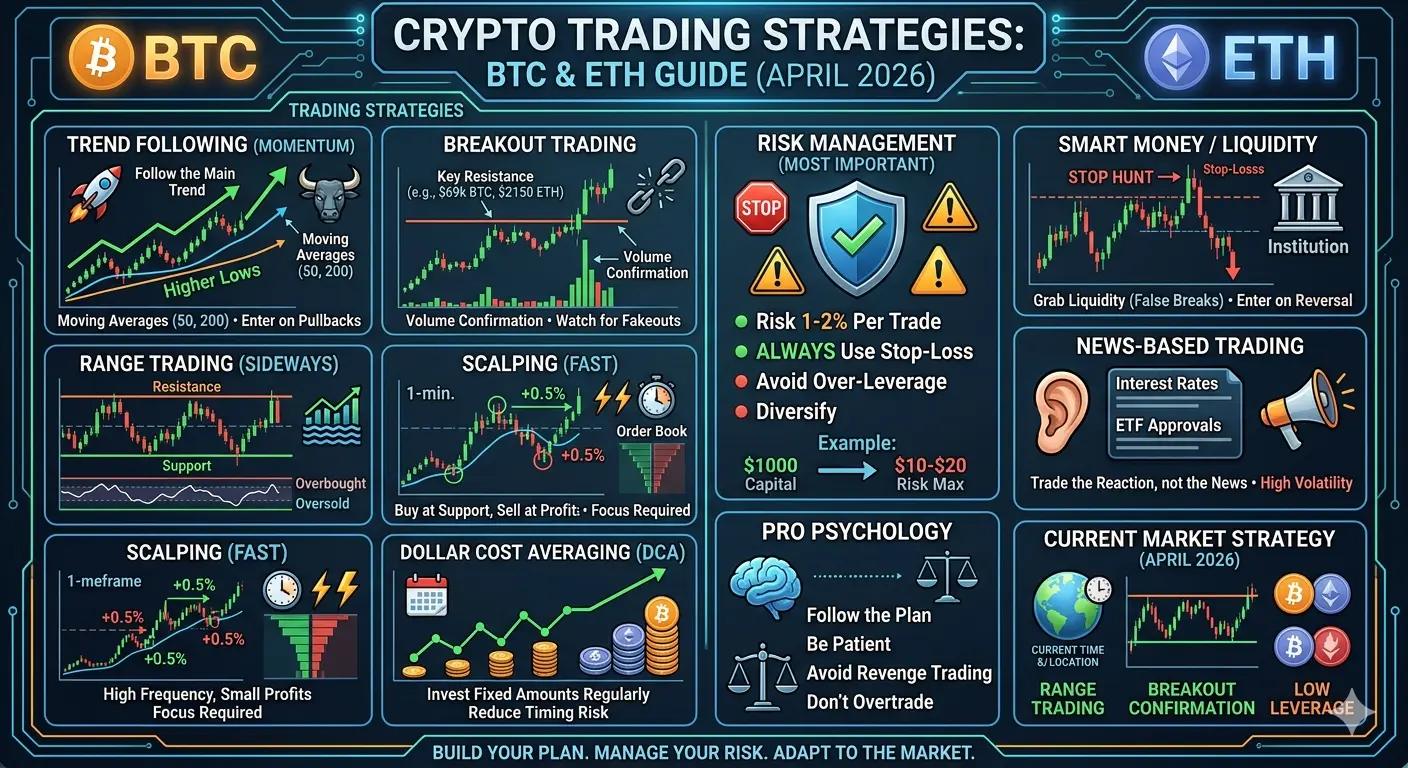
📊 Crypto Trading Strategies (BTC & ETH Focus)
🧠 1. Trend Following Strategy (Momentum Trading)
This is one of the most widely used strategies in crypto.
🔹 Concept:
“The trend is your friend”
Trade in the direction of the main market trend
🔹 How to Use:
Identify trend using:
Higher highs & higher lows → uptrend
Lower highs & lower lows → downtrend
Enter on pullbacks, not at peaks
🔹 Indicators:
Moving averages (50, 100, 200)
Trendlines
MACD
🔹 Example:
If Bitcoin (BTC) is trending upward and pulls back to support → buy the dip
If Ethereum (ETH) breaks resis
BTC-1,62%
ETH-3,71%
Vortex_Kingvip
#GateSquareAprilPostingChallenge
📊 Crypto Trading Strategies (BTC & ETH Focus)
🧠 1. Trend Following Strategy (Momentum Trading)
This is one of the most widely used strategies in crypto.
🔹 Concept:
“The trend is your friend”
Trade in the direction of the main market trend
🔹 How to Use:
Identify trend using:
Higher highs & higher lows → uptrend
Lower highs & lower lows → downtrend
Enter on pullbacks, not at peaks
🔹 Indicators:
Moving averages (50, 100, 200)
Trendlines
MACD
🔹 Example:
If Bitcoin (BTC) is trending upward and pulls back to support → buy the dip
If Ethereum (ETH) breaks resistance → follow breakout
🔹 Best For:
Swing traders
Medium-term traders
Strong trending markets
⚡ 2. Breakout Trading Strategy
🔹 Concept:
Trade when price breaks a key support or resistance level
🔹 How It Works:
Identify strong resistance (e.g., BTC near $69,000)
Wait for a confirmed breakout
Enter after breakout with volume confirmation
🔹 Key Tools:
Volume spikes
Bollinger Bands
Resistance zones
🔹 Example:
BTC breaks above resistance → bullish momentum may accelerate
ETH breaks above $2,150 → potential continuation move
🔹 Risk:
Fake breakouts (fakeouts) are common
Always use stop-loss
🔁 3. Range Trading Strategy (Sideways Markets)
🔹 Concept:
Trade between support and resistance when the market is not trending
🔹 How It Works:
Buy near support
Sell near resistance
🔹 Example:
BTC moving between $64k–$72k
ETH moving between $1,900–$2,200
🔹 Indicators:
RSI (overbought/oversold)
Support/resistance zones
🔹 Best For:
Low volatility markets
Experienced traders
📉 4. Short Selling Strategy (Bear Market)
🔹 Concept:
Profit when price goes down
🔹 How It Works:
Sell high → buy back lower
🔹 Example:
If BTC fails resistance → short the market
If ETH breaks support → bearish continuation
🔹 Indicators:
Bearish divergence
Downtrend confirmation
🔹 Risk:
Unlimited loss if price rises
Use strict stop-loss
💰 5. Scalping Strategy (Fast Trading)
🔹 Concept:
Make small profits from quick trades
🔹 Characteristics:
Very short timeframes (1–5 minutes)
Multiple trades per day
Small profit targets
🔹 Tools:
RSI
Order book
Support/resistance micro-levels
🔹 Example:
Enter trade on small dip
Exit after 0.5%–1% profit
🔹 Best For:
Active traders
High focus required
⏳ 6. Swing Trading Strategy
🔹 Concept:
Hold trades for several days to weeks
🔹 How It Works:
Enter at support
Exit at resistance
🔹 Example:
Buy BTC during dip
Hold until next resistance zone
🔹 Tools:
Daily & 4H charts
Moving averages
Trend structure
🔹 Best For:
Part-time traders
Lower stress strategy
📈 7. Dollar Cost Averaging (DCA)
🔹 Concept:
Invest fixed amounts regularly regardless of price
🔹 How It Works:
Buy BTC or ETH weekly/monthly
Smooth out volatility
🔹 Example:
Invest $100 every week in BTC
🔹 Benefits:
Reduces timing risk
Ideal for long-term holders
🧠 8. Smart Money / Liquidity Strategy
🔹 Concept:
Follow where big players (institutions) move the market
🔹 Key Idea:
Markets move to grab liquidity (stop-loss hunting)
🔹 How to Use:
Identify liquidity zones:
Above resistance
Below support
Wait for fake moves, then enter
🔹 Example:
BTC spikes above resistance → triggers stop-losses → then drops
Smart traders short at liquidity traps
📊 9. News-Based Trading
🔹 Concept:
Trade based on market-moving news
🔹 Examples:
Interest rate decisions
ETF approvals
Geopolitical events
🔹 Strategy:
Trade the reaction, not the news itself
Markets often overreact first
🔹 Risk:
High volatility
Requires experience
🧩 10. Multi-Timeframe Strategy
🔹 Concept:
Analyze multiple timeframes before entering
🔹 How It Works:
Daily chart → trend
4H chart → structure
1H/15M → entry
🔹 Benefit:
Reduces false signals
Improves accuracy
⚖️ Risk Management (MOST IMPORTANT)
No strategy works without risk control.
🔹 Rules:
Never risk more than 1–2% per trade
Always use stop-loss
Avoid over-leveraging
Diversify trades
🔹 Example:
If your capital is $1000:
Risk per trade = $10–$20 max
🧠 Pro Trading Psychology
Avoid revenge trading
Follow your plan strictly
Don’t overtrade
Be patient — good setups come to you
📌 Best Strategy Combination (Recommended)
For BTC & ETH traders:
👉 Trend Following + Breakout + Risk Management
This combination:
Captures big moves
Reduces fake trades
Works in most market conditions
🔮 Current Market Strategy (April 2026 Context)
Based on current conditions:
Market is range-bound with volatility
BTC → neutral bias
ETH → slightly stronger
👉 Best Strategy Right Now:
Range trading
Breakout confirmation
Low leverage
Short-term cautious trading
📊 Final Takeaway
There is no “perfect” strategy
The best traders adapt to market conditions
Risk management is more important than entry strategy
BTC & ETH require different timing but similar discipline
repost-content-media
  • Reward
  • 1
  • Repost
  • Share
ybaservip:
2026 GOGOGO 👊
#GateSquareAprilPostingChallenge
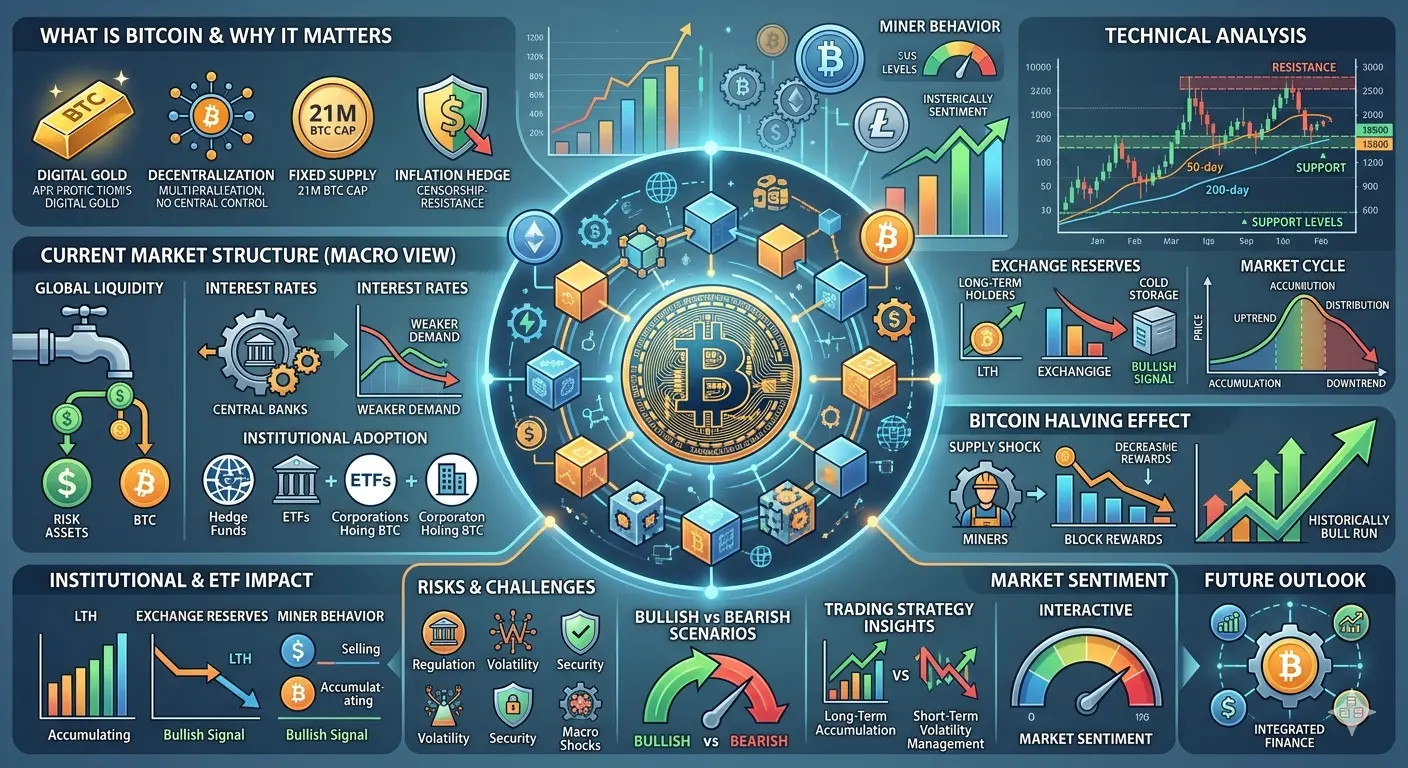
🟠 Bitcoin (BTC) Deep Research & Market Analysis
1. What is Bitcoin and Why It Matters
Bitcoin is the world’s first and largest cryptocurrency by market value. It operates on a decentralized network called blockchain, meaning no central authority controls it.
Bitcoin is often seen as:
A store of value (like digital gold)
A hedge against inflation
A global, censorship-resistant asset
Its importance comes from its scarcity (only 21 million BTC will ever exist) and its role as the benchmark for the entire crypto market.
2. Current Market Structure (Macro View)
Bi
BTC-1,62%
Vortex_Kingvip
#GateSquareAprilPostingChallenge
🟠 Bitcoin (BTC) Deep Research & Market Analysis
1. What is Bitcoin and Why It Matters
Bitcoin is the world’s first and largest cryptocurrency by market value. It operates on a decentralized network called blockchain, meaning no central authority controls it.
Bitcoin is often seen as:
A store of value (like digital gold)
A hedge against inflation
A global, censorship-resistant asset
Its importance comes from its scarcity (only 21 million BTC will ever exist) and its role as the benchmark for the entire crypto market.
2. Current Market Structure (Macro View)
Bitcoin moves strongly based on macroeconomic conditions. Key factors include:
🌍 Global Liquidity
When central banks inject liquidity into markets:
Risk assets (stocks, crypto) tend to rise
Bitcoin usually follows this trend
When liquidity tightens:
Bitcoin often enters correction or consolidation
💵 Interest Rates
High interest rates → weaker BTC demand
Lower rates → more capital flows into crypto
🏦 Institutional Adoption
Big players (hedge funds, ETFs, corporations) now hold BTC, which:
Reduces volatility over time
Increases long-term price stability
Brings new capital into the ecosystem
3. On-Chain Data Insights
On-chain analysis gives us a deeper understanding of investor behavior:
📊 Long-Term Holders (LTH)
Long-term holders are still accumulating BTC
This indicates strong conviction in future price growth
📉 Exchange Reserves
BTC held on exchanges is decreasing
This suggests investors are moving BTC to cold storage
Lower supply = bullish signal
🧠 Miner Behavior
Miners sell BTC to cover costs
When mining profitability drops, selling pressure increases
When miners accumulate, it signals confidence
4. Technical Analysis (Market Behavior)
📈 Key Support Levels
Bitcoin usually reacts strongly at:
Psychological levels (e.g., 20K, 30K, 50K)
Previous accumulation zones
Moving averages (50-day, 200-day)
📉 Resistance Zones
Areas where sellers dominate
Often where profit-taking happens
🔄 Market Cycles
Bitcoin moves in cycles:
Accumulation phase
Uptrend (bull run)
Distribution
Downtrend (bear market)
This cycle is often influenced by the Bitcoin halving event.
5. Bitcoin Halving Effect
The halving reduces BTC supply issued to miners every ~4 years.
Impact:
Supply shock
Increased scarcity
Historically leads to bull runs
After each halving:
Price tends to rise significantly within 12–18 months
6. Institutional & ETF Impact
Recent Bitcoin ETFs have changed the game:
Allow traditional investors to gain exposure
Increase liquidity in BTC markets
Reduce volatility over time
Major institutions now treat Bitcoin as:
A portfolio diversifier
A macro hedge asset
7. Risks & Challenges
Despite strong fundamentals, Bitcoin faces risks:
⚠️ Regulation
Governments may impose strict rules
Can impact adoption and price
⚠️ Market Volatility
BTC can experience sharp price swings
Liquidation cascades in leveraged trading
⚠️ Security & Custody
Exchange hacks
Poor wallet management
⚠️ Macroeconomic Shocks
Financial crises
Geopolitical tensions
8. Bullish vs Bearish Scenarios
🟢 Bullish Case
Continued institutional adoption
Strong ETF inflows
Post-halving supply shock
Increasing global uncertainty (safe-haven demand)
🔴 Bearish Case
Tight monetary policy
Regulatory crackdowns
Major market crashes
Loss of investor confidence
9. Trading Strategy Insights
📊 Long-Term Strategy
Accumulate during dips
Hold through cycles
Focus on fundamentals
⚡ Short-Term Trading
Use support/resistance zones
Trade volatility
Manage risk carefully
🛡️ Risk Management
Never over-leverage
Use stop-losses
Diversify portfolio
10. Market Sentiment
Bitcoin sentiment shifts quickly:
Fear → accumulation opportunity
Greed → distribution phase
Tools like:
Fear & Greed Index
Funding rates
Open interest
help identify sentiment extremes.
11. Future Outlook
Bitcoin’s long-term outlook remains strong due to:
Fixed supply (scarcity)
Increasing adoption
Growing institutional participation
Integration into global finance
However, short-term volatility will always exist.
🧠 Final Thoughts
Bitcoin is not just a cryptocurrency—it is a global financial revolution. Its value is driven by:
Scarcity
Trust
Adoption
Market cycles
Smart investors focus on:
Long-term vision
Risk control
Understanding macro trends
Bitcoin rewards patience, not emotion.
repost-content-media
  • Reward
  • Comment
  • Repost
  • Share
#GateSquareAprilPostingChallenge
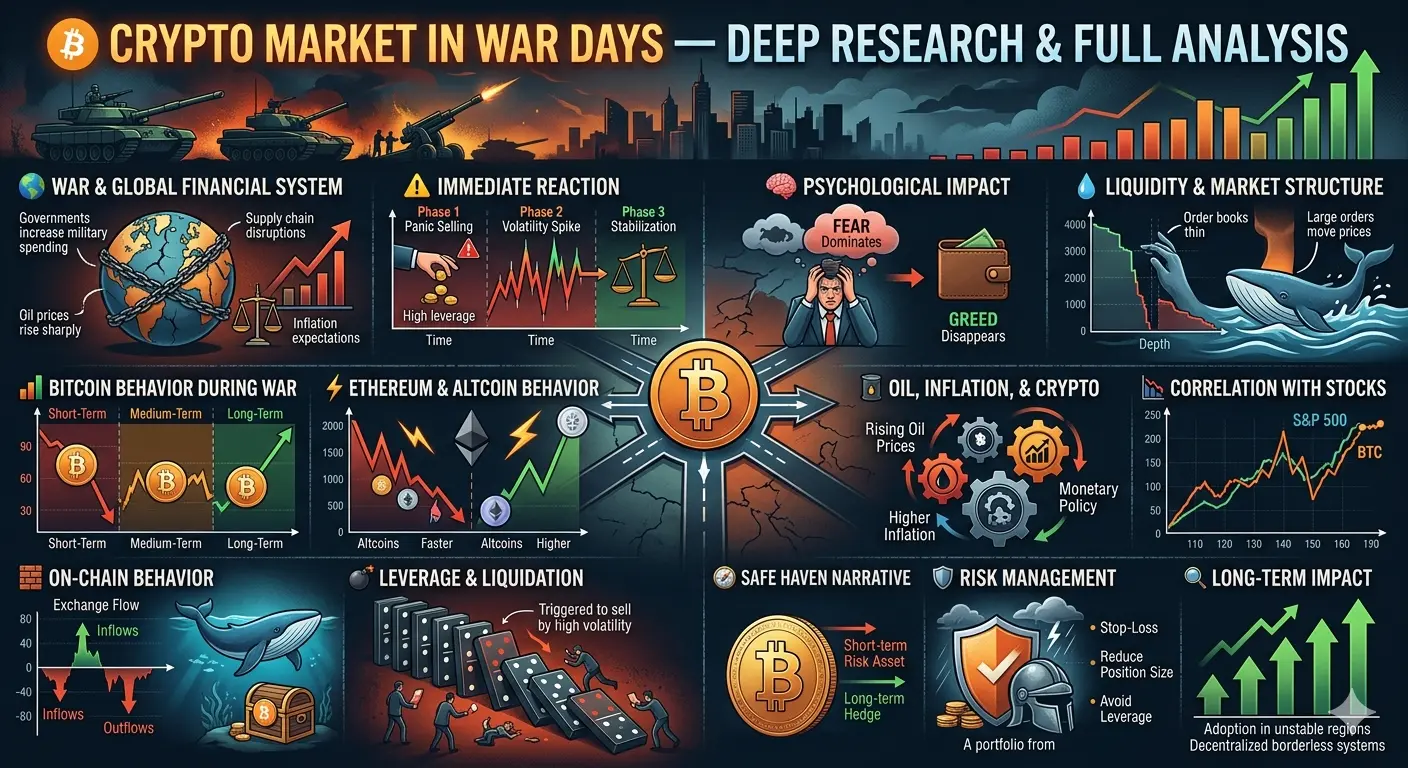
The crypto market behaves very differently during war or geopolitical tension compared to normal market conditions. War creates uncertainty, fear, liquidity stress, and rapid capital movement. These forces directly impact assets like Bitcoin and Ethereum, as well as the entire altcoin ecosystem.
This analysis explains how war shapes the crypto market from multiple angles: macroeconomics, liquidity, investor psychology, technical behavior, and long-term structural effects.
1. 🌍 War and the Global Financial System
War is not just a political event — it is a fin
BTC-1,62%
ETH-3,71%
Vortex_Kingvip
#GateSquareAprilPostingChallenge
The crypto market behaves very differently during war or geopolitical tension compared to normal market conditions. War creates uncertainty, fear, liquidity stress, and rapid capital movement. These forces directly impact assets like Bitcoin and Ethereum, as well as the entire altcoin ecosystem.
This analysis explains how war shapes the crypto market from multiple angles: macroeconomics, liquidity, investor psychology, technical behavior, and long-term structural effects.
1. 🌍 War and the Global Financial System
War is not just a political event — it is a financial shock.
When conflict starts or escalates:
Governments increase military spending
Supply chains get disrupted
Oil prices rise sharply
Inflation expectations increase
Global risk perception changes
All of this creates uncertainty in financial markets.
Crypto, being a global and highly speculative asset class, reacts quickly to these changes.
2. ⚠️ Immediate Reaction of Crypto Markets
When war news breaks, crypto markets usually react in the following sequence:
Phase 1: Panic Selling
Traders react emotionally
High leverage positions get liquidated
Rapid price drops occur
Liquidity disappears temporarily
Phase 2: Volatility Spike
Price swings become extreme
Both upward and downward wicks appear
Stop-losses are triggered frequently
Phase 3: Stabilization or Continuation
Market decides direction based on:
War escalation or de-escalation
Central bank reactions
Market liquidity conditions
3. 🧠 Psychological Impact on Traders
War creates one of the strongest emotional reactions in markets.
Fear Dominates:
Panic selling increases
Retail investors exit early
Social media sentiment turns negative
Greed Disappears Temporarily:
Risk appetite drops
Investors prefer stable assets
Capital shifts to safer instruments
Uncertainty:
Traders are unsure about future outcomes
This leads to indecision and sideways trading
Psychology plays a major role in short-term crypto movements during conflict.
4. 💧 Liquidity and Market Structure
Liquidity is one of the most important factors during war.
What Happens to Liquidity:
Market depth decreases
Order books become thin
Large orders move prices significantly
Why This Matters:
Small trades can create large price movements
Whales can manipulate markets more easily
Volatility increases sharply
Crypto markets are already less liquid than traditional markets, and war makes this even more extreme.
5. 📊 Bitcoin Behavior During War
Bitcoin is the most important asset to analyze during war.
Short-Term Behavior:
Initial drop after war headlines
Strong intraday volatility
Liquidations of leveraged traders
Medium-Term Behavior:
Range-bound movement
Market tries to find equilibrium
Accumulation by smart money
Long-Term Behavior:
Depends on macro liquidity, not war alone
Historically recovers after panic phases
Bitcoin often behaves like a risk asset in the short term but can act as a macro hedge in the long term.
6. ⚡ Ethereum and Altcoin Behavior
Ethereum and altcoins behave differently from Bitcoin during war.
Key Observations:
More volatile than Bitcoin
Higher downside during panic
Stronger upside during recoveries
Why Altcoins React More:
Lower liquidity
Higher speculation
Retail-driven trading
Less institutional support
During war, investors usually:
Sell altcoins first
Then rebalance into Bitcoin
Or exit to stable assets
7. 🛢️ Oil Prices, Inflation, and Crypto
War often leads to rising oil prices.
Effects:
Increased transportation and production costs
Inflation expectations rise
Central banks may tighten monetary policy
Impact on Crypto:
Higher inflation can increase interest in Bitcoin as a hedge
But tighter monetary policy reduces liquidity, which is bearish
This creates a conflict between bullish and bearish forces in the market.
8. 🏦 Central Banks and Monetary Policy
Central banks play a huge role during war.
Possible Responses:
Increasing liquidity (printing money)
Lowering interest rates
Providing economic support
OR
Tightening policy to control inflation
Impact on Crypto:
More liquidity → bullish for crypto
Less liquidity → bearish for crypto
War often forces central banks into difficult decisions.
9. 📉 Correlation With Stock Markets
Crypto is increasingly correlated with traditional markets.
During War:
Stock markets usually fall
Risk assets decline together
Crypto follows similar patterns
However:
Crypto reacts faster
Crypto recovers faster
Crypto has 24/7 trading advantage
This makes crypto more volatile but also more dynamic.
10. 🧱 On-Chain Behavior During War
On-chain data gives powerful insights into market behavior.
Exchange Flows:
Outflows increase during accumulation
Inflows increase during panic selling
Long-Term Holders:
Continue holding or accumulate
Rarely sell during short-term fear
Whale Activity:
Large players often buy during fear
They accumulate during dips
War often creates opportunities for smart money accumulation.
11. 💣 Leverage and Liquidation Cascades
Crypto markets are highly leveraged.
During war:
Volatility triggers liquidations
Forced selling amplifies price drops
Liquidation cascades can crash prices rapidly
This is one of the biggest risks in crypto trading during conflict.
12. 🧭 Safe Haven Narrative vs Reality
There is a debate: Is crypto a safe haven during war?
Reality:
Short term: Not a safe haven
Medium term: Mixed behavior
Long term: Potential store of value
Why Not Immediate Safe Haven:
High volatility
Strong correlation with risk assets
Speculative trading dominance
Why It Still Has Potential:
Decentralized
Borderless
Independent of governments
The narrative is evolving but not fully realized yet.
13. 🔄 Market Cycles During War
Crypto markets still follow cycles even during war.
Cycle Stages:
Accumulation (quiet period)
Expansion (bullish move)
Distribution (profit-taking)
Decline (bear phase)
War can:
Accelerate the decline phase
Delay the expansion phase
Create fake breakouts
Understanding cycles is critical during uncertain times.
14. 🛡️ Risk Management in War Markets
Trading during war requires strict discipline.
Key Rules:
Avoid over-leverage
Use stop-loss orders
Reduce position size
Stay cash-heavy when uncertain
Strategy Focus:
Preserve capital first
Trade only high-probability setups
Avoid emotional decisions
War markets punish overconfidence.
15. 📈 Institutional Behavior During War
Institutions behave differently from retail traders.
Actions:
Accumulate during fear
Reduce exposure before extreme risk
Use hedging strategies
Institutions often:
Provide liquidity
Stabilize markets over time
Influence long-term direction
Their involvement has made crypto more resilient than in earlier years.
16. 🔍 Long-Term Impact of War on Crypto
War does not permanently damage crypto markets.
Long-Term Effects:
Increases global awareness of decentralized assets
Highlights need for borderless financial systems
Encourages adoption in unstable regions
Structural Growth:
More institutional participation
Better infrastructure
Improved market maturity
Crypto continues to evolve regardless of geopolitical events.
17. 📊 Bullish and Bearish Scenarios
🟢 Bullish Scenario:
Liquidity injection by governments
End or de-escalation of war
Increased adoption
Strong institutional inflows
🔴 Bearish Scenario:
Prolonged war escalation
Global economic slowdown
Tight monetary policy
Mass liquidation events
Markets will follow the dominant macro trend.
18. 🧠 Final Thoughts
Crypto markets during war are driven by:
Fear and uncertainty
Liquidity changes
Investor psychology
Macroeconomic forces
In the short term, war creates volatility and fear.
In the long term, it often creates opportunities.
Bitcoin and Ethereum may drop, range, or spike unpredictably during conflict. However, the underlying trend of adoption, institutional participation, and technological growth continues.
The key principle is simple:
War creates chaos, but markets reward discipline, patience, and strategy.
repost-content-media
  • Reward
  • Comment
  • Repost
  • Share
#BTC Market Trend Analysis
🚀 READY (READY) Trading Competition Your Chance to Win! 💥
Get in on the action and compete for a share of $8,000 in rewards! 🎮💰
⏳ Ends: February 17, 04:00 AM (UTC)
💸 Total Prize Pool: $8,000
🔥 How to Participate?
✅ Trade #READY and split $5,000 in rewards!
✅ New Users Bonus: $2,000 prize pool for first time traders!
✅ Refer & Earn: Invite friends and grab a share of $1,000!
📌 Sign up & start trading now: Join Here!
🔗 Full details: Read More
Don’t miss out on this exciting opportunit Trade, Win & Level Up! 🚀💎
#Web3 Luxury Music Gala—Token of Love #Which A
BTC-1,62%
READY-1,58%
  • Reward
  • 1
  • Repost
  • Share
I won!
Join Gate.io Answer & Earn
Take the Quiz to Win Fancy Prizes https://www.gate.io/activities/answer-earn/?refUid=20946553&ch=307
  • Reward
  • Comment
  • Repost
  • Share
  • Pin